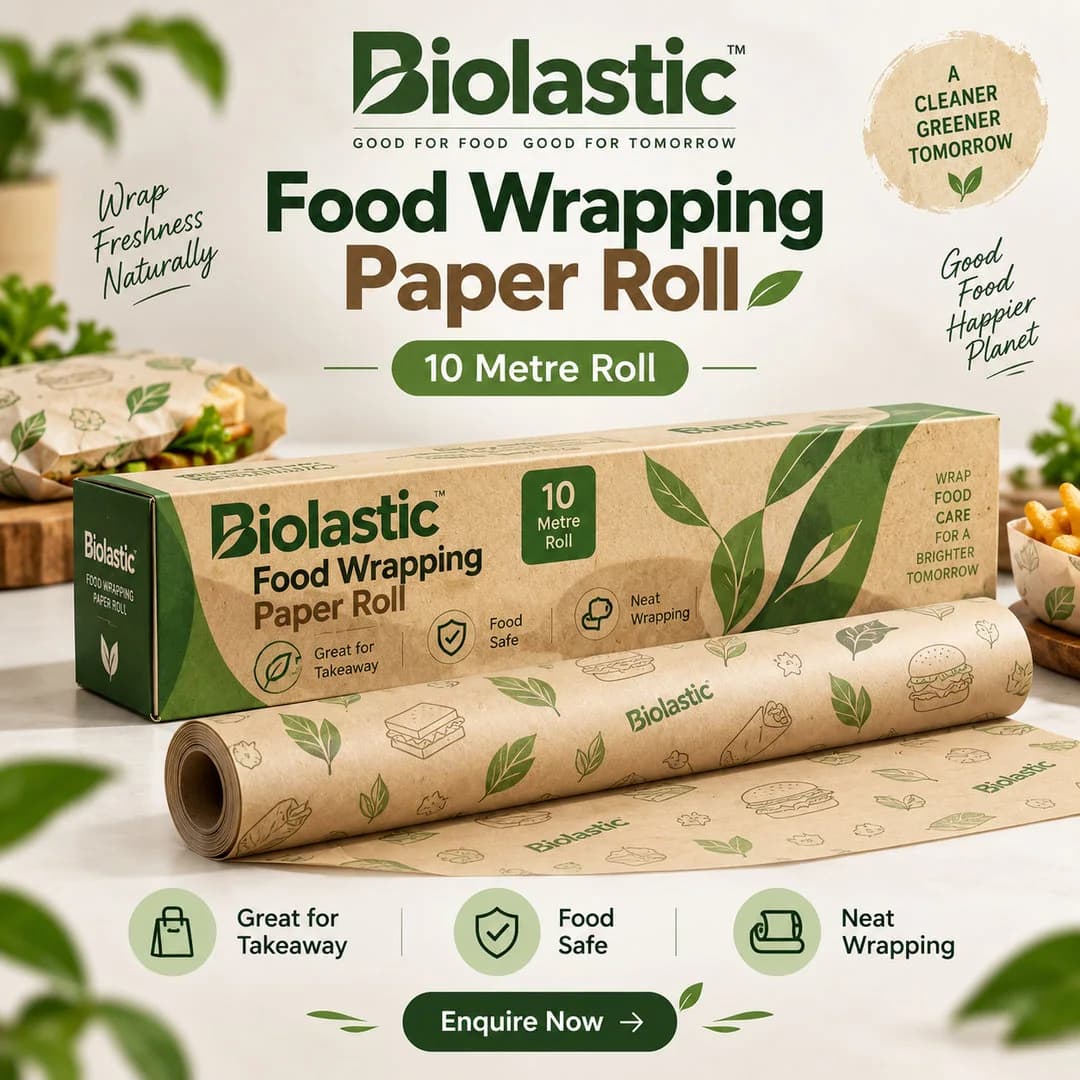
10 Metre Food Wrapping Paper Rolls: Grease Resistance, Yield & Wholesale Cost
A café orders a “10 metre food wrapping paper roll” because the length looks familiar. On delivery, the staff discover the roll is narrower than their burger wrap requires. They need two sheets per order, and the supposed saving disappears. Another takeaway counter buys a thicker-looking paper for oily snacks, only to find that grease marks appear on the outside of the pack.
The practical answer: choose food wrapping paper by food type, verified food-contact suitability, usable roll width, cut length, grease performance and cost per accepted wrap. The label “10 metres” establishes nominal length—not GSM, coating, food-contact compliance, grease resistance or heating suitability.
This guide is for restaurant purchasing teams, cafés, bakeries, sandwich shops, catering operators, packaging wholesalers and international B2B buyers. It also helps businesses sourcing food-service packaging in Siliguri, Jalpaiguri, Darjeeling, Bagdogra, the Dooars, Sikkim, Assam and North Bengal. All numerical examples below are illustrative calculations, not specifications or prices for a particular Biolastic production batch.
1. What a 10 metre roll tells you—and what it doesn't
The live Biolastic catalogue includes a 10 Metre Food Wrapping Paper Roll for Takeaway. Its nominal length is 10 metres and the listing accepts specification-based enquiries. The listing does not verify the supplied width, paper GSM, coating or lamination, grease resistance, food-contact approval, PFAS status, heating tolerance, current price, carton quantity, MOQ or stock. Request these details for the exact quoted grade.
A roll has at least six buying dimensions:
| Specification | Why a buyer needs it | What to request |
|---|---|---|
| Nominal and usable length | Determines how many complete cuts are possible | Metres per roll and permitted length tolerance |
| Web width | Determines coverage, folds and whether one sheet is enough | Millimetres of usable width, with tolerance |
| Paper grammage (GSM) | Influences sheet mass and handling | Actual measured grade and tolerance |
| Coating / treatment | Can change oil, moisture and heat behaviour | Material construction and intended-use evidence |
| Food-contact conditions | Controls whether the wrap suits the specific food | Supported food types, contact times and temperatures |
| Roll and carton packing | Determines handling, storage and landed cost | Core, rolls per carton, net weight, MOQ and dispatch terms |
A nominal 10 m roll at 300 mm wide has 3.0 m² of paper area. A 10 m roll at 450 mm wide has 4.5 m². Both have the same length, but the second provides 50% more area. That does not automatically make it the better purchase: a wider roll can create excess material for small portions.
2. Match the paper to the food, not just the menu category
The key question is not “Is this food wrapping paper?” but “Will this exact paper perform safely and neatly against our actual food for the time and temperature we use?”
| Food-service scenario | Primary concern | Sensible qualification trial |
|---|---|---|
| Dry bakery item or relatively dry bread | Clean handling, folding, lint and transfer | Wrap a real portion and inspect after normal holding time |
| Sandwich with moist filling | Moisture migration and fold integrity | Pack at serving temperature; check for softening and wet spots |
| Burger with oil or sauce | Grease staining, leakage at folds | Use actual recipe and hold period; inspect outside and hand contact |
| Chapati or hot takeaway roll | Temperature, condensation and contact safety | Verify supported use temperature; observe steam and sogginess |
| Fried snack or oily pastry | Oil penetration, strength while warm | Test grease transfer, folding and handling |
| Branded printed wrap | Ink migration or set-off, artwork quality | Verify food-contact side and printing controls |
These are test-planning examples, not a declaration that Biolastic's current 10 m roll is approved for every application above. A dry-food-approved paper may not suit a fatty or hot food. Likewise, a wrapper intended for short-term service may not be a validated long-term storage barrier.
A useful three-sample trial
Request three candidate constructions only if each has appropriate food-contact documentation for the proposed use. Label them A, B and C. Cut the same sheet dimensions, wrap the same food weight, and use the same temperature and holding period. Check visible grease marks, moisture penetration, paper tearing, fold retention, odour transfer and how the customer opens the package.
Photograph the results and record the time. A wrapper that looks good immediately may fail after a realistic delivery interval. A wrapper that passes a practical trial still needs the relevant food-contact compliance evidence: performance and legal suitability are different questions.
3. Greaseproof, grease-resistant and ordinary paper are not interchangeable
Paper can be engineered to slow oil penetration through fibre structure, refining, coating or surface treatment. GSM alone cannot establish grease resistance. Two sheets of similar weight may perform very differently.
The industry uses test methods to evaluate aspects of grease resistance. For example, TAPPI T 559 cm-22 is a grease-resistance “kit test” developed around the behaviour of fluorochemical-treated papers. TAPPI explicitly notes that suitability for papers with film-like barriers or non-fluorochemical treatments needs evaluation. Do not use a kit rating as a universal proof of barrier performance or as proof that a material is free from any particular chemistry.
A buyer can ask the supplier for:
- A description of the actual food-contact surface, including coating or lamination if present.
- The test method and conditions used for any claimed grease resistance.
- A declaration or report relevant to the target market and intended food.
- Evidence supporting any PFAS-free, recyclable, compostable or plastic-free claim if that claim is offered. None should be inferred from the appearance of brown or white paper.
- A production sample from the quoted grade, not a visually similar reference roll.
Why a home oil-drop demonstration is not certification
Putting a drop of cooking oil on paper is a quick screening exercise. It can help compare samples under identical conditions, but it is not a validated substitute for standard testing, chemical-composition evidence or food-contact compliance. Oil type, temperature, paper orientation and contact time can change the result. Use the same recipe and documented test conditions if you repeat the trial.
4. GSM: useful for yield and handling, insufficient for safety
GSM means grams per square metre. ISO 536:2019 specifies a method for determining the grammage of paper and board. ISO confirmed the 2019 edition in 2025. Grammage can help estimate theoretical sheet weight; it does not reveal all coating components, suitability for food, oil barrier, tear behaviour or permitted heating temperature.
Theoretical paper mass (g) = width (m) × length (m) × GSM (g/m²)
Consider a hypothetical uncoated paper with a measured grammage of 60 GSM:
- At 300 mm × 10 m, area is 3.0 m²; theoretical paper mass is 180 g.
- At 450 mm × 10 m, area is 4.5 m²; theoretical paper mass is 270 g.
This calculation excludes any coating, adhesive, ink, moisture variation, core and external packaging. It is not the weight of Biolastic's listed roll; its GSM and width have not been established.
A heavier sheet may be easier to handle in one application and unnecessarily bulky in another. Evaluate the full construction and accepted-wrap yield rather than purchasing solely on a higher GSM.
5. The 10 metre wrap-yield calculator
The simplest useful purchasing formula is:
Maximum complete pieces per roll = floor(usable roll length ÷ cut length)
Keep both lengths in the same units. This is a theoretical count of full cuts and excludes defects, torn starts, blade kerf and other losses.
For a 10,000 mm usable roll length:
| Cut length per sheet | Theoretical complete sheets | Remaining length |
|---|---:|---:|
| 250 mm | 40 | 0 mm |
| 350 mm | 28 | 200 mm |
| 400 mm | 25 | 0 mm |
| 500 mm | 20 | 0 mm |
| 600 mm | 16 | 400 mm |
Example: a café cutting 350 mm sheets gets 28 complete sheets from a nominal 10 m length, assuming the entire length is usable. The final 200 mm cannot make another 350 mm sheet. A different food size or folding method will change the cut length.
Width changes the result even when cut count stays the same
Suppose a 350 mm cut length is enough, but the package needs a 400 mm wide sheet to fold securely. A 300 mm wide roll may require a second overlapping sheet or an entirely different wrapping pattern. It would be misleading to quote “28 wraps per roll” before confirming that one cut sheet actually completes one accepted pack.
Measure the food's largest cross-section, the fold path and the closure method. Use the real item rather than estimating from the menu description. Do not assume that an unwrapped food's flat footprint equals the required sheet dimensions.
6. Cost per accepted wrap beats cost per roll
A lower roll price is not automatically a lower packaging cost. The relevant unit is an accepted, customer-ready wrap.
Paper cost per accepted wrap = delivered roll cost ÷ accepted wraps per roll
Worked cost example — hypothetical, not a Biolastic quotation
Assume a 10 m roll costs ₹40 delivered, and each portion needs a 350 mm cut. The ideal full-cut yield is 28. If a controlled trial produces 26 accepted wraps, the cost is:
₹40 ÷ 26 = about ₹1.54 per accepted wrap.
If another paper costs ₹36 per roll but only produces 20 accepted wraps because of width, tearing or double-wrapping, its paper cost becomes ₹1.80 per accepted wrap. This is an illustration of the comparison method, not a statement about any supplier's real performance.
For a complete comparison, include paper, labels or tape, packing labour, wasted portions, handling time and delivery-related complaints. If a wrap must be supplemented with a second barrier or outer bag, include those items too.
A simple buying scorecard
Score each qualified sample against your actual process:
| Measure | Sample A | Sample B | Sample C |
|---|---|---|---|
| Food-contact evidence fits intended use | Pass / Fail | Pass / Fail | Pass / Fail |
| One-sheet coverage of the food | Yes / No | Yes / No | Yes / No |
| Grease or moisture trial result | Record | Record | Record |
| Accepted wraps from measured roll | Count | Count | Count |
| Time to wrap a portion | Seconds | Seconds | Seconds |
| Delivered cost per accepted wrap | Currency | Currency | Currency |
| Current availability and reorder terms | Confirm | Confirm | Confirm |
Treat food-contact evidence as a pass/fail gate, not as a score to be traded against a lower price.
7. Monthly purchasing: calculate demand before requesting a wholesale rate
A business that wraps 200 portions per day over 26 working days needs 5,200 accepted wraps in that month. If a validated trial shows 26 accepted wraps per roll, the mathematical requirement is:
5,200 ÷ 26 = 200 rolls, before any buffer.
If the team issues whole rolls separately to each counter every day and cannot share the remaining sheets, the practical issue quantity could be higher. For example, ceil(200 ÷ 26) = 8 rolls per day, or 208 rolls over 26 days. That is an operational planning assumption, not material wastage automatically caused by the paper.
If you choose a 10% planning buffer on the 208-roll operational requirement, the result is 229 rolls after rounding up. The buffer is a buyer-selected contingency, not a recommended universal standard.
Track real usage for at least several shifts. Busy weekend demand, menu changes, promotional combos and waste during staff training can change the actual reorder point.
8. Food-contact requirements: India, EU and United States
Food wrapping is a food-contact application when the paper touches food. Compliance depends on the actual materials, additives, inks, food type, contact duration, temperature and destination jurisdiction. A roll's name or appearance is not proof of approval.
India: FSSAI packaging requirements
India's Food Safety and Standards (Packaging) Regulations, 2018 establish requirements for packaging materials, including paper and board used with food. The FSSAI amendments catalogue lists subsequent changes, including an amendment dated 7 August 2026; purchasers should check the currently applicable consolidated requirements rather than treating a 2025 compendium as the final word.
For a supplier quotation, request documentation for the exact paper construction and intended use. Where a printed wrapper is involved, verify the ink system and that the food-contact face is appropriately controlled. Do not substitute ordinary printed paper or newspaper for approved food packaging.
European Union: framework and manufacturing controls
The EU's Regulation (EC) No 1935/2004 sets general safety principles for materials intended to contact food. Regulation (EC) No 2023/2006 covers good manufacturing practice, including controls for printing inks and transfer from printed surfaces. Depending on the paper construction and market, additional applicable rules or national measures may need checking.
Do not interpret these general frameworks as a blanket EU approval for any particular paper roll. Obtain the supplier's product-specific compliance basis and confirm requirements in the destination market.
United States: intended food type matters
For the US, 21 CFR §176.170 concerns components of paper and paperboard intended to contact aqueous and fatty foods, subject to specified conditions. Dry-food applications can involve 21 CFR §176.180. These provisions are not an automatic product approval. Ask for the exact construction, permitted substances and conditions of use, and any other applicable compliance evidence.
What about “PFAS-free”, “compostable” and “recyclable”?
These are separate claims that require separate support. Grease resistance does not prove a PFAS-free composition. Paper fibre content does not by itself establish compostability or acceptance in a particular recycling stream. Coatings, inks, adhesives and food contamination can affect end-of-life routes. Unless the supplier provides specific evidence, do not print those claims on a customer-facing label.
9. Food wrapping paper is not automatically baking parchment
In the market, terms such as butter paper, greaseproof paper, sandwich wrap and baking paper are sometimes used loosely. They can refer to different constructions with different approved conditions.
A paper that works for cold sandwich service should not be assumed suitable for a hot oven, air fryer or microwave. A paper that resists oil at room temperature may behave differently against hot oil or steam. Ask the manufacturer for the permitted contact temperature, time and food categories for the actual supplied material.
If the business needs cooking or baking rather than takeaway wrapping, source a product expressly specified and documented for that use.
10. Printing and branding: a good logo should not create a food-contact problem
Custom graphics can help a café look consistent, but print is not simply a decorative afterthought. Inks, curing, the direction in which the paper is wound, and contact between layers of a printed reel all matter.
A professional specification should record:
1. Which face is printed and which face contacts food.
2. Ink system and applicable food-packaging compliance evidence.
3. Whether ink can transfer through the substrate or by set-off from a wound roll.
4. Artwork repeat, colour tolerances, registration and winding direction.
5. Any additional coating needed for the food application.
6. Minimum order quantity and sample-approval procedure.
EU GMP rules explicitly address set-off and transfer risks for inks on the non-food-contact side. For India, verify the relevant FSSAI and referenced Indian standards for the intended packaging. Do not assume a printed wrapper is safe merely because the design is on the outside.
11. Storage and handling: prevent avoidable losses after delivery
Even an appropriate paper grade can be spoiled by poor storage. Keep rolls protected from water, dust, insects, odours and contact with cleaning chemicals. Use clean dispensers and cutters. Record the incoming batch and keep the original specification with the stock.
Avoid putting an open roll next to a steam outlet or sink. If the wrapping station is humid, check whether the paper becomes difficult to tear or fold after exposure. Train staff to cut a repeatable length rather than guessing each time; inconsistent cut lengths make both cost control and product presentation harder.
For wholesalers, agree carton integrity, roll identification, storage recommendations and handling expectations with the supplier. An attractive unit price is not enough if rolls arrive damaged or cannot be traced to a supplied grade.
12. A seven-step first-order qualification plan
Step 1 — Describe the food. Include whether it is dry, oily, sauced, hot or moist, plus the expected contact time and serving temperature.
Step 2 — Set the geometry. Measure the portion and decide the cut length, usable width and number of sheets per accepted pack.
Step 3 — Request documentation. Ask for paper construction, GSM, food-contact basis, coating and ink details where relevant, and any claimed grease-resistance evidence.
Step 4 — Compare equal-size samples. Test the same food under the same conditions. Record grease staining, wetting, tearing and customer handling.
Step 5 — Measure yield. Count accepted wraps from a measured length rather than relying only on theoretical cuts.
Step 6 — Calculate delivered cost. Include freight, taxes as applicable, carton packing and any additional packaging consumed.
Step 7 — Approve a written reorder specification. Keep a reference sample and document width, length, grade, coating, permitted use, tolerances, carton count and lead-time confirmation.
Copy-and-send wholesale enquiry template
We need food wrapping paper rolls for [food item], packed at [temperature] for approximately [contact time]. Expected demand: [wraps per day or rolls per month]. Please quote 10 m nominal rolls with usable width [mm], preferred cut length [mm], and the appropriate GSM/coating for this use. Please provide food-contact evidence for the intended market, grease-resistance information if applicable, sample availability, carton quantity, MOQ, delivered price and lead time to [city / pincode / country].
For buyers in Siliguri and North Bengal, include your shop or factory delivery location so the team can discuss the current supply arrangement. For international enquiries, state the destination country and compliance requirements; international availability and export terms must be confirmed, not assumed.
13. Which Biolastic product should you enquire about?
For cut-to-length food-service wrapping, review the 10 Metre Food Wrapping Paper Roll for Takeaway. The live listing establishes the nominal 10 m format but leaves width, GSM, coating, food-contact status and commercial terms for quotation and verification.
If your purchasing decision is instead paper versus aluminium foil, see our separate Aluminium Foil vs Food Wrapping Paper restaurant guide. That article addresses material selection; this guide focuses on paper-roll qualification, wrap yield and procurement economics.
You can also explore Biolastic's food wrapping roll category and send a specification-led enquiry. Do not infer that a specific product is in stock or approved for a particular food until confirmed.
Frequently asked questions
Is a 10 metre food wrapping paper roll automatically greaseproof?
No. Length does not determine oil resistance. Request the construction and relevant test evidence, and test the real food.
How many 35 cm wraps come from a 10 metre roll?
The ideal count is 28 complete pieces, leaving 20 cm. The actual accepted-wrap count depends on usable length, cutting loss and whether one sheet covers the product.
Is food wrapping paper the same as baking parchment?
No. Market names overlap, but the constructions and permitted temperatures may differ. Do not bake on generic wrapping paper without explicit product-specific approval.
What is the GSM of Biolastic's 10 metre roll?
The live listing does not confirm it. Request the supplied grade's measured grammage and tolerance.
Does higher GSM guarantee grease resistance?
No. Oil barrier depends on construction, fibre structure and any treatment or coating; GSM is only mass per unit area.
Can the paper directly touch hot burgers or chapatis?
Only if the exact material is supported for the food type, contact duration and temperature. Confirm food-contact compliance before bulk purchase.
How do I compare wholesale quotations fairly?
Use the same width and application, verify compliance, count accepted wraps, and compare delivered cost per accepted wrap, not only the roll price.
Can I enquire from Siliguri or North Bengal?
Yes. Biolastic lists the product for enquiries. Share your food application, quantity, width and delivery location; price, MOQ and availability are confirmed individually.
Request a specification-led quotation
Tell Biolastic what food you wrap, how wide the sheet must be, how many wraps you use each day and where you need the order delivered. Ask for the correct grade, relevant food-contact evidence and a sample trial before committing to volume.
Request Food Wrapping Paper Samples & Wholesale Quote →
---
Technical and regulatory references
Reference dates and requirements were reviewed for this guide in November 2026. Product-specific claims and destination-market obligations must always be checked against current documentation for the actual supplied grade.