3×6 Inch Compostable Pouches: Piece Count, Heat Sealing & Wholesale Buying Guide
A tiny pouch can create an expensive packing problem. The material may look fine on a sample table, yet a few millimetres of missing headspace can make a 100 g fill impossible to seal. A batch that looks inexpensive by the kilogram can also produce fewer usable packs than expected if its film gauge, dimensions or rejection rate differ from the quotation.
This guide is for small-pack manufacturers, dry-goods businesses, packaging distributors, purchasing managers and contract packers assessing 3×6 inch compostable pouches. It is relevant to global B2B purchasing as well as the everyday realities of businesses in Siliguri, the Dooars, North Bengal and India. The objective is simple: compare usable, accepted pouches, not just advertised dimensions or a low price per kilogram.
Start with the live Biolastic listing
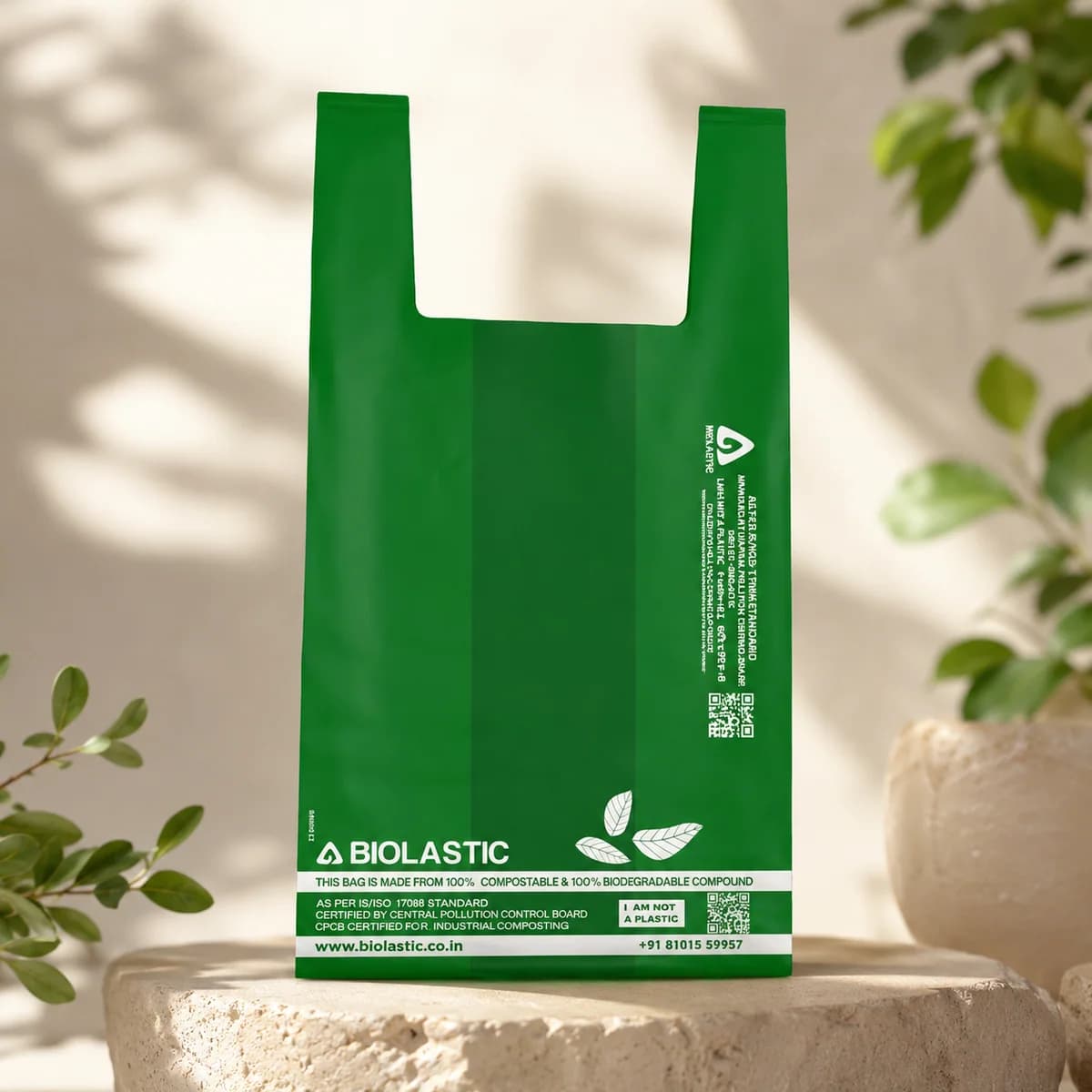
The Biolastic 3×6 inch compostable packaging pouch lists a nominal 3×6 inch format, approximately 330–350 pouches per kilogram and an indicative capacity of up to 100 g. Its description identifies a starch-derived bio-based compostable resin blend and discusses compatible heat sealing and potential custom colour, micron, dimensions and printing, all subject to technical feasibility.
These are catalogue statements, not a guarantee that every filling application will work. In particular, the listed 100 g capacity cannot be applied to every powder, spice, seed or granule. The catalogue has a quote-only sales setting, and the product's MOQ and variant packing fields should be reconciled in a written offer before anyone commits to a quantity. Although the catalogue includes a certification label, buyers should obtain and check current product-specific CPCB approvals and test documents rather than treating a database field as independent proof.
Why a 3×6 inch pouch is not a 3×6 inch usable cavity
The nominal dimensions do not tell you how much of the bag can actually be filled. Side seals, bottom construction, top closure, trimming and manufacturing tolerance all affect internal volume. Ask whether the quoted dimensions are external finished size, usable inside width or flat-film dimensions.
For an initial layout, draw the pouch at full scale and mark the bottom seam, fill zone, intended top seal and any tear notch or print-safe area. A top seal needs clean material on both faces. If a powder reaches that zone, even a bag with ample theoretical volume may fail in production.
Buyer checklist for geometry:
| Parameter | What to specify | What can go wrong |
|---|---|---|
| Nominal size | 3×6 inches and dimensional tolerance | Different vendors measure differently |
| Internal fill area | Clear width and usable length | Product occupies the seal zone |
| Film gauge | Microns and tolerance, per wall | Mass and sealing response change |
| Seam construction | Side and bottom seam details | Weak or uneven joints |
| Closure | Heat seal width and location | Leaks or insufficient headspace |
| Pack form | Loose pouches, bundles or cartons | Miscount and handling damage |
| Artwork | Print orientation, registration, unprinted seal zone | Cropped text or contaminated seal |
A sample pouch filled with the real product is far more informative than a drawing alone.
Is the “up to 100 g” claim suitable for your product?
Mass and volume are different. A dense granular product can occupy much less space than a fluffy herb or a light powder of the same weight. The first approximation is:
Product volume (mL) = fill mass (g) ÷ measured bulk density (g/mL).
For example, at an assumed bulk density of 0.50 g/mL, a 100 g fill occupies 200 mL. At an assumed density of 0.80 g/mL, it occupies 125 mL. These numbers are mathematical examples, not measured properties of any Biolastic pouch or food ingredient.
Bulk density can change with vibration, settling and moisture. Measure a representative production lot, then perform actual fill trials with the intended machine or scoop. Check headspace after settling and confirm that the pouch closes without excessive tension or product trapped in the seal.
A pack that is physically full is not necessarily an acceptable retail pack. Label space, tamper evidence, product protection and handling all matter.
Piece count per kilogram: turn a headline into a purchasing calculation
The live listing indicates approximately 330–350 pieces per kilogram. This is a useful planning range, but it is not a certified tolerance for every future order.
At that indicative range, a hypothetical 10 kg lot would contain about 3,300–3,500 pieces before any rejection or count variance. A hypothetical 25 kg lot would contain about 8,250–8,750 pieces. Neither is a stock offer or a confirmed pack size.
To compare suppliers, ask for a weighed sample of at least several bundles and record the average pouch mass, count variance and number of damaged pieces. Count accepted pouches after a real filling and sealing run.
Effective pouch cost = total delivered material cost ÷ accepted usable pouches.
For illustration only, if 3,400 pouches are supplied and 68 fail an agreed trial inspection, 3,332 remain accepted. A fictional delivered lot cost of ₹1,700 gives ₹1,700 ÷ 3,332 = ₹0.51 per accepted pouch, rounded. This is not a Biolastic selling price or observed rejection rate.
A procurement comparison should also include labour, line stoppages, spoilage, printing setup, freight, taxes and any minimum-order constraint.
Heat sealing: qualify a process window, not a magic temperature
Compostable films are not all the same formulation. Seal response depends on the finished film construction, gauge, surface condition, sealer type and how the material has been stored. It would be misleading to publish a universal jaw temperature or dwell time for the catalogue pouch.
Start with a small test matrix using the actual sealer. Vary one parameter at a time: temperature, dwell time, pressure and seal width. Fill with the real product, not only air, because fine powder and oily residues can contaminate the seal zone. Inspect immediately and after the expected handling and storage interval.
Common failures and what to investigate:
- Peeling or opening seams: insufficient fusion, uneven jaw contact, contamination or unsuitable material/equipment combination.
- Burn-through, shrinkage or distortion: excessive heat input, pressure or dwell time.
- Channel leaks: trapped particles, folds or irregular jaws.
- Inconsistent results between shifts: changed machine settings, operator technique, ambient conditions or film lot.
- Weak corners: poor alignment or a geometry mismatch between pouch and sealing jaws.
Document acceptable ranges and reject criteria before bulk approval. If the intended contents are moisture-sensitive, a good-looking seal alone is not evidence of adequate barrier performance.
Moisture, oxygen and shelf life: separate the questions
Compostability does not establish a water-vapour barrier, oxygen barrier or safe shelf life. For moisture-sensitive powders, request a water-vapour transmission rate with the test method and environmental conditions. For oxygen-sensitive products, ask whether oxygen-transmission evidence is relevant. For aromatic goods, evaluate odour retention and possible interaction with the packaging.
The complete pack is what matters. Even good flat-film results can be undermined by pinholes, seams, repeated handling or unsuitable secondary packaging. Define the storage temperature, humidity, product quality limits and intended distribution period. Run an appropriate product-specific stability or transport trial before making shelf-life claims.
This is particularly relevant when sourcing for humid conditions in North Bengal or for distribution across very different climates. Do not substitute a geographic assumption for measured evidence.
Compostability and food contact are separate approvals
ISO 17088:2021 addresses plastics suitable for organic recycling under controlled composting conditions, including disintegration, biodegradation, effects on compost and constituent controls. It does not establish home compostability, disappearance as litter or food-contact suitability. It also does not mean a particular finished pouch is certified simply because its raw material supplier has a test report.
For India, check the applicable Plastic Waste Management requirements and the current Central Pollution Control Board process for the actual product. Request the current certificate or approval, scope, manufacturer identity and any relevant test reports. Claims printed on a pouch should match the evidence and applicable rules.
If the pouch will directly contact food, assess the FSSAI Food Safety and Standards (Packaging) Regulations, 2018 and amendments. The FSSAI amendment register includes an update dated 7 August 2026. Food-contact suitability depends on the intended food, time, temperature, construction and appropriate documentation; compostability alone is insufficient.
For sales outside India, determine the destination market's food-contact, packaging and environmental-claim requirements separately. Do not assume export availability or legal compliance in another country without confirmation.
Printing and custom specifications: reduce artwork mistakes
The catalogue discusses custom printing, colours and micron options subject to feasibility and MOQ. Before requesting artwork approval, specify whether the printing is on the outside surface, where seals will run, whether registration marks are needed and how colours should be approved.
A production-ready brief should include a dimensioned dieline, artwork file, print colours, orientation, legal copy supplied by the buyer, barcode placement and a clear non-print area around seals. If the package is intended for food, request applicable printing-ink and migration documentation for the actual construction.
Do not assume that a digital mockup is a production proof. Approve a physical printed sample when the visual appearance, machine registration or regulatory information is important.
How to run a meaningful supplier comparison
Create one shared specification and send it to every supplier. Do not compare a thin, unprinted sample from one source against a heavier printed pouch from another as though they are identical.
A practical evaluation has four stages:
1. Document review. Confirm supplier identity, product dimensions, film gauge, pouch count basis, applicable certificates, test scope, quote validity, tax and delivery terms.
2. Fit trial. Fill the actual product to the intended weight, inspect headspace and close the pouch with the production sealer.
3. Performance trial. Check seal integrity, visible defects, handling damage and product quality under agreed conditions.
4. Commercial comparison. Compare delivered cost per accepted pouch, MOQ unit, sampling charges, printing setup, lead time and repeat-order consistency.
Record the lot number and sample date. If a later shipment differs from the approved sample, you need a way to identify what changed.
A practical wholesale RFQ for Biolastic
Instead of asking “best rate for 3×6 pouch,” send a brief that makes a useful quotation possible:
We require 3×6 inch compostable pouches for [product], filled to [grams]. The product's measured bulk density is [g/mL]. Please confirm finished external and internal dimensions, film gauge and tolerance, approximate pieces/kg, seam construction, recommended trial-sealing process, current product-specific compliance documents, food-contact evidence if applicable, MOQ with unit, printing options, sample procedure, lead time and delivered quotation for [destination].
Include the expected monthly quantity, whether the pouch touches food, intended shelf life, and a photo or drawing of your current packaging. Buyers in Siliguri, Bagdogra, Jalpaiguri and the wider North Bengal region should add their delivery pincode. International procurement teams should request explicit confirmation of overseas supply feasibility and destination-specific documentation.
Request a 3×6 inch pouch sample review and wholesale quotation from Biolastic. The team can assess the proposed application and confirm current availability, pricing, MOQ, production feasibility and delivery terms rather than relying on a generic assumption.
Frequently asked questions
How many 3×6 inch compostable pouches are in one kilogram?
Biolastic's catalogue indicates approximately 330–350 pieces per kilogram for the listed configuration. Actual count depends on film gauge, dimensions, seams and manufacturing tolerance; verify by weighing a representative lot.
Can a 3×6 inch pouch hold 100 grams?
The catalogue says up to 100 g as an indicative application capacity, not a universal fill guarantee. The product's bulk density, headspace and closure allowance determine whether it fits.
Are these pouches suitable for direct food contact?
Do not assume so from compostability alone. Request evidence for the exact finished pouch and its intended food, temperature and duration under applicable food-contact rules.
What heat-sealer temperature should I use?
No universal setting can be stated without the actual film and machine. Qualify jaw temperature, dwell time, pressure, seal width and product contamination through trials.
Does ISO 17088 mean home compostable?
No. ISO 17088:2021 addresses organic recycling under managed composting conditions, not household composting or litter degradation.
Can I order custom printing or colours?
The Biolastic catalogue describes custom colour, thickness, dimensions and printing as subject to feasibility, MOQ and artwork approval. Confirm each requirement in writing.
Is the online price a guaranteed wholesale quotation?
No. The listing is quote-only; request current commercial terms, unit basis, tax, freight and availability.
What should an overseas buyer ask before ordering?
Request destination-specific regulatory review, sample approval, documented export feasibility, lead time, Incoterms and freight terms. Overseas delivery is not assumed.
Sources and verification notes
Product reference: Biolastic 3×6 inch compostable pouch listing. Technical and regulatory references: ISO 17088:2021, FSSAI Packaging Regulations amendment register, and CPCB. All sample densities, rejection rates and cost calculations are illustrative; request actual lot documentation and a written quotation for purchasing decisions.