450ml vs 650ml Aluminium Foil Food Containers: A Practical Bulk Buyer’s Guide
A takeaway box can look right on the shelf and still be wrong for the meal. A 450ml container may hold the planned portion but leave too little room to close the lid cleanly. A 650ml container may be easier to pack, yet cost more to store and send if its extra space is never used.
The practical answer: choose between 450ml and 650ml aluminium foil food containers by testing your actual cooked portion, lid, delivery route and handling process. Nominal capacity is useful for shortlisting; it is not the same as a safe working fill line, guaranteed meal weight or leakproof performance.
This guide is for restaurants, cloud kitchens, caterers, canteens, bakeries and food-packaging distributors. It also helps international buyers compare specifications with suppliers in India, including businesses serving Siliguri, Darjeeling, Jalpaiguri and North Bengal.
Quick comparison: 450ml or 650ml?
| Buying factor | 450ml aluminium foil container | 650ml aluminium foil container |
|---|---|---|
| Nominal volume | 450ml (0.45 litre) | 650ml (0.65 litre) |
| Difference | Baseline | 200ml more nominal volume, approximately 44.4% higher |
| Best reason to trial | Smaller portions, side dishes, compact meal components | Larger portions, mixed dishes, more headroom for packing |
| Key risk to check | Overfilling and lid contact | Oversized pack relative to portion |
| Lid requirement | Matching lid for the exact rim and tray | Matching lid for the exact rim and tray |
| Cost comparison | Cost per accepted packed meal | Cost per accepted packed meal |
| Catalogue format | 100-piece pack listing | 100-piece pack listing |
The size comparison is mathematical, not a promise about a specific food serving. A 650ml tray is not automatically stronger, more leak-resistant or better for reheating than a 450ml tray. Those properties depend on foil gauge, tray geometry, forming quality, lid material and use conditions.
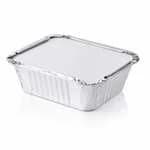
Biolastic currently lists a 450ml aluminium foil food container, pack of 100 and a 650ml aluminium foil food container with lid, pack of 100. Both are described as rectangular formats. Exact tray dimensions, foil thickness, current commercial terms and documentation should be reconfirmed before purchase.
First, understand what the capacity number means
A millilitre is a unit of volume. It does not tell you how much biryani, curry, noodles, cake or cooked rice fits by weight.
Volume and food weight are different. Water has a density near 1g/ml under ordinary conditions, but cooked rice contains air gaps, gravies vary in density, and foods with large pieces leave voids. The same 450ml tray can hold very different food weights depending on the recipe and how it is packed.
The number on a catalogue page may also refer to a nominal tray capacity, rather than the amount a kitchen should fill before closing the lid. Buyers should request the supplier's capacity definition and then determine their own working fill level.
Why headspace matters
Headspace is the space between the top of the food and the closed lid. You may need it for a clean closure, food expansion or movement during transport. A tray filled to its nominal brim capacity may not be practical to seal.
Consider a hypothetical packing rule that uses only 80% of the nominal volume. Under that assumption:
- 450ml × 0.80 = 360ml working volume
- 650ml × 0.80 = 520ml working volume
These are examples for planning, not measured usable capacities or Biolastic filling recommendations. Your real working volume should come from a filled-tray trial with the correct lid and recipe.
Which size fits common food-service jobs?
Small portions and sides
For a single side dish, dry snack or compact serving, a 450ml tray may be a sensible trial candidate. The important question is whether the portion fits without being compressed or smeared against the lid.
A small tray can help standardise portions, but only when the kitchen measures the food. Using the same tray does not automatically produce the same food weight.
Main dishes and mixed meals
A 650ml tray may be worth testing for a larger rice portion, pasta, noodles or a meal that combines several components. Its 200ml extra nominal capacity offers more room on paper, but the tray's length, width and depth also affect whether the meal sits neatly.
A wide, shallow tray and a narrow, deep tray can both be labelled 650ml. If the dish contains long pieces or needs attractive presentation, ask for external and internal dimensions rather than relying on volume alone.
Saucy foods and gravies
Sauce introduces a different challenge. Even a perfectly sized tray can leak through a poorly fitted or inadequately closed lid. A folded or crimped foil lid should not be called leakproof without testing.
For gravies, soups and oily dishes, check lid fit, closure method, transport angle and the need for an additional suitable outer package. If the product will be carried on a motorcycle or delivery bike, simulate the real journey.
Bakery and prepared meals
Some bakeries choose foil trays for portioned bakes or prepared foods, but do not assume a particular tray-and-lid combination is oven-safe merely because the tray is aluminium. Any coating, paperboard lid, adhesive, printing or accessory may have different limits. Request the specific supplier's intended-use instructions.
Five measurements buyers should request
A 450ml container from one supplier may not accept a 450ml lid from another. A matching volume label does not guarantee matching tooling.
| Specification | What to request | What it helps prevent |
|---|---|---|
| Top outside dimensions | Length × width, including rim | Wrong lid or sealing equipment |
| Bottom dimensions | Length × width | Unstable stacking or poor equipment fit |
| Overall height | Height in mm | Carton, shelf and delivery-bag fit problems |
| Foil gauge or tray weight | Gauge range, weight and tolerance | Misleading comparisons between trays |
| Lid specification | Material, dimensions, coating and closure method | Loose lids, contamination and transport failures |
Ask for tolerances as well as nominal values. A sample that fits one lid perfectly may not represent all production lots unless dimensions are controlled.
A quick dimensional check at your packing counter
Take the actual cooked meal, not a dry ingredient sample. Fill the tray using the portioning tool your staff will use. Close the correct lid. Stack several packed trays, lift them, place them in the real delivery bag and open them after a representative journey.
Record whether the lid lifts, corners deform, sauce reaches the rim, or the food becomes unattractive. A two-minute counter test is useful, but it is not a substitute for a realistic transport trial.
Aluminium tray strength: why micron alone is not enough
It is tempting to rank containers by foil thickness. Gauge matters, but so do alloy, temper, tray shape, rib design, depth, corner geometry and forming consistency.
A tray with well-designed ribs may handle differently from a flat-walled tray at the same nominal gauge. A heavy tray is not automatically the most economical if the lid fails or the packed meal shifts during transport.
For an RFQ, ask for tray weight, gauge, dimensional tolerance and the intended application. Then validate with a sample from the actual supply grade.
Simple load and handling trial
Prepare a small batch of filled trays. Include your lightest and heaviest normal menu items. Compare:
1. Pick-up: Does the base deform when staff lift it by the sides or support it from below?
2. Stacking: Do closed trays remain stable at the stack height used in your kitchen?
3. Transit: Do lids remain secure after realistic movement and handling?
4. Opening: Is the food presentable when the customer removes the lid?
5. Repeatability: Do results remain acceptable across multiple samples and production batches?
If a trial fails, do not simply demand thicker foil. First identify whether the failure begins at the tray wall, rim, lid or packing method.
Lid fit matters as much as tray capacity
The lid is part of the package, not an optional afterthought. The Biolastic 450ml listing describes a fitted foil lid, while the 650ml listing describes a matching flat lid. Confirm the exact lid construction supplied with each order.
Some foil-container systems use crimped rims to hold a paperboard or foil-laminated lid; other systems use different closures. These systems should not be treated as interchangeable.
Ask whether the quoted price includes lids, how many lids are packed per 100 trays, whether lids are supplied separately, and what happens if trays or lids are damaged in transport.
Can you put a sticker over the lid?
A label can help with branding, meal identification or tamper indication, but its adhesive and printed surface must be appropriate for the expected temperature and packaging use. A sticker does not automatically make a tray leakproof or tamper-evident.
For export-oriented food brands, also check the destination's applicable labelling requirements. Do not assume that a generic plain container meets every food business's compliance obligations.
Are aluminium foil containers safe for hot food?
Food-contact suitability is product-specific. Aluminium is a familiar food-packaging material, but a supplier still needs to identify the grade, intended food types and use conditions, including temperature, contact time and any coatings.
In India, the Food Safety and Standards (Packaging) Regulations, 2018, as amended, set requirements for food-contact packaging. Buyers should check the latest amendments and request applicable conformity evidence for the exact container and lid, not a generic claim about aluminium.
For EU-market procurement, the European Commission's food-contact materials guidance explains the framework under Regulation (EC) No 1935/2004 and good manufacturing practice requirements under Regulation (EC) No 2023/2006. Applicable national requirements and product-specific documentation may also matter.
Neither catalogue listing establishes a product-specific international food-contact certification by itself. Ask the supplier what documentation can be provided before using the packaging for your intended market.
What about acidic or salty food?
Food chemistry and contact conditions can affect interactions with aluminium. If you pack acidic sauces, heavily salted foods or meals held for long periods, obtain the supplier's specific suitability guidance and supporting documentation. Do not assume that all aluminium trays or coatings are suitable for every recipe.
Can aluminium containers go in a microwave?
Do not microwave these Biolastic trays unless the exact container, lid and appliance instructions expressly allow it.
The US FDA's microwave oven guidance explains that metal pans and aluminium foil generally should not be used in microwave ovens because they can reflect microwaves, cause uneven heating and potentially damage equipment. Some specially designed packages have manufacturer-specific instructions, but that is not permission to microwave an ordinary foil tray.
For a customer-facing takeaway business, the safest default is to advise transferring food to a suitable microwave-safe dish unless the exact package is approved for that use.
Can the tray go in an oven?
Do not treat microwave suitability and conventional-oven suitability as the same question. The tray material, lid, coating and closure all need approval for the proposed temperature and duration. A paperboard lid, for example, may have a different limit from the metal tray beneath it. Confirm with the manufacturer before giving customers reheating instructions.
Does a foil container keep food hot for hours?
No container should be sold as a substitute for safe food-temperature control. Aluminium transfers heat readily, and the actual cooling rate depends on the meal, fill weight, lid, insulation, ambient temperature and delivery conditions.
The USDA guidance on takeaway foods recommends holding hot food at 140°F (about 60°C) or above and cold food at 40°F (about 4.4°C) or below; it also gives a two-hour limit for perishable food left at room temperature, reduced to one hour in conditions above 90°F (about 32.2°C). Local food safety rules may differ.
If your service promises hot meals at the door, evaluate the whole delivery system: packing time, insulated carrier, journey duration and food temperature checks.
How to compare the real cost per packed meal
A common purchasing mistake is to divide a carton price by the number of trays and stop there. That produces tray acquisition cost, not the full packaging cost per successful order.
Use this calculation:
Packaging cost per accepted meal = (trays + lids + labels + outer bags + relevant packing losses) ÷ accepted packed meals
Include the actual landed cost: quoted price, taxes where applicable, freight and any handling charges. A nominally cheap container may become expensive if lids are sold separately or the package needs frequent repacking.
Worked example: 1,000 meal orders
Imagine a kitchen expects 1,000 accepted meals in a week. In a controlled trial, it purchases 1,030 container-and-lid sets to allow for setup damage and packing rejects.
If the hypothetical delivered set price is ₹4.50, then:
- Purchased packaging sets: 1,030
- Total tray-and-lid spend: 1,030 × ₹4.50 = ₹4,635
- Accepted packed meals: 1,000
- Tray-and-lid cost per accepted meal: ₹4.635, or about ₹4.64
This does not include labels, bags, labour or energy. The ₹4.50 figure is an illustration only, not a Biolastic price or quotation.
The same method works for any currency. Buyers in the UK, EU, Middle East or elsewhere can use their local delivered unit cost.
A capacity trap worth avoiding
The 650ml tray has 44.4% more nominal capacity than the 450ml tray, but that does not mean it costs 44.4% more, saves 44.4% of labour or holds 44.4% more of every food. Those outcomes must be measured.
Use the larger tray when it solves a real packing or portion problem, not simply because the number is bigger.
Wholesale ordering: what to check before paying
Whether you are buying 100 trays for a sample run or planning recurring cartons for multiple outlets, a clear purchase specification protects both buyer and supplier.
Confirm these details:
- Product identity: 450ml or 650ml rectangular aluminium foil container, with exact lid type.
- Dimensions and tolerances: Top, base, height, rim profile, tray weight and foil gauge.
- Packing: Number of trays and lids per pack and carton, plus carton dimensions.
- Use conditions: Intended foods, contact time, heat limits and any coating details.
- Documents: Food-contact declarations and test reports relevant to the destination.
- Commercial terms: Current unit price, MOQ, taxes, sample charge, freight, lead time and damage policy.
- Continuity: Whether repeat orders will use the same tooling, specification and lid.
The Biolastic catalogue identifies both products as 100-piece formats. It does not remove the need to verify current price, stock, lead time or the supplied lid before placing a purchase order.
Buying in Siliguri, North Bengal and beyond
A small takeaway outlet in Siliguri may need a container that stacks neatly behind the counter. A caterer serving events in Jalpaiguri may care more about packing several hundred portions without lid failures. A distributor supplying restaurants in Darjeeling, Cooch Behar or the Dooars may focus on consistent cartons, repeat supply and damage during transport.
International buyers have the same underlying questions plus destination-specific documentation, customs and freight costs. An enquiry from another country is welcome, but export serviceability, country-specific compliance, duties and delivery availability must be confirmed for each transaction.
Start with the Biolastic aluminium food container category and share your meal type, preferred size, monthly quantity and delivery destination.
Copy-ready supplier enquiry
We need rectangular aluminium foil food containers for [food/application]. Please quote 450ml and/or 650ml sizes with matching lids. Expected use is [hot takeaway/chilled meal/catering/other]. Monthly volume: [quantity]. Please provide top and bottom dimensions, height, tray weight, foil gauge, lid material and closure type, pieces per carton, current MOQ, unit and carton price, taxes, freight, lead time, food-contact documents and sample availability. Delivery destination: [city, postal code, country]. Please confirm any heating restrictions for the exact tray and lid.
Frequently asked questions
Is a 650ml aluminium foil container 200ml larger than a 450ml one?
Yes, by nominal capacity: 650 − 450 = 200ml, approximately 44.4% more than 450ml. This does not guarantee 200ml more usable working fill after allowing for headspace and lid closure.
Which is better for biryani: 450ml or 650ml?
It depends on the intended cooked portion, food density and how the meal is presented. Pack your actual recipe into both samples, close the lids and compare presentation, spillage and delivery handling. Do not convert millilitres directly into grams of biryani.
Do 450ml and 650ml aluminium trays use the same lid?
Not necessarily. Lid compatibility depends on the rim and tooling, not the capacity label. Request the matching lid specification for the exact product and test the closure.
Are aluminium foil takeaway containers leakproof?
Not automatically. Leakage depends on lid fit, closure method, food type, fill level and handling. Test a filled pack at the angles and movements expected during delivery; use suitable secondary packaging when needed.
Can I microwave a Biolastic aluminium food container?
Do not do so without specific approval for the exact tray, lid and appliance. Metal packaging can cause uneven microwave heating or damage. Transfer the food to a suitable microwave-safe dish unless the relevant instructions explicitly permit otherwise.
Is the 100-piece pack price the complete cost of a takeaway meal?
No. Calculate landed cost per accepted packed meal, including lids, labels, outer bags, freight, losses and other relevant expenses. Confirm whether lids are included in the current quotation.
Can I buy 450ml or 650ml foil containers wholesale in Siliguri?
Biolastic lists both 100-piece formats and accepts business enquiries. Share quantity, intended use and delivery pincode; current availability, commercial terms and lead time require confirmation.
Can overseas distributors request quotations from Biolastic?
Yes, they can submit a specification-based enquiry. Export availability, destination-specific food-contact documents, minimum order, freight and customs arrangements must be confirmed before accepting an international order.
The bottom line
A good takeaway container does three things well: it fits the food, closes reliably and survives the journey. The difference between 450ml and 650ml matters, but the right choice comes from an actual packing trial, not from the capacity number alone.
Compare Biolastic's 450ml aluminium food container with its 650ml aluminium container with lid, then request a specification-based quotation for your food, quantity and destination.
Editorial note (24 October 2026): Catalogue formats were checked before publication. Product-specific food-contact certificates, dimensions, gauge, heating approval, stock, pricing and international dispatch have not been independently verified. The numerical cost illustration is hypothetical. Official regulatory and food-safety links are supplied for buyer verification; consult the latest rules applicable to your market.