Last updated: July 2026 · Reading time: about 7 minutes
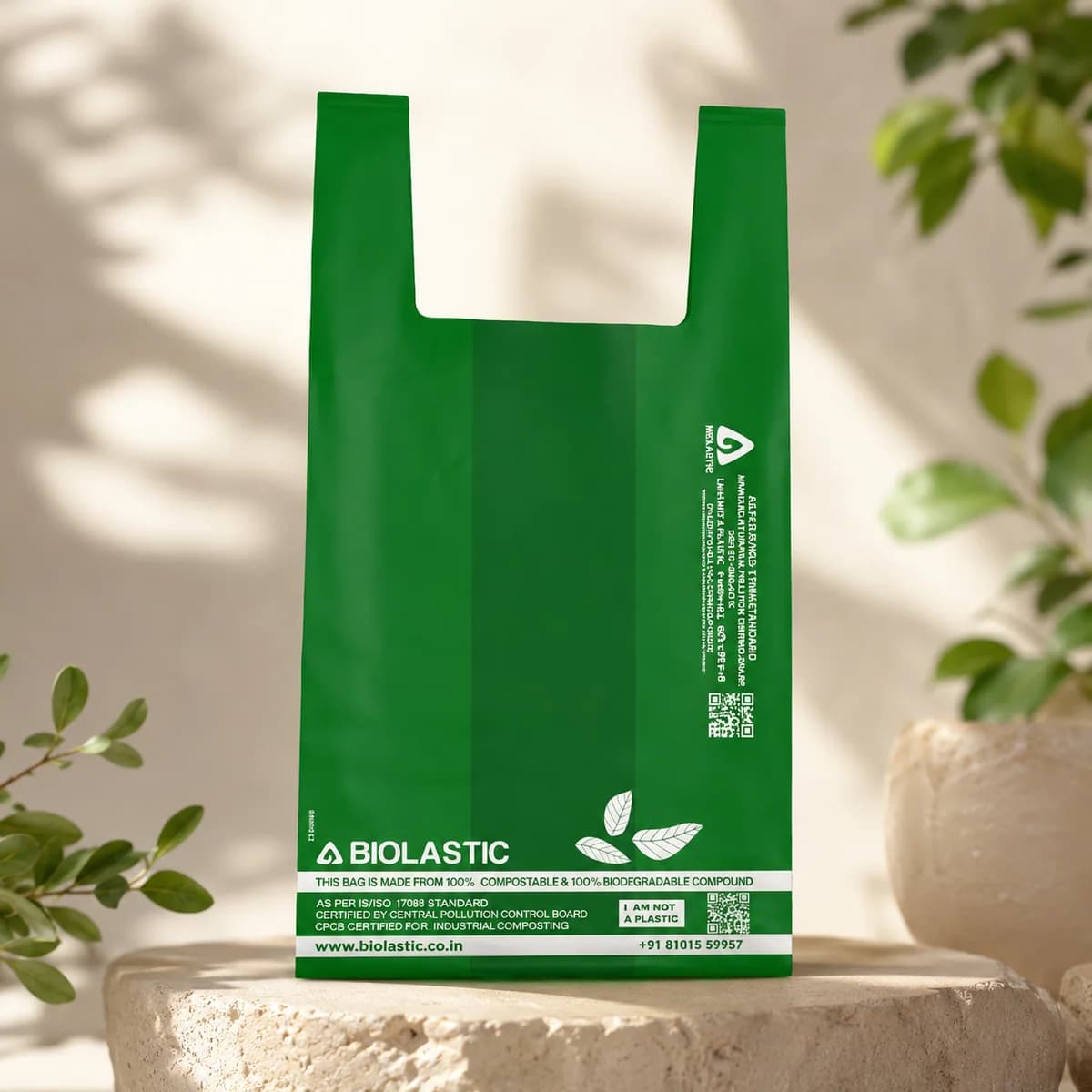
A supplier shows you a green carry bag with a leaf symbol and says, “This is biodegradable.” Is that enough to place a bulk order?
No. Colour, artwork and verbal claims do not prove what a bag is, whether the documentation applies to it, or whether it will perform at your checkout counter.
This question matters more in 2026 because plastic enforcement, environmental claims and disposal infrastructure are receiving closer attention. Recent reporting on a Kerala High Court matter also renewed discussion about a crucial point: a product described as compostable should not automatically be treated as biodegradable in every environment. The exact claim, certification and disposal conditions matter.
This guide is designed for retailers, supermarkets, pharmacies, restaurants, hotels, caterers, vegetable sellers and procurement teams that want to buy compostable bags without making an expensive mistake.
Important: This is a practical procurement guide, not legal advice. Product rules and permitted uses can vary by product type, state, municipality and later regulatory updates. Verify the current position with CPCB, the relevant State Pollution Control Board and your local authority.
First: Take the 30-Second Buyer Test
Answer yes or no:
1. Can the supplier show current documents that match the company and product being quoted?
2. Have you tested the proposed bag with your real products and maximum expected load?
3. Do you know where the used bags are expected to go after disposal?
If any answer is no, do not approve custom printing or a large purchase order yet.
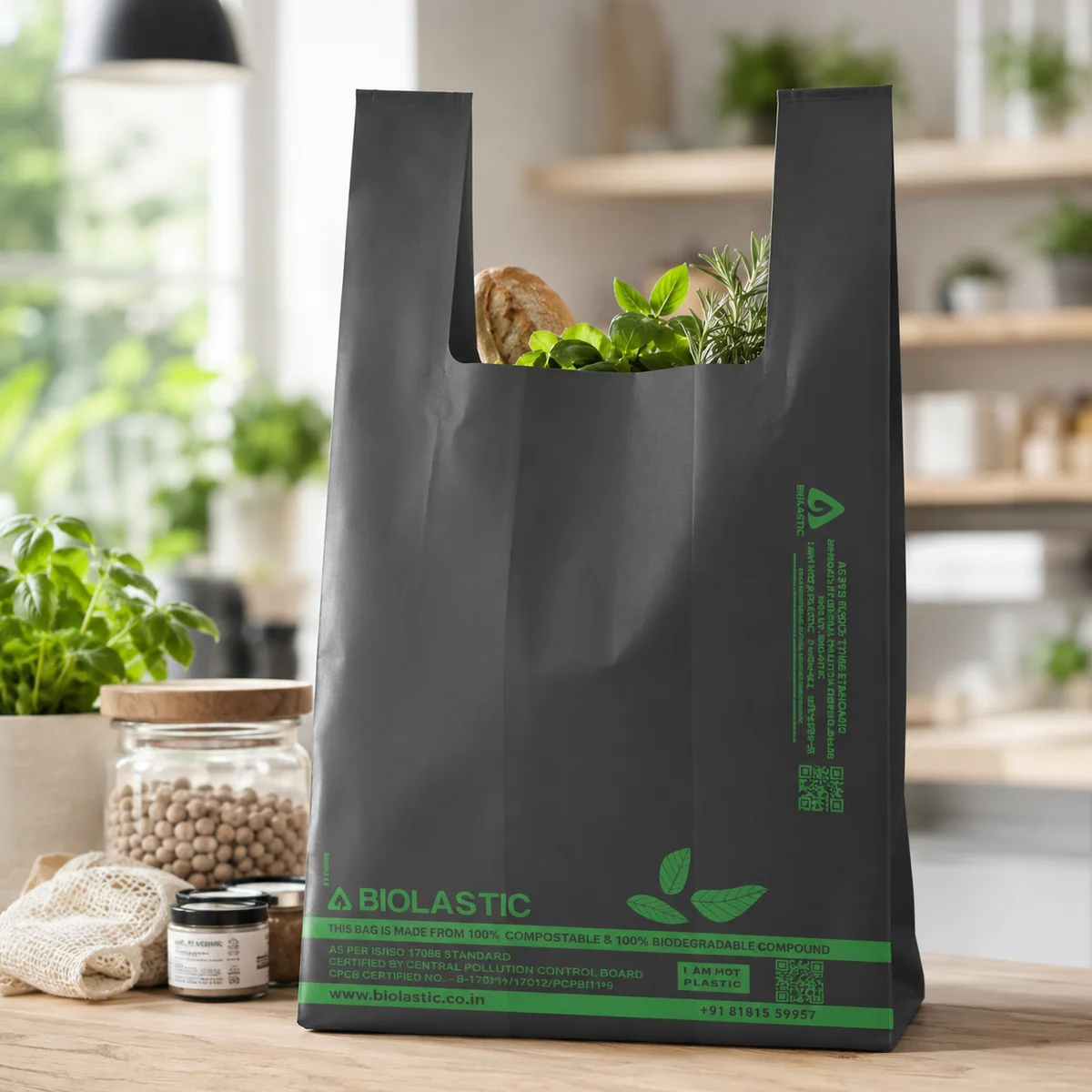
Bag colour and branding can be customised, but the specification and supporting documents should be checked before production.
Compostable vs Biodegradable: What Should a Buyer Understand?
The two words are often mixed together in sales conversations, but they should not be treated as synonyms.
A compostable plastic product is designed to break down under defined composting conditions and according to an applicable standard. Those conditions may require controlled temperature, moisture, oxygen and processing time.
A biodegradable claim is broader, but it still needs a clearly defined environment, test method and time frame. It should not be interpreted as “disappears anywhere after throwing it away.”
The safest buying question is not:
“Is this eco-friendly?”
Ask this instead:
“Which exact claim applies to this finished product, what document supports it, and under which disposal conditions?”
The 7 Checks to Complete Before Buying
1. Match the Supplier Identity
The name on the quotation, invoice, product marking and supporting documentation should make sense together.
Check:
- Legal company or manufacturer name
- Manufacturing or registered address
- GST and contact details where relevant
- Brand name versus actual manufacturer name
- Whether the seller is the manufacturer, distributor or reseller
A certificate belonging to an unrelated company should not be accepted simply because the bag looks similar.
2. Ask for Current, Product-Relevant Documents
Do not collect documents only for a file. Read them.
When a supplier refers to CPCB approval, IS/ISO 17088 or another supporting standard, confirm:
- The issuing authority or laboratory
- The company named on the document
- The material or product covered
- Certificate, report or registration number
- Issue and validity dates, where stated
- Whether the document covers the finished product, raw material or only a tested sample
- Whether current regulatory or local requirements need anything additional
Red flag: a cropped screenshot with no complete page, product scope, date or traceable number.
3. Inspect the Printed Markings
A genuine procurement review should include the actual bag artwork—not only a supplier brochure.
Before printing, check whether the proposed bag contains the applicable:
- Product identification
- Manufacturer or marketer details
- Required licence, certificate or traceability information
- Standard or disposal wording supported by documents
- Batch or production traceability where applicable
- Customer-facing disposal instruction
Avoid adding dramatic claims such as “vanishes in nature,” “zero pollution” or “100% harmless everywhere” unless they are specifically supported and legally permitted.
4. Test a Physical Sample With Real Products
A certificate does not tell you whether the handle will survive your customer’s order.
Use this five-minute test:
1. Fill the sample with a normal customer purchase.
2. Add the heaviest realistic combination.
3. Carry it for five minutes.
4. Inspect the handles, side seals and bottom area.
5. Repeat the test with sharp-edged, chilled or moisture-prone items where relevant.
Record the approved size, thickness, colour, printing and sample. Future supplies should be compared against that approved specification.
5. Choose Size by Use—Not Guesswork
The bag must fit the product and remain comfortable to carry. A larger bag is not automatically stronger, and a smaller bag may fail because it is overstretched.
Here is a quick starting point from Biolastic’s current W-cut range. Load figures are indicative product listings and should be validated using your actual packed products.
| Common requirement | Starting size to review | Indicative listed load | Product |
|---|---:|---:|---|
| Medicines, small accessories, light counter items | 8 × 10 inch | Up to 500 g | View 8 × 10 W-cut bag |
| Small takeaway or pharmacy orders | 9 × 13 inch | Up to 1 kg | View 9 × 13 W-cut bag |
| Grocery and mixed retail items | 11 × 14 inch | Up to 2 kg | View 11 × 14 W-cut bag |
| Medium grocery orders | 13 × 16 inch | Up to 3 kg | View 13 × 16 W-cut bag |
| Larger retail and restaurant orders | 14 × 20 inch | Up to 5 kg | View 14 × 20 W-cut bag |
| High-volume grocery packing | 20 × 24 inch | Up to 7 kg | View 20 × 24 W-cut bag |
For boxed, bulky or unusually shaped goods, request a sample in more than one size.
6. Confirm Storage and Consumption Time
Compostable film can be sensitive to storage conditions. Ask for product-specific guidance and keep unused stock:
- In original protective packaging
- Away from direct sunlight and excessive heat
- Protected from moisture
- Away from chemicals or strong odours
- On a first-in, first-out stock rotation
Do not buy only on the basis of the lowest per-kilogram price. An oversized order that remains in poor storage can become more expensive than a smaller, well-planned purchase.
7. Plan the Disposal Route Honestly
A bag should not be marketed as if it will instantly disappear on a road, in a drain, in a river or in unmanaged landfill.
Ask:
- Is industrial composting available locally?
- Will the bag enter a segregated organic-waste stream?
- Does the local collector accept compostable film?
- What instruction should staff and customers receive?
- Will printed labels, stickers or contents affect disposal?
Responsible packaging combines the correct material with correct collection and disposal behaviour.
Interactive Decision: Which Bag Style Fits Your Counter?
Choose W-Cut When…
- Checkout speed is important
- You need an economical integrated handle
- The bag is used for grocery, pharmacy, vegetable or takeaway packing
- Multiple sizes are required across one retail operation
Explore the Biolastic compostable W-cut carry bag range.
Choose D-Cut When…
- You prefer a punched handle and flatter presentation
- The bag will carry lighter boutique, bakery, gift or pharmacy items
- You want a clean front area for custom branding
Explore compostable D-cut carry bags.
Ask for a Custom Recommendation When…
- Your products have sharp corners
- The order contains wet or chilled items
- You need a gusset
- You require custom colour or multi-colour printing
- Your monthly consumption is high
- Your load or dimensions are unusual
Calculate Your Monthly Requirement
Use this simple planning formula:
Daily bag use × operating days × 1.10 safety buffer = monthly quantity
Example:
300 bags/day × 26 days × 1.10 = 8,580 bags per month
Then split the quantity by size. A supermarket may need 40% small, 40% medium and 20% large bags rather than one universal size.
For kilogram-based quotations, ask the supplier for the approximate pieces per kilogram for the final approved size and thickness. The count can change with micron, dimensions, colour and production tolerance.
Copy This Quote Request and Send It to the Supplier
Business type:
Products to be packed:
Preferred bag style: W-cut / D-cut / other
Required size or product dimensions:
Normal load:
Maximum load:
Daily or monthly quantity:
Colour:
Custom printing: yes / no
Number of print colours:
Delivery location:
Required date:
Please share: current quotation, sample, packing details, lead time and applicable supporting documents.
This information helps a manufacturer recommend a useful specification instead of sending a generic price list.
Five Red Flags That Should Pause the Order
- “It is green, so it is compostable.”
- “All biodegradable and compostable products are the same.”
- “No sample is required before printing.”
- “The bag will disappear anywhere after disposal.”
- “The certificate cannot be shared until after payment.”
A professional supplier should be able to explain the product, limitations, documents, sample process and production terms clearly.
Why This Topic Is Trending in 2026
Businesses are under increasing pressure to reduce conventional single-use plastic while avoiding misleading environmental claims. Enforcement activity continues in multiple Indian markets, and recent court scrutiny has highlighted the importance of competent approval and real disposal infrastructure—not just material marketing.
That creates a practical opportunity for retailers: switch carefully, test the product properly, communicate honestly and use custom printing to turn necessary packaging into visible brand value.
The Smart Buying Sequence
Documents → sample → load test → artwork → written specification → purchase order → incoming quality check
Following this order reduces the risk of unusable stock, printing errors, customer complaints and unsupported claims.
Frequently Asked Questions
Are compostable carry bags legal in India?
They may be supplied for permitted uses when the product and supplier meet applicable national, state and local requirements. Verify current CPCB-related documentation, product markings and local restrictions before ordering.
Does a CPCB logo on a bag prove compliance?
A logo alone is not enough. Match the printed information with complete, current and product-relevant documents and verify traceable details.
Are compostable and biodegradable bags the same?
No. The claims and required conditions differ. Ask which exact standard and disposal environment apply to the product.
Can compostable bags be custom printed?
Custom colours and logo printing may be available subject to size, quantity, artwork, number of colours and production feasibility.
Which W-cut bag size is best for a grocery shop?
Most grocery operations need more than one size. Start by testing small, medium and large samples with actual customer orders, then forecast monthly consumption by size.
Will compostable bags decompose in normal soil or landfill?
Do not assume this. Performance depends on the exact certified material and the temperature, moisture, oxygen, microbes and processing conditions available.
Ready to Compare a Sample?
Biolastic supplies compostable W-cut and D-cut carry bags in multiple sizes with manufacturer-direct quotation, custom colour and brand-printing options subject to specification, MOQ and artwork approval.
Browse all Biolastic products or request a quotation with your size, load, monthly quantity and printing requirement.
Sources and Further Verification
- Refer to the latest Plastic Waste Management information published by the Central Pollution Control Board and the relevant State Pollution Control Board.
- Review current municipal or state restrictions for the place where the bags will be distributed and used.
- Recent 2026 reporting on the Kerala High Court’s Sabarimala decision illustrates why compostable and biodegradable claims, competent approval and disposal conditions should be checked separately.