Carton Bundling Shrink Film vs Strapping: Pack Stability, Damage & Cost per Bundle
A bundle of four cartons can leave a packing line looking tidy and arrive with crushed corners, a loose strap or a split film seam. The material alone is rarely the whole story. The arrangement of boxes, how the bundle is lifted, the packing equipment and the journey to the customer all influence whether it survives.
For manufacturers, distributors and contract packers, the practical choice is often heat-shrink film or plastic strapping. Both can group cartons, but they do different jobs. This guide helps purchasing and operations teams specify the right secondary packaging, run a meaningful trial and compare cost per accepted delivered bundle rather than cost per kilogram.
What Biolastic actually offers
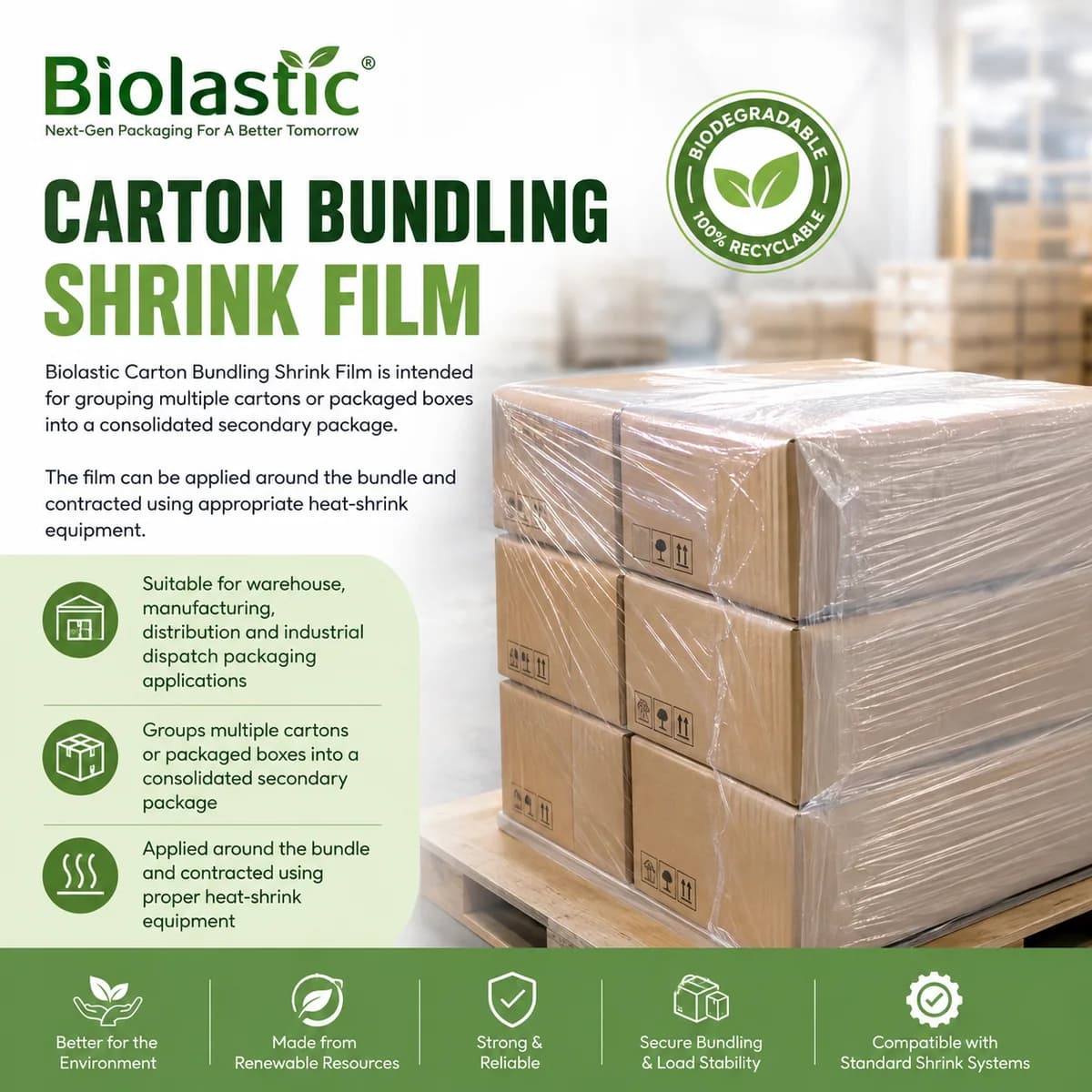
The live Biolastic Carton Bundling Shrink Film Roll catalogue entry describes a quotation-based shrink film for grouping cartons and packaged boxes in warehouse, manufacturing and dispatch applications. It asks buyers to confirm bundle dimensions, film width, thickness, roll format, roll weight and machine details. The listing identifies the material broadly as shrink film, not a guaranteed polymer grade. It does not establish a fixed micron, shrink percentage, seal strength, food-contact approval, recycling certification, stock or export availability.
The catalogue lists an MOQ field of 100 without defining the commercial unit in the description; buyers should clarify whether that means rolls, kilograms or another unit before budgeting. Prices and production feasibility require a current quotation. This article is a procurement guide, not a promise of any specific performance.
Shrink film and strapping restrain cartons differently
Heat-shrink film wraps around a group of cartons, is sealed where required and contracts under controlled heating. Depending on the pack design, it can provide broad surface coverage and help keep individual cartons together. It can also hide printed labels or interfere with scanning if the material is not sufficiently clear.
Plastic strapping, typically applied with a tensioning and joining system, creates narrow bands of restraint. It can leave most carton faces visible and avoid a shrink tunnel, but concentrated forces may mark weak cartons or damage corners. Edge protectors or a different carton arrangement may be needed. Neither system should be described as inherently safer, cheaper or stronger without testing.
| Buying question | Heat-shrink film | Plastic strapping |
|---|---|---|
| Where restraint acts | Across wrapped surfaces and seals | Along one or more narrow bands |
| Typical equipment | Film feed, seal and controlled heat process | Tensioning and strap joining equipment |
| Carton print visibility | Depends on clarity, overlap and folds | Usually more carton surface exposed |
| Common trial failures | Open seams, punctures, wrinkles, uneven shrink | Loose straps, cut-in corners, broken joints |
| Material calculation | Web width, length, thickness, density and scrap | Strap length, width, thickness and joints |
| Best decision metric | Cost per accepted delivered bundle | Same metric |
Important: Carton bundling is not the same as securing a full pallet or restraining a heavy industrial load. If your shipment needs pallet-level load containment, design and validate that separately.
Begin with the carton and distribution route
Before requesting film samples, write down the finished dimensions and mass of one carton, the number of cartons per bundle, their arrangement and whether they contain fragile or crush-sensitive goods. Record where the bundle will be picked up: from underneath, by hand, by conveyor or with a mechanical device.
A two-by-two bundle of identical rigid boxes behaves differently from a long stack of mixed cartons. The same film can be adequate for one arrangement and fail on another. Also document warehouse humidity, stacking height, loading patterns and expected transit handling. These are conditions to investigate, not reasons to guess a film gauge.
For regional dispatch around Siliguri, Jalpaiguri, Darjeeling and the Dooars, test the actual loading and unloading pattern. For domestic or overseas B2B enquiries, ask the logistics partner about handling, stacking and destination-specific packaging requirements. International fulfilment by Biolastic must be confirmed rather than assumed.
The film specification buyers should request
A meaningful RFQ needs a proposed polymer construction, nominal single-wall thickness in microns, width, roll format, core and winding direction, roll net mass, seal requirements and relevant test data. If the film is tubular, distinguish layflat width from the material width around the circumference. A 500 mm layflat tube contains two film walls; treating it as a single 500 mm sheet understates material mass.
Ask for shrink response in the machine direction (MD) and transverse direction (TD), with the actual test conditions. Film shrinkage is not one universal number. ASTM D2732 addresses unrestrained linear thermal shrinkage of plastic film; the finished carton bundle still needs an equipment trial because cartons restrain film movement.
Thickness measurement and tolerances should also be documented. ISO 4593 describes mechanical scanning methods for determining thickness of plastic film and sheeting. A nominal gauge without tolerance or a reliable measurement method is a weak basis for comparing suppliers.
Sealing, heat and the cartons themselves
The film has to shrink without damaging the packaged goods. Excessive heat can deform sensitive contents, weaken adhesives or affect carton appearance. Insufficient or uneven heat can leave slack areas. A poor seal can open even when the film itself remains intact.
Do not copy tunnel temperatures from another supplier's product or machine. Instead, record the selected film lot, seal settings, tunnel configuration, conveyor speed and finished-pack observations. Agree on an acceptable window with the film and equipment suppliers. If goods are heat-sensitive, investigate whether a non-heat method is more appropriate.
A useful trial includes several consecutive production runs rather than one attractive demonstration bundle. Inspect the first and last packs after startup, measure rejects and document any operator intervention. Keep an approved physical reference pack.
Where strapping may be the better option
Strapping deserves consideration when the buyer needs easy access to carton labels, wants to avoid a heat process or already operates a suitable strapping line. But the strap tension, joint integrity and carton-edge compression must be validated. A tight strap is not automatically a secure strap; it may simply be crushing the packaging.
If the bundle contains soft cartons, investigate edge protectors and load spreading. If cartons are very smooth or irregular, check whether straps can migrate during handling. For high-volume production, compare machine throughput, changeover waste, maintenance and labour—not only the material invoice.
Film weight: a worked example, not a product specification
For a single flat film layer, theoretical mass is:
Mass (kg) = width (m) × length (m) × thickness (µm) × density (g/cm³) ÷ 1000.
Suppose an illustrative film web is 0.60 m wide, uses 0.80 m of length per bundle, is 50 µm thick and has an assumed density of 0.92 g/cm³. The mass is 0.02208 kg, or about 22.1 g per bundle, before sealing trim, rejects or any overlapping layers. These are hypothetical inputs, not Biolastic film specifications.
If 8% of purchased film mass is lost in startup and trimming, a simple illustrative estimate is 22.08 ÷ 0.92 = 24.0 g of purchased film per accepted bundle, before accounting for failed finished packs. For a tubular web, include both walls and avoid counting the same material twice. Printing, additives and actual density can change the result.
This is why comparing only ₹/kg can mislead: a film with a lower kilogram price may require more material per pack or generate more rejects.
Compare the complete cost per accepted delivered bundle
Create two trial columns—shrink film and strapping—with the same carton arrangement and shipment conditions. Include:
1. Material consumed, including trims, joints and startup waste.
2. Packaging-line labour and actual achievable throughput.
3. Equipment depreciation or rental, energy and maintenance.
4. Rework and rejected bundles.
5. Carton or product damage after representative handling.
6. Disposal or recovery charges where relevant.
Then divide the total relevant cost by the number of accepted delivered bundles. A hypothetical ₹18,000 process cost producing 12,000 accepted bundles equals ₹1.50 each; the same spending with 10,000 accepted bundles equals ₹1.80 each. Those figures demonstrate the method, not market prices.
If you lack transit data, label the result packing-line cost per accepted pack rather than pretending it includes downstream damage.
A practical qualification trial
Start with a written pass/fail checklist. Confirm the bundle remains grouped, labels can be read, seals or strap joints remain intact, carton corners are not excessively marked and operators can handle the package safely.
Test production handling and the expected distribution environment. Use a repeatable drop, compression or vibration protocol appropriate to the package and shipping route, with competent packaging engineers defining the acceptance criteria. Do not claim that a single generic test certifies all shipping conditions.
Track film punctures, loose wraps, open seals, strap slippage, corner damage, heat effects, material consumption and changeover time. Keep the results by sample lot and machine setting. Only then choose the specification and negotiate commercial terms.
Common causes of carton bundle failure
Loose shrink wrap: check film fit, carton arrangement, heat distribution and actual shrink response; increasing heat indiscriminately can make other problems worse.
Film tears at corners: inspect sharp edges, handling abrasion, film selection and pack geometry. Gauge alone may not solve a concentrated stress point.
Seams open: investigate sealing temperature, dwell, pressure, contamination and seal location.
Cartons crush under strapping: inspect strap tension, carton strength, edge protectors and stacking arrangement.
Barcode scanning fails: inspect film haze, overlap, wrinkles and label placement under real warehouse lighting.
Unexpectedly high packaging cost: measure material per bundle, startup waste, rejected packs and line stoppages rather than using only nominal roll price.
Environmental and regulatory due diligence
Shrink film should not be called compostable, biodegradable, recycled-content certified or universally recyclable without evidence for the actual supplied construction. Film identification, inks, contamination and collection infrastructure matter. Likewise, a strap made from a commonly recycled polymer is not guaranteed to be collected and recycled in every market.
For India, consult the Central Pollution Control Board and applicable Plastic Waste Management requirements for the relevant packaging and business role. For EU-bound goods, assess the EU Packaging and Packaging Waste Regulation (EU) 2025/40, including the applicable dates and producer responsibilities. Do not assume a product quotation proves destination-market compliance.
The Biolastic carton-bundling listing does not establish compostability, recycled content or any third-party certification. Request documents for the exact material and shipment, and have compliance responsibilities checked before making environmental claims.
A procurement checklist for India and global buyers
A buyer in Siliguri, a national warehouse network and an overseas distributor may have different commercial terms, but each benefits from a precise enquiry. Send the carton dimensions and weight, cartons per bundle, bundle pattern, target output per hour, current packaging method, heat or strapping equipment, film width if known, estimated monthly consumption and delivery location.
Ask the supplier to identify which values are guaranteed, which are indicative and which require trial approval. Request the actual material specification, sample availability, MOQ unit, quotation validity, taxes, transport terms and lead time. Never infer current stock or international dispatch capability from a catalogue listing.
Ready-to-send wholesale RFQ
We need secondary packaging for [number] cartons per bundle. Each carton is [L × W × H] and weighs [kg]. Finished bundle dimensions are [L × W × H]. Current method is [film/strap/none]. Our line uses [machine details] and produces [bundles/hour]. Expected monthly volume is [quantity]. Delivery location is [city/country]. Please confirm feasible shrink-film construction, single-wall micron, web format, seal and shrink trial requirements, sample process, MOQ unit, price, lead time and documentation.
Request carton bundling shrink film samples and a wholesale quotation from Biolastic. Attach a photograph of the assembled carton bundle and your machine details. A specific enquiry produces a more useful technical discussion than “send your lowest film rate.”
Frequently asked questions
Is shrink film stronger than plastic strapping?
Neither is universally stronger. They restrain loads differently; compare the complete carton bundle under actual handling and distribution conditions.
Can shrink film replace strapping on a pallet?
Not without validation. Pallet containment and heavy-load restraint are separate engineering decisions from small carton bundling.
Which shrink film micron should I choose for cartons?
Specify carton geometry, weight, equipment and damage criteria, then test candidate gauges. The Biolastic listing does not state a fixed thickness.
Does carton shrink film need a heat tunnel?
Heat-shrink film requires a compatible controlled heat process; exact equipment and settings depend on the chosen film and bundle.
How do I compare film and strapping prices?
Compare total material, equipment, labour, energy, rework and transit-damage cost divided by accepted delivered bundles.
Is carton bundling shrink film recyclable?
That depends on its actual polymer construction, inks and local collection infrastructure; request material identification and destination-specific guidance.
Can Biolastic supply custom widths?
The catalogue invites specification-based enquiries, but width, format, production feasibility, MOQ, stock and lead time must be confirmed in a written quotation.
What should I send for a wholesale quote?
Send carton dimensions, bundle pattern and mass, film machine details, target monthly quantity, trial criteria and delivery destination.
Sources and scope
Product-specific statements are based on the live Biolastic carton bundling shrink film catalogue. Testing context: ASTM D2732 and ISO 4593. Regulatory reference: Regulation (EU) 2025/40 and CPCB. Numerical examples are illustrative and are not commercial offers, measured product performance or certification claims.