Choosing the right carry bag is not only about selecting a size and placing an order. For retailers, restaurants, hotels, pharmacies, supermarkets and institutional buyers, the bag must work reliably at the counter, represent the brand well and match the intended product load.
This practical guide explains how to compare compostable carry bags, what to confirm before bulk production and how to avoid common procurement mistakes.
What Is a Compostable Carry Bag?
A compostable carry bag is made from material designed to break down under specified composting conditions. The word compostable should not be treated as a general marketing term. Buyers should ask for supporting documents that apply to the exact material, thickness and finished product being supplied.
Compostable, biodegradable, recycled and reusable describe different material or end-of-life characteristics. They should not be used interchangeably. A responsible supplier should clearly explain what the product is, how it should be stored and which disposal route is appropriate.
1. Start With the Actual Use Case
The best bag for a pharmacy may not be the best bag for a grocery counter or a clothing store. Before requesting a quotation, define:
- The products that will be packed
- The typical and maximum carrying weight
- Whether the products have sharp corners, moisture or heat
- The required bag capacity
- Whether custom branding is needed
- The number of bags used daily or monthly
This information helps the manufacturer recommend a practical size, thickness, handle style and packing format instead of quoting a generic bag.
2. Select the Right Bag Style
W-Cut Carry Bags
W-cut bags have integrated handles and are widely used for fast counter operations. They are suitable for many grocery, pharmacy and general retail applications. Gusset options can provide additional usable volume.
D-Cut Carry Bags
D-cut bags use a punched handle and provide a clean surface for branding. They can be a good fit for boutiques, takeaway counters, events and lighter retail applications.
Loop-Handle Carry Bags
Loop-handle bags offer a more premium carrying experience and a larger branding area. They are often considered for apparel, gifting and applications where presentation and carrying comfort are priorities.
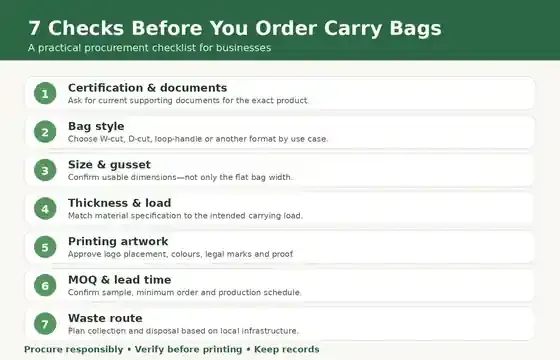
Seven practical checks for comparing carry-bag suppliers and specifications.
3. Confirm the Usable Size, Not Only the Flat Size
A size written as width × height may not tell the complete story. Ask the supplier to confirm:
- Finished bag width and height
- Bottom or side gusset, if any
- Handle opening dimensions
- Usable internal dimensions
- Expected tolerance
A physical sample is especially useful when your product is bulky, boxed or unusually shaped. Test the actual item inside the proposed bag before approving a bulk order.
4. Match Thickness and Strength to the Product
Do not select thickness only by comparing the lowest price. The required specification depends on bag dimensions, material behaviour, sealing quality, product shape and intended load.
Ask for a sample and perform a practical test:
1. Pack the normal customer order.
2. Lift and carry the bag for a realistic distance.
3. Check the handle, side seals and bottom area.
4. Repeat with the expected maximum load.
5. Test sharp-edged or chilled items separately.
Where load performance is business-critical, document the approved sample and specification so that future batches can be checked consistently.
5. Verify Documents Before Printing or Bulk Production
Ask the supplier for current supporting documents relevant to the exact product being offered. Confirm that the company name, material, product category and other identifying information are consistent.
Requirements may vary by product, location and intended use. Buyers should verify the latest applicable rules, marking requirements and local restrictions before placing an order. Avoid relying only on a logo printed on a sample bag or an unsupported environmental claim.
6. Plan Custom Printing Carefully
Custom-printed carry bags turn every customer order into a moving brand impression. A simple design often performs better than an overcrowded layout.
Before production, approve a final proof that clearly shows:
- Logo size and placement
- Brand colours
- Phone number, website or QR code
- Mandatory product markings
- Print area and safe margins
- Number of print colours
- Front-only or front-and-back printing
Check the spelling of every word and number. One incorrect phone number or website address can affect the entire printed batch.
7. Review MOQ, Lead Time and Packing
The lowest unit price may require a much larger quantity than your business can use within a practical period. Compare the total purchase, not only the price per bag.
Confirm the following in writing:
- Minimum order quantity
- Quantity per packet and carton
- Production lead time
- Artwork or cylinder charges, if applicable
- Delivery terms
- Payment terms
- Sample approval process
- Replacement or complaint procedure
For recurring requirements, ask whether the supplier can maintain an approved specification and repeat artwork for future batches.
8. Store Compostable Bags Correctly
Storage can affect the performance of many packaging materials. Keep carry bags in their original packaging, away from excessive heat, moisture and direct sunlight. Use older stock first and avoid ordering more than you can reasonably consume within the recommended storage period.
Ask the supplier for product-specific storage and handling guidance because different formulations and bag constructions may behave differently.
9. Plan the End-of-Life Route
Purchasing a compostable product is only one part of responsible packaging management. Businesses should also consider how used bags will be collected, identified and processed.
Communicate realistic disposal instructions to staff and customers. Do not claim that a bag will disappear immediately in the open environment. Appropriate disposal depends on the product specification and the waste-management facilities available locally.
Quick Supplier Comparison Table
| Check | What to Ask | Why It Matters |
|---|---|---|
| Material and documents | Are the supporting documents current and product-specific? | Reduces compliance and claim risk |
| Size | What are the finished and usable dimensions? | Prevents capacity mismatch |
| Strength | Can we test a sample with the intended load? | Reduces breakage at the counter |
| Printing | Will we receive a final artwork proof? | Prevents costly print errors |
| MOQ | What is the total quantity and packing configuration? | Improves stock planning |
| Lead time | When will production and dispatch be completed? | Prevents packaging shortages |
| Storage | What conditions and shelf guidance apply? | Protects product performance |
Common Buying Mistakes to Avoid
- Ordering only on the basis of the lowest price
- Approving dimensions without testing the actual product
- Using environmental claims without checking supporting documents
- Skipping a physical sample before custom printing
- Not checking artwork, phone numbers and website details
- Ignoring carton quantity, storage space and consumption rate
- Assuming every location has the same disposal infrastructure
Why Work Directly With a Manufacturer?
Manufacturer-direct sourcing can simplify specification discussions, sample development, repeat ordering and custom branding. It also allows the buyer to communicate practical requirements such as size, gusset, thickness, handle style, colour, printing and packing in one place.
Biolastic works with businesses that need wholesale and customised packaging solutions. Share your product type, required bag size, expected load, monthly quantity and artwork requirements to receive a more relevant recommendation.
Frequently Asked Questions
Which carry-bag style is best for retail shops?
W-cut bags are commonly considered for fast counter use, while D-cut and loop-handle bags may offer different presentation and carrying benefits. The correct choice depends on product size, weight, workflow and branding requirements.
Can compostable carry bags be custom printed?
Yes. Custom printing may be available depending on quantity, bag size, material, artwork and number of colours. Approve a final proof before production.
How do I choose the correct size?
Measure the actual products or typical customer order, then account for gusset and handle space. A tested physical sample is more reliable than selecting a size only from a list.
What should I ask a supplier before ordering?
Ask about product-specific documents, material, dimensions, thickness, load suitability, sample availability, MOQ, printing, lead time, packing, storage and disposal guidance.
Should I test a sample before placing a bulk order?
Yes. Pack the intended products, test the handles and seals, and confirm the print and dimensions before approving production.