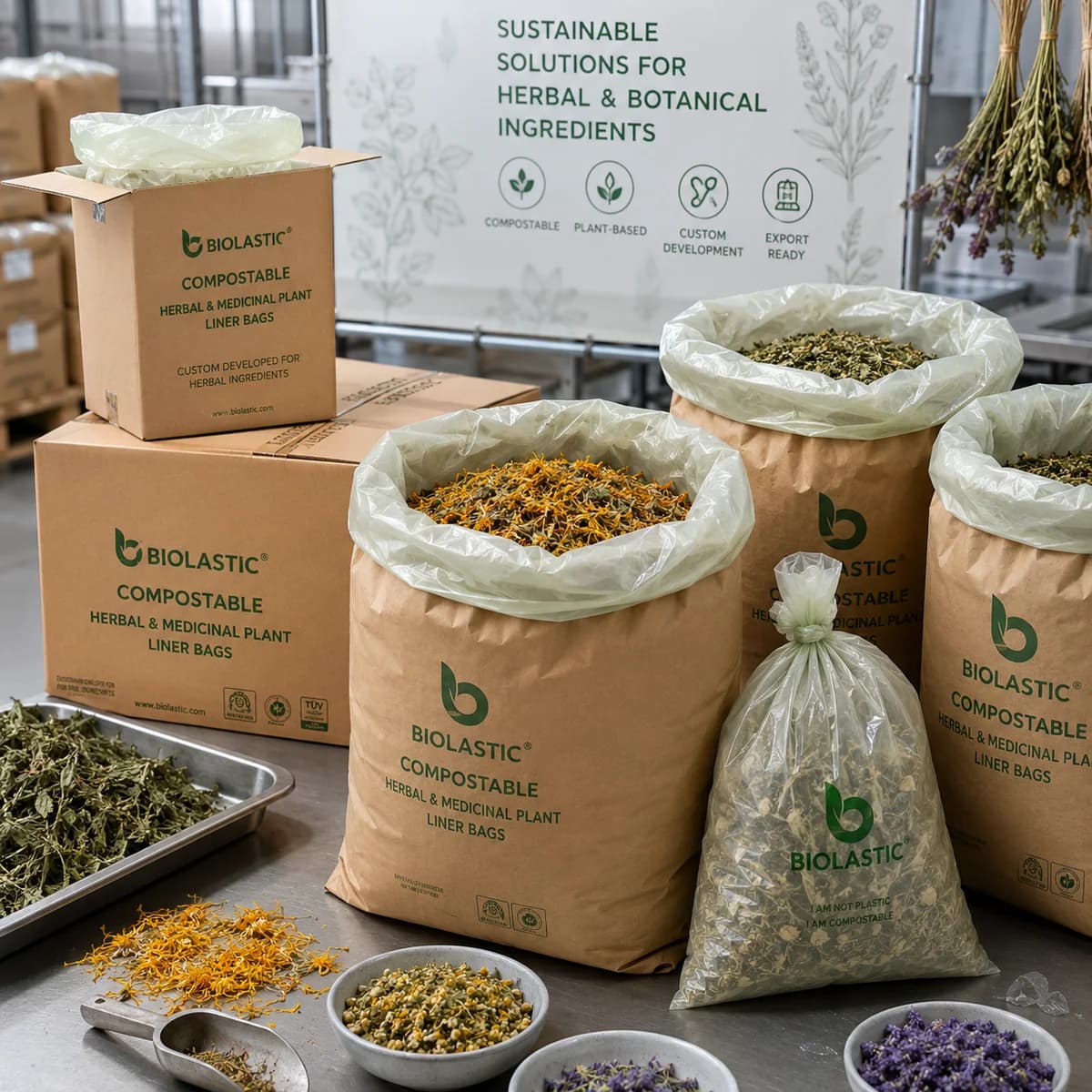
Compostable Herbal & Botanical Liner Bags: Roots, Leaves, Powders and Bulk RFQ Guide
A dried-leaf processor and a root-cutting facility can both order a “10 kg herbal liner” and receive bags that behave very differently on the packing floor. Leaves are bulky and compressible. Chopped roots can be abrasive. Fine botanical powders escape through small gaps and contaminate sealing jaws. These are practical reasons to specify a liner around the ingredient, rather than buying by nominal kilogram capacity alone.
This guide helps herbal ingredient manufacturers, Ayurvedic raw-material suppliers, botanical traders, nutraceutical ingredient packers and wholesale packaging buyers evaluate compostable inner liners for dried herbs. It is written for global B2B procurement teams, including those operating in Siliguri, the Dooars, North Bengal and elsewhere in India.
What Biolastic actually lists
The live Biolastic Compostable Herbal & Medicinal Plant Liner Bags catalogue entry describes 5 kg, 10 kg and 25 kg application formats for dried leaves, roots, flowers, seeds and botanical powders. It describes a corn-starch-derived compostable flexible-film formulation with no conventional PE or PP intentionally added, and offers enquiries for custom dimensions, film thickness and sealing formats subject to technical review.
Those are catalogue descriptions, not independently verified batch-test results. The listing asks buyers to request product-specific IS/ISO 17088:2021 and applicable CPCB documents. Review the actual documents, scope and validity before making any certification claim. Its MOQ field reads 100 without a clearly defined unit; its zero price is a quotation placeholder, not a selling price. Stock, current price, lead time and overseas supply require confirmation.
Four botanical forms, four different failure modes
Dried leaves: volume and compression
Whole dried leaves can occupy far more volume per kilogram than compact powders. Overfilling to hit a target mass may distort the sack, stress the liner mouth or crush the ingredient. Measure loose and settled bulk density using a representative lot. Test the liner inside the intended kraft sack or carton, with the actual closure and stacking method.
Chopped roots and coarse botanicals: puncture and abrasion
Hard edges and irregular pieces can rub against the inner film during filling, transport and pallet handling. Inspect filled liners after a repeatable handling trial. Do not equate a nominal micron value with a guaranteed puncture rating: polymer formulation, seam design, sharp-edge geometry and outer-pack protection all matter.
Flowers and aromatic herbs: odour and quality
Aromatic botanicals may have product-specific sensitivity to oxygen, moisture, light or contact materials. Ask for relevant migration, odour-transfer and barrier evidence when the intended application demands it. A generic “compostable” label does not establish aroma retention or shelf life.
Fine botanical powders: dust and seals
Powders can enter the heat-seal area and create channels or weak closures. Evaluate dust extraction, filling height, seal width, dwell time, jaw cleanliness and closure integrity on the actual equipment. If the material is dusty, evaluate operator exposure and housekeeping under the facility's safety procedures as well.
Sizing a 5 kg, 10 kg or 25 kg botanical liner
Capacity is a mass target, not a universal physical dimension. A practical first estimate is:
Required product volume (litres) = fill mass (kg) ÷ measured bulk density (kg/L).
For illustration, a 10 kg fill at an assumed bulk density of 0.25 kg/L needs 40 L of product space, while 10 kg at 0.50 kg/L needs 20 L. Neither density is a specification for any named herb. The difference demonstrates why nominal capacity cannot determine bag width.
Measure bulk density after the same settling or vibration conditions expected in production. Then make a trial pack with the proposed liner inside its real outer sack. Record layflat width, gusset, length, headspace, fill height, closure allowance and settled shape. Do not scale a 5 kg liner mechanically to 25 kg without a new fit and handling trial.
| Specification | What the buyer should provide | Why it matters |
|---|---|---|
| Botanical type | Leaf, root, flower, seed or powder; particle range | Determines abrasion, dust and packing behaviour |
| Target fill | 5 kg, 10 kg or 25 kg; measured density | Establishes required volume |
| Outer pack | Sack/carton drawing and internal dimensions | Controls fit and corner stress |
| Liner geometry | Layflat width, length, gusset and tolerance | Avoids folds and overfilling |
| Closure | Heat seal, tie or fold with acceptance criteria | Determines containment |
| Storage | Temperature, humidity, duration and stacking | Defines validation conditions |
| Destination | Country, intended use and distribution route | Determines document review |
Moisture and oxygen: do not buy a promise
Dried botanicals can be affected by ambient humidity, temperature and time. If moisture protection matters, request the water-vapour transmission rate (WVTR) of the proposed construction with units, method, temperature and humidity gradient. Where oxidation or aroma retention is important, request relevant oxygen-transmission or finished-pack stability data. The absence of data is a reason to run trials, not a reason to assume the material is impermeable.
A measured film value is not the same as shelf-life validation. Seals, pinholes, closures, carton design and handling may dominate the result. Run product-specific storage trials and define acceptance criteria such as moisture change, appearance, odour and any microbiological or chemical limits relevant to the ingredient.
For North Bengal procurement, assess warehouse humidity and seasonal handling conditions. For international shipments, evaluate the actual route and destination environment. Neither regional context alone establishes a required film thickness or guaranteed shelf life.
Test the full pack before approving a bulk order
Start with a representative ingredient lot. Fill at normal operating speed, close with the intended equipment and inspect the seal or tie. Repeat after stacking and simulated handling. Record damaged liners, powder escape, seal defects, downtime and rework. Include worst-case particle sizes rather than only clean samples.
A useful qualification plan has three gates:
Gate 1 — geometry: Can operators fill and close the bag without stretching corners, crushing ingredients or trapping excessive folds?
Gate 2 — mechanical integrity: Does the packed system resist the handling and transport stresses defined by the buyer?
Gate 3 — product quality: Does the ingredient remain within its approved quality limits over the planned storage and distribution period?
Agree on acceptance limits before the trial. “Strong,” “premium” and “high barrier” are not substitutes for measurements under specified conditions.
Compostability, food contact and medicinal use are different questions
ISO 17088:2021 sets specifications for plastics suitable for organic recycling through aerobic composting. It does not, on its own, prove food-contact suitability, home compostability, moisture protection or acceptance by every composting facility. Check evidence for the finished, converted liner, including any inks or additives, rather than assuming a resin document covers every finished product.
For packaging that contacts food ingredients in India, assess the applicable FSSAI packaging regulations and amendments. Compostable plastic claims in India also require checking the applicable Plastic Waste Management framework and CPCB processes. For other markets, check the destination's rules separately. The buyer should obtain professional regulatory advice where classification is uncertain.
“Medicinal plant” describes the intended packaging category; it is not a therapeutic claim. A liner cannot establish the identity, purity, potency, legal classification or safety of its contents. Herbal medicinal products, food ingredients and cosmetic botanicals may face different requirements. Ask the responsible quality team to define which documents apply.
Cost per accepted botanical pack, not just cost per bag
A cheaper liner may cost more if it produces damaged ingredients or rework. Compare quotations on the same specification and test criteria.
Cost per accepted pack = total relevant packaging, handling and reject costs ÷ accepted packed units.
For a fictional example, suppose 1,000 packs are attempted, 25 fail the agreed checks and total relevant spend is ₹18,000. Cost per accepted pack is ₹18,000 ÷ 975 = ₹18.46. This is a calculation example only—not a Biolastic quote, failure rate or performance claim.
For film-weight comparisons, weigh a representative batch of finished liners. Nominal micron alone will not capture gussets, seams, trim, density or conversion tolerances. Request delivered-price terms, packaging unit and MOQ unit explicitly.
A wholesale RFQ that gets a useful response
Instead of “Need 10 kg herbal bags, best rate,” send a specification-led enquiry:
We pack 10 kg dried chopped roots in a kraft outer sack. Attached are the filled-sack drawing, measured bulk density, particle photos and closure details. Please advise a trial liner specification, sample process, product-specific compliance documents, MOQ unit, lead time and quotation basis. Storage is [temperature/humidity/duration]; delivery destination is [location].
Add monthly usage, whether the liner directly contacts the ingredient, intended food/medicinal/cosmetic classification, and any existing failure examples. If buying from outside India, request written confirmation of export feasibility, destination compliance and freight terms before planning procurement.
For procurement teams in Siliguri, Jalpaiguri, the Dooars and wider North Bengal, this same engineering brief reduces avoidable trial cycles. For overseas buyers, it provides a common technical basis without implying that export service is already confirmed.
Request a botanical liner sample review and wholesale quotation from Biolastic. Share your ingredient, target weight, outer-pack drawing and storage requirements so the team can assess a suitable proposal. Pricing, samples, production feasibility and delivery are subject to confirmation.
Frequently asked questions
Can one compostable liner pack dried leaves, roots and powders?
Not automatically. Each botanical form needs its own fill, puncture, dust-containment, sealing and storage validation.
Are 5kg, 10kg and 25kg the finished bag dimensions?
No. These are application capacities; confirm dimensions, gussets, thickness and outer-pack fit for each material.
Does compostability guarantee moisture protection?
No. Ask for product-specific water-vapour transmission data under stated conditions and validate the full packed system.
Can compostable botanical liners be used for food ingredients?
Only after checking applicable food-contact requirements and evidence for the actual liner and intended use.
Does ISO 17088 certification mean a bag is home compostable?
No. ISO 17088 addresses plastics suitable for organic recycling through aerobic composting under defined conditions; home compostability is a separate claim.
Is the Biolastic MOQ of 100 bags?
The catalogue lists 100 without an unambiguous unit. Ask the sales team to specify pieces, kilograms, rolls or another unit.
Are medicinal benefits implied by the packaging?
No. The packaging listing does not make medicinal or therapeutic claims about botanical contents.
Can buyers outside India order?
They can request a quotation, but export feasibility, destination rules, documentation and shipping terms must be confirmed in writing.
Sources and scope
Product facts: Biolastic Herbal & Medicinal Plant Liner Bags. Regulatory references: ISO 17088:2021, FSSAI packaging regulations, CPCB. The illustrative numbers are not product specifications or quotations. Confirm current requirements and obtain documents for the actual supplied article.