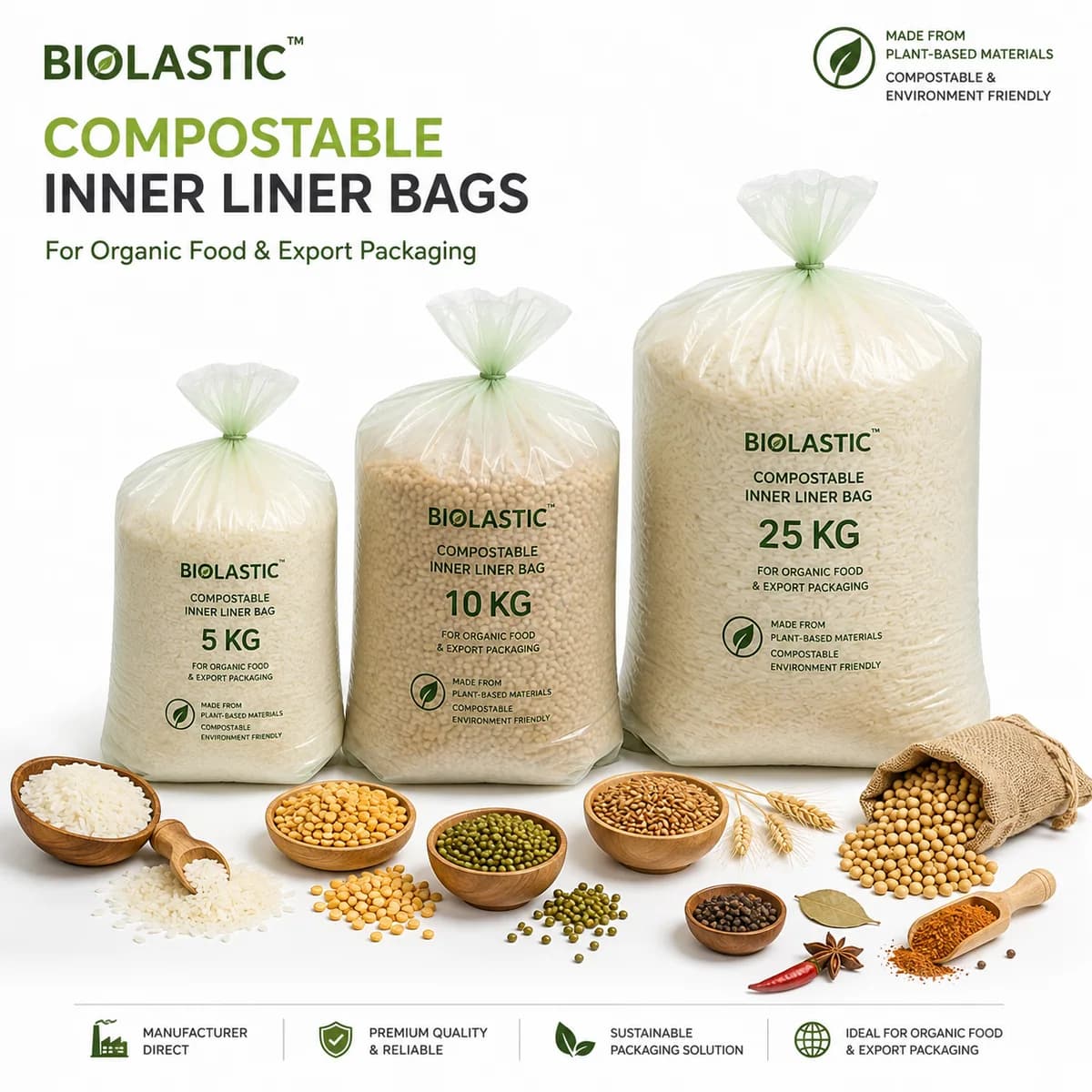
Compostable Rice, Grain & Seed Liners: Puncture, Moisture, Germination and Bulk Buying
A rice mill may discover that a liner which seals beautifully on an empty bench develops tiny holes after being filled with sharp grains. A seed processor may find a bag that protects a product during a short journey but does not suit its longer storage or germination requirements. These are not interchangeable applications, even when both are sold in 10 kg sacks.
This guide is for rice mills, premium grain brands, agricultural packers, seed processors and packaging procurement teams comparing compostable rice, grain and seed liner bags for 5 kg, 10 kg and 25 kg packs. It explains how to write a meaningful specification, test the complete packed system and request a wholesale quotation without confusing compostability with shelf-life performance.
Start with the actual Biolastic product
The live Biolastic rice, premium grain and seed liner listing identifies 5 kg, 10 kg and 25 kg application categories and describes a corn-starch-derived compostable flexible-film formulation with no conventional PE/PP intentionally added. It invites custom dimensions, thickness and sealing formats subject to review. These descriptions are not guaranteed dimensions, barrier values, puncture ratings or proof that a particular seed retains germination. The listing asks buyers to request product-specific IS/ISO 17088:2021 and applicable CPCB documentation. Ask to inspect the actual documents and their scope rather than treating their availability on request as a verified certification for every order.
The catalogue is quotation-led. Its MOQ field is 100 but does not clearly establish the commercial unit, so clarify that unit in writing. A zero placeholder price is not a selling price; stock, export service, delivery time and current quotations require confirmation.
Rice, coarse grains and seeds need different tests
Polished rice: Check how filled sacks settle, how edges rub against the liner and whether handling or vibration produces pinholes. Premium aromatic rice also warrants a product-specific review of odour and storage conditions.
Coarse grains and cereals: Kernel geometry, broken particles and foreign matter can change puncture risk. Test representative lots, not only the smoothest sample.
Agricultural seeds: Packaging must be evaluated against seed moisture, respiration, storage temperature, intended storage period and germination or viability targets. A liner appropriate for a food grain is not automatically appropriate for planting seed. Work with the seed quality team on a validated storage protocol and applicable labelling rules.
A compostable material designation cannot substitute for these trials. It describes a particular end-of-life assessment, not a universal preservation capability.
Choose 5 kg, 10 kg or 25 kg by geometry, not just mass
The packed weight alone cannot determine layflat width, length or gusset. Measure the product's bulk density, fill height, outer sack and closure allowance. For a first estimate:
Required product volume (litres) = filled mass (kg) ÷ measured bulk density (kg/L).
For illustration only, at an assumed bulk density of 0.75 kg/L, a 10 kg grain fill occupies about 13.3 litres before headspace and packaging geometry. That figure is hypothetical; it is not a Biolastic product specification or a universal density for rice.
Make a filled reference pack using the intended outer sack or carton. Record its width, depth, settled height, corner shape and how much liner extends above the product for closing. Ask for a drawing showing layflat width, length, gussets, seam type and tolerance. Approve each nominal capacity separately: scaling the length of a 5 kg liner by five is not a sound way to design a 25 kg liner.
For Siliguri, the Dooars and North Bengal, include realistic handling through local warehouses and distribution routes. For international buyers, specify the destination climate and transport chain, but do not assume overseas supply is available without written confirmation.
Puncture testing: the hidden cost of a cheaper liner
The lowest price per kilogram of film may produce the highest repacking cost. Sharp grains, sack stitching, carton edges, pallet nails and abrasive handling can all create damage. Test the filled pack, not just a loose sample of film.
A practical qualification trial should compare the same grain lot, outer packaging, fill weight and handling sequence. Inspect liners after filling, sealing, stacking and simulated dispatch. Record holes, tears, seal opening and leakage. Include worst-case kernel shape and plausible rough handling. Where standardized test results are requested, specify the exact method, specimen preparation and acceptance threshold; a generic statement such as “high puncture resistance” is not a measurable purchasing criterion.
Thickness alone is not a reliable shortcut. Two films of equal nominal micron can behave differently because formulation, processing and seal design differ. Do not assume a thicker film always solves punctures: inspect outer sack edges, loading methods and overfilling first.
Moisture control: request evidence under stated conditions
Rice, grain and seed storage outcomes depend on starting moisture, relative humidity, temperature, time and packaging construction. Ask for water-vapour transmission rate (WVTR) data for the proposed film, including units, test temperature, relative humidity and method. A single WVTR number without conditions is not enough to predict shelf life.
Measure moisture changes in the packed product during the intended storage period. Look for caking, mould risk, changes in appearance or odour and other product-specific quality indicators. The food or seed business remains responsible for defining safe storage limits and validating its shelf life.
A compostable liner should not be described as waterproof, moisture-proof, oxygen-barrier or suitable for long-term seed storage unless the particular construction and intended use have supporting test evidence. If an outer sack or carton is essential to performance, evaluate the complete packaging system rather than attributing all protection to the liner.
Seal integrity and filling-line compatibility
The strongest-looking film still fails when grain particles become trapped in a heat seal or the sealing jaws are misaligned. Trial the actual filling process and document temperature, pressure, dwell time, cooling and seal position. For tied or folded closures, define what level of containment is needed; do not describe a tie as hermetic without validation.
Inspect the sealing zone immediately after filling. Test seal continuity after a representative handling cycle. If a line is automated, check feeding, static, tracking, friction, throughput and whether the proposed format is a premade liner or a roll-fed web. A machine-compatible sample on one line does not establish compatibility with every packing machine.
Food contact, compostability and seed use are separate decisions
In India, consult the FSSAI Food Safety and Standards (Packaging) Regulations and applicable amendments when the liner contacts food grains. Request documentation relevant to the actual food-contact layer, intended food and conditions of use. Packaging suitability for agricultural planting seeds may involve different product-specific obligations; food-contact documentation alone does not validate seed viability.
ISO 17088:2021 specifies requirements for plastics suitable for organic recycling through aerobic composting. It does not establish suitability for littering, home composting, food contact, puncture strength or moisture protection. A resin's compostability evidence should not be casually transferred to every finished, printed or converted package. Check certificate issuer, test scope, identification, validity and whether the finished article is covered.
For Indian compostable plastic claims, check applicable Central Pollution Control Board processes and the current Plastic Waste Management framework with a qualified compliance adviser. For export destinations, investigate local packaging and food-contact requirements separately; no single certificate guarantees approval everywhere. Compostability also does not mean a package will be accepted by every local composting facility.
Calculate cost per accepted pack
Compare quotations on a common basis: the same pack size, filled product, outer sack, closure and performance requirement. Include material spend, transport, filling labour, damage, rejects and repacking.
Cost per accepted pack = total relevant packaging and failure costs ÷ number of accepted packs.
Imagine 2,000 packs are attempted, 40 fail quality checks and total relevant spend is ₹24,000. The illustrative cost is ₹24,000 ÷ 1,960 = ₹12.24 per accepted pack. These are fictional figures to demonstrate the method—not Biolastic pricing, defect rates or test results.
If comparing film by mass, weigh a representative set of finished liners rather than relying only on thickness. Gussets, seals, trim, film density and tolerances affect pieces per kilogram. Ask for the exact unit behind the supplier's MOQ and quote.
An approval workflow for procurement teams
1. Describe the product. State whether it is polished rice, specialty grain, coarse cereal or planting seed; include grain shape, starting moisture and any quality or germination requirement.
2. Describe the pack. Supply 5 kg, 10 kg or 25 kg target fill, actual outer sack dimensions, liner drawing, fill method, closure, pallet pattern and handling route.
3. Request evidence. Ask for the proposed construction, dimensional tolerance, food-contact documentation where relevant, compostability documents tied to the finished product and any available barrier or mechanical test data.
4. Run a production trial. Fill on the real equipment with representative material. Record jams, seal contamination, tears, pinholes, reject rate and line speed.
5. Validate storage. Use the intended climate, warehouse, transport and storage duration. For seed applications, include viability and germination tests under the seed team's protocol.
6. Approve in writing. Freeze the tested specification, tolerances, acceptance criteria, packaging format and documentation requirements before ordering production quantities.
What to send in a wholesale RFQ
A useful enquiry reads like a short engineering brief: “10 kg premium rice; existing outer sack drawing attached; measured grain bulk density; heat-sealed inner liner; monthly requirement; warehouse and transit conditions; destination; requested food-contact and compostability documents; sample trial needed.” Add photos of the filled sack and the sealing station.
Ask the supplier to quote the proposed width, length, gusset, micron, material description, tolerance, packing unit, MOQ unit, sample availability, lead time, price basis and delivery terms. For seed applications, include intended seed type, storage period and germination requirements. For international shipments, request written confirmation of export feasibility and destination-specific documentation.
Send your rice, grain or seed liner specification to Biolastic for a technical wholesale enquiry. Buyers in Siliguri, North Bengal, elsewhere in India and overseas can use the same checklist; commercial availability and delivery must be confirmed for each request.
Frequently asked questions
Are 5 kg, 10 kg and 25 kg liners fixed standard dimensions?
No. They are nominal application categories. Width, length, gusset, micron and closure should be approved against the actual product and outer sack.
Can the same liner be used for rice and planting seeds?
Not without separate validation. Seed moisture and germination requirements can make a food-grain liner unsuitable.
Does compostable mean the liner is moisture-proof?
No. Request film-specific WVTR data with test conditions and validate the complete pack over the required storage period.
Is thicker film always more puncture-resistant?
Not necessarily. Formulation, kernel geometry, seams and outer packaging all matter. Test the actual filled pack.
Does ISO 17088 prove food-contact safety?
No. Compostability and food-contact compliance are separate assessments.
Can the liner be heat-sealed?
The product listing invites sealing-format enquiries. Actual settings and performance require machine trials and supplier confirmation.
Is Biolastic's listed MOQ of 100 equal to 100 bags?
The catalogue does not clearly specify the unit. Confirm whether the MOQ means pieces, kilograms, rolls or another unit before ordering.
Can international buyers order these liners?
They may enquire, but export availability, destination compliance, freight and delivery terms must be confirmed in writing.
Sources and scope
Product: Biolastic Compostable Rice, Premium Grain & Seed Liner Bags. Standards and regulators: ISO 17088:2021, FSSAI packaging regulations and amendments, CPCB. Illustrative calculations are not specifications or commercial offers. No unsupported certification, test result, stock, price or export promise is made.