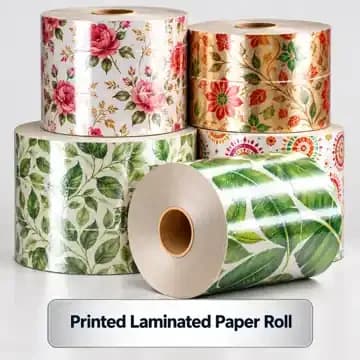
Custom Printed Paper Plate Raw Material Rolls: A B2B Specification Guide
A printed paper plate can look perfect in a product photograph and still fail on the factory floor. The artwork sits off-centre after die cutting. The paper cracks at the rim. A roll that looked economical on a per-kilogram quotation produces too many rejects. Or the buyer discovers, after printing, that nobody has documented whether the food-contact surface is suitable for the intended meal.
For manufacturers, private-label packaging buyers, caterers and distributors, the right way to source custom printed paper plate raw material rolls is to approve a complete converting specification—not just a design and a price.
Quick answer: Before placing a bulk order, agree on the paper grammage (GSM), roll width, core and reel dimensions, print repeat and registration tolerance, approved artwork, laminate construction, food-contact surface, forming-die compatibility, sample acceptance criteria and delivery terms. Run the material on the actual plate or dona machine before approving production quantities.
This guide is useful to buyers internationally and to converting units in Siliguri, North Bengal, Darjeeling, Jalpaiguri, the Dooars and elsewhere in India. It explains how to prepare an enquiry that a supplier can quote accurately—and how to avoid the costly mistakes that are easy to miss on a sample sheet.
What Biolastic currently lists
Biolastic's live catalogue includes a Custom Printed Paper Plate Raw Material Roll intended for buyers who want a specific pattern or brand artwork. The product listing describes custom printed laminated paper with selectable 100, 120, 140, 150, 160 and 180 GSM options. It is an enquiry-based product, not a fixed-price online offer.
The catalogue explicitly makes custom work dependent on artwork approval, print feasibility, roll width, order quantity and production schedule. Colour matching depends on the printing process and an approved sample. No publicly verified minimum production run, final laminate structure, food-contact certification, stock level, export arrangement or delivery time is supplied for every possible custom order. These must be confirmed in writing.
For ready-made decorative alternatives, see the Printed Laminated Paper Roll. A stock-pattern enquiry and a new custom-print project are not the same procurement exercise: artwork setup, repeat length and minimum economical run can differ.
1. Start with the finished plate, not the roll
A useful quotation begins with the plate or dona you want to sell.
Tell the converter or material supplier the finished plate diameter, intended rim shape, approximate depth, whether the product is a shallow snack plate or deeper dona, and whether the forming process uses a heated or unheated die. Mention the number of layers pressed at once if your machine stacks blanks.
A material that forms acceptably into a small dona may not form cleanly into a large thali. Die profile, moisture, paper fibre direction, laminate, pressure and dwell all affect the result. There is no single GSM that guarantees successful forming across every machine.
Give the supplier these production details
| Field | What to specify | Why it matters |
|---|---|---|
| Finished article | Plate/dona diameter, depth and rim profile | Defines blank geometry and forming demands |
| Blank diameter | Actual cutter dimension, not marketing plate size | Determines print placement and cutting layout |
| Machine | Make/model or die drawing, feed direction and process | Helps assess machine compatibility |
| Press conditions | Typical temperature, pressure/dwell and layers per stroke | Identifies what must be trialled |
| Target use | Dry snacks, oily food, wet food or short-duration serving | Guides food-contact and grease-resistance evaluation |
| Visual target | Approved print file and reference sample | Prevents design interpretation disputes |
| Quantity | Trial quantity and anticipated repeat order | Supports a realistic commercial quotation |
Practical example: A buyer selling a “12-inch plate” should not assume that the cutter is exactly 12 inches. The formed article and the flat blank may have different dimensions. Send the actual blank drawing or a measured approved sample.
2. GSM: understand what the number does—and does not—tell you
GSM means grams per square metre, a measure of sheet grammage. The international reference ISO 536:2019 specifies a method for determining paper and board grammage; ISO confirmed that edition as current in 2025.
GSM is useful for comparing paper mass per unit area, but it is not a standalone measurement of plate stiffness, coating thickness, food safety, grease resistance or forming performance.
For a new project, consider the six GSM options currently shown in Biolastic's custom-print listing—100, 120, 140, 150, 160 and 180 GSM—as candidates to be sampled, not as automatic grades for specific plate diameters. A higher grammage may increase mass and influence rigidity, but the paper furnish, moisture, lamination and die design still matter.
Paper GSM versus finished laminate weight
When a supplier quotes “120 GSM laminated paper”, ask whether 120 GSM refers to the base paper alone or to the complete printed-and-laminated structure. They are not necessarily equal.
For a simple mass estimate:
Area (m²) × grammage (g/m²) = paper mass (g).
A circular blank of 300 mm diameter has an area of approximately 0.07069 m². At a hypothetical 120 g/m² paper-only grammage, its paper mass is about 8.48 g before adding any laminate, ink or adhesive and before accounting for process waste. This is a geometry calculation, not a published Biolastic plate weight or a promise of actual output.
If the supplier specifies paper GSM but invoices by the kilogram of finished laminated roll, ask for the complete structure's measured mass per square metre. Otherwise, cost-per-blank calculations will be misleading.
3. Roll width and die layout: why cheap rolls can waste money
A roll's usable width determines how many blanks can fit across it. But a layout that fits on paper is not necessarily the layout that your machine can cut at production speed.
Start with four dimensions: actual usable roll width, blank diameter, required edge clearance and minimum gap between cutting paths. Add machine feed tolerance and the placement of any print registration mark.
For two circular blanks across a web, a basic feasibility check is:
Required width ≥ 2 × blank diameter + outer edge allowances + any inter-blank gap.
Suppose the cutter uses 290 mm blanks, the web is 610 mm wide and the process requires a combined 20 mm of edge and between-blank allowances. Two blanks need 600 mm, so the width may be feasible geometrically. It still needs validation for registration, slitting, tooling and machine tracking. This is an illustrative layout, not a recommended Biolastic roll dimension.
Important: Width utilisation is not the same as total material yield. Circular cutting creates waste between rows and along the web, even when the width appears nearly full. A staggered layout may improve nesting in some systems, but not every feed and die arrangement supports it.
Compare cost per accepted blank, not just price per kilogram
For an internal trial, record:
1. Kilograms of finished roll consumed.
2. Number of acceptable blanks or formed plates.
3. Rejected pieces from print misregistration, edge damage and forming faults.
4. Startup and changeover waste.
5. Labour, machine time and any additional converting cost.
Then calculate:
Material cost per accepted plate = (roll kilograms consumed × actual landed price per kilogram) ÷ accepted plates.
This is a material-only metric. To compare suppliers fairly, use the same finished-plate specification and add the relevant labour, energy, packaging and reject costs to calculate total conversion cost.
A roll that is slightly dearer per kilogram can be cheaper per acceptable plate if it registers consistently and produces fewer rejects. Conversely, paying more does not guarantee better yield—measure it.
4. Artwork: prepare a print-ready production file
A photograph sent over messaging is rarely enough for custom-print approval. Provide a vector file where possible, identify fonts and colours, and tell the supplier how the design should appear on the finished formed plate, not merely on a flat strip.
Your artwork brief should cover:
- Trim and safe area: Keep important text, logos and critical graphics away from the cutting edge and formed rim.
- Print repeat: Confirm how frequently the design repeats in the machine-feed direction.
- Registration: Specify the permitted offset between the printed motif and the cut blank; agree how it will be measured.
- Orientation: Mark machine direction, front/back and any rotation constraints.
- Colour target: Approve a physical production sample under agreed lighting; a screen preview is not a colour guarantee.
- Variable branding: Confirm whether each design needs its own setup, minimum run and price.
- Proof sign-off: Record the final artwork version and who has authority to approve it.
A centrally printed motif may require registration-controlled feeding. If the machine has no print-mark sensor or other registration mechanism, continuous feed drift can move the design relative to the cutter. Ask whether the proposed layout can tolerate this or whether the converting line needs a different arrangement.
What is a registration mark?
A registration mark is a detectable printed reference used by compatible equipment to synchronise the web position with cutting or forming. The presence of a mark alone does not make a machine register accurately. Sensor contrast, mark size, feed slip, web stretch, controller response and cutter timing all affect the result.
Before approving an artwork repeat, confirm the actual sensor and controller requirements with the machine operator. Avoid promising a specific registration tolerance without a measured production trial.
5. Lamination: request the full construction
“Laminated paper” is not a complete technical specification. It does not tell a buyer whether the coating is a particular plastic film, another barrier layer or a different surface treatment.
For each proposed structure, ask the supplier to identify:
| Layer or property | Buyer question |
|---|---|
| Base paper | What paper grade and measured GSM are used? |
| Print | Which surface is printed and which inks are used? |
| Adhesive or bonding | What bonding system is used, and is it suitable for the intended food-contact construction? |
| Laminate or coating | What material, nominal thickness and orientation are proposed? |
| Food-contact side | Which finished surface will touch the food? |
| Thermal behaviour | Has the structure been assessed under the actual forming and serving conditions? |
| Evidence | What traceable declarations or test reports apply to this exact construction? |
The food-contact face matters especially for decorative printed plates. Do not assume that a printed surface may directly touch food simply because the finished plate looks glossy. The construction, migration risk and applicable rules must be evaluated.
A surface that resists water briefly may still perform poorly with hot oil, acidic food or prolonged holding. Ask for relevant testing under your intended conditions rather than treating “waterproof”, “oilproof” or “food grade” as universal performance guarantees.
Is a laminated paper plate recyclable or compostable?
Not automatically. A paper substrate does not make the entire printed, glued and laminated structure recyclable in every local collection system. Nor does it establish compostability or biodegradability.
Those claims depend on the complete finished material, the relevant test method and certification scope, and the disposal infrastructure in the destination market. Biolastic's custom-printed roll listing does not publish a compostability or recyclability certification for every proposed custom laminate. Do not print an environmental logo or claim on packaging without evidence for the exact structure.
6. Food-contact compliance: India, EU and international buyers
A paper plate is intended to touch food. That makes material selection, ink placement, laminate chemistry and manufacturing controls a safety question—not only a design question.
India: FSSAI rules and the printed surface
India's Food Safety and Standards (Packaging) Regulations, 2018 require suitable food-grade materials for their intended use. The rules address paper used for plates and other direct-contact articles, require printing inks for food packages to conform to IS 15495, and state that printed packaging surfaces must not directly contact food. They also set expectations for conformity documentation for relevant direct-contact materials.
Check the FSSAI packaging amendment register for updates. As of 28 October 2026, it lists amendments dated 27 January 2022, 30 August 2022 and 28 March 2025; FSSAI's notifications also list a 10 August 2026 final amendment concerning pan masala packaging, which should not be misrepresented as a general paper-plate approval. Some other 2025–2026 packaging proposals were published as drafts, not automatically binding final rules.
For an Indian plate order: request documents that identify the exact paper, printing and laminate construction, intended food-contact surface, applicable test scope and sample identity. Have the responsible food business and compliance adviser verify current requirements for the finished article and intended use.
European Union: safety, traceability and printing controls
The European Commission's food-contact legislation guidance describes the general requirements of Regulation (EC) No 1935/2004 and good manufacturing practice under Regulation (EC) No 2023/2006. The GMP regime addresses controls for printing on the non-food-contact side, including the risk of substances transferring through a material or by set-off when printed webs are stacked or wound into reels.
For an EU-bound project, a generic statement that paper is “food safe” is not enough. The buyer and importer should review the full construction, applicable national and EU requirements, supporting evidence and intended contact conditions.
United States and other destinations
The US FDA's food-contact overview explains that packaging components, including adhesives and colourants, can be food-contact substances and that applicable authorisations depend on the substance and intended use. The rules are not satisfied by assuming all printed or laminated paper is interchangeable.
If your purchase is for export or overseas resale, specify the destination country in the RFQ. A listing on an Indian website does not itself establish export availability, customs documentation, destination-market compliance or international freight arrangements.
7. How to approve a roll before bulk production
A sensible sample trial checks both appearance and performance. Do not sign off only on a flat printed proof.
Stage A — paper and print inspection: Check the approved colour and motif, roll winding, surface marks, edge condition, GSM measurement and any visible laminate defects.
Stage B — machine trial: Run the actual roll through the intended feeder, cutter and forming die. Observe tracking, registration, blank separation, rim forming, sticking, wrinkling and rejected pieces. Record machine settings and whether the test used one or multiple plies.
Stage C — food-service trial: With the exact intended foods and safe test procedures, examine shape retention, grease or moisture behaviour, visible transfer, handling comfort and service duration. Performance testing must match the product's documented safe-use conditions.
Stage D — commercial sign-off: Approve a physical sample and a written specification, then agree acceptable tolerances, packing method, batch identification and how nonconforming material will be handled.
If the sample passes on one machine but the bulk run is planned on another, recheck compatibility. Differences in die geometry, heating, feed control and operator settings can change the result.
A simple acceptance log
| Trial field | Record |
|---|---|
| Roll identification | Supplier, lot, artwork version |
| Measured properties | GSM, usable width, reel dimensions |
| Machine settings | Die, feed mode, temperature/dwell where applicable |
| Production count | Input quantity, accepted pieces, rejects by cause |
| Print result | Centre offset and visible defects |
| Forming result | Wrinkles, cracks, rim defects |
| Intended food test | Food type, contact duration, observed issues |
| Approval | Name, date, accepted sample and agreed tolerance |
This record gives both parties a way to diagnose a later problem instead of arguing about whether the second shipment “looks different”.
8. A supplier RFQ that gets a useful quotation
Copy this checklist into your purchase enquiry:
Product: Custom printed paper plate/dona raw material roll
Finished plate and blank sizes: [mm/inches, with drawing]
Paper GSM: [target and acceptable tolerance]
Complete laminate construction: [request proposed layers and food-contact face]
Roll width, core ID and maximum reel OD/weight: [dimensions]
Artwork: [file version, repeat length, print direction, approved colours]
Registration tolerance: [required tolerance, subject to machine trial]
Machine/process: [die, feed type, temperature, layers per stroke]
Food use and market: [food type, temperature, duration, destination country]
Documents required: [applicable conformity and testing evidence]
Quantity: [trial and repeat order estimates]
Quotation basis: [price per kg or roll, tax, packing, freight, payment and lead time]
Delivery location: [Siliguri / North Bengal / other location]
Approval: [physical sample, inspection method and acceptance criteria]
For an accurate landed-cost comparison, ask whether the price includes artwork setup, cylinders or plates if relevant, packing, freight, tax and any trial charges. Never assume the lowest unit rate includes all of these.
9. Siliguri and North Bengal: a practical procurement approach
A small plate-making unit in Siliguri may buy for a different reason than a large branded caterer. The unit needs reliable machine yield and predictable replenishment; the caterer may place more value on colour consistency and brand presentation. Both need traceable specifications.
Buyers serving Siliguri, Jalpaiguri, Darjeeling, Cooch Behar, the Dooars, Sikkim or neighbouring markets should share their exact delivery point and required date in the enquiry. Freight, minimum production quantity and lead time are quotation-specific. Biolastic's catalogue confirms an enquiry route for custom printed raw material, but does not establish a guaranteed dispatch window or supply coverage for every address.
If you are testing a new pattern, start by approving a small representative production trial where commercially feasible. For repeat procurement, retain the approved artwork version and roll specification so a later batch can be compared against the same baseline.
10. The seven mistakes buyers can avoid
Mistake 1: Ordering by GSM alone. GSM does not describe the laminate, stiffness or forming behaviour.
Mistake 2: Confusing plate size with blank size. The cutter needs the actual blank dimension and edge allowances.
Mistake 3: Ignoring print repeat. A beautiful design may land off-centre after die cutting.
Mistake 4: Treating the glossy side as automatically food-safe. Ask which surface contacts food and what evidence supports that use.
Mistake 5: Comparing only the roll's price per kilogram. Track accepted plates, not just raw-material spend.
Mistake 6: Assuming paper means compostable. Claims must be supported for the complete printed and laminated article.
Mistake 7: Approving a PDF but not a machine sample. The converting trial is where alignment, cracking and sticking problems become visible.
Frequently asked questions
What GSM is best for custom printed paper plates?
There is no universal best GSM. Biolastic's current custom-print listing offers 100–180 GSM options, but the correct choice depends on blank diameter, paper grade, laminate, forming die and intended use. Test candidate constructions on the actual machine.
Can I print my own brand logo on paper plate raw material rolls?
Biolastic lists a custom-print enquiry product for buyer artwork. Production remains subject to artwork review, printing feasibility, minimum economic order quantity and schedule. Submit a print-ready file and request a physical proof before approving a run.
Does a printed laminated paper roll automatically meet food-contact regulations?
No. Compliance depends on the complete construction, the surface touching food, the intended conditions of use and the destination market. Request relevant declarations and testing evidence for the exact material. Do not let printed ink directly contact food where applicable rules prohibit it.
How do I calculate material cost per plate?
Measure the kilograms of roll consumed in a representative run, multiply by the actual landed rate per kilogram and divide by the number of acceptable plates. Include laminate mass and cutting/forming waste. Add labour and energy separately for total conversion cost.
What details are needed to quote a custom printed roll?
Provide the blank and finished plate sizes, desired GSM, roll width and core, artwork, print repeat, laminate requirement, machine process, intended food contact, quantity and delivery location. Ask for price, setup charges, MOQ, sample procedure and lead time.
Are custom printed paper plates biodegradable or recyclable?
Not merely because they contain paper. The finished structure can include ink, adhesive and a laminate. Environmental claims require evidence for the exact product and relevant disposal or recovery route. Biolastic's custom-print catalogue entry does not provide a blanket certification for every design.
Can overseas buyers request this material?
An overseas buyer can submit a specification enquiry, but export availability, destination compliance, customs documentation, shipping arrangements and lead time must be confirmed individually. No blanket export promise is made by this guide.
Request a specification-led quotation from Biolastic
If you manufacture paper plates or donas, distribute food-service supplies or want a branded plate design, start with the actual blank drawing, artwork and target quantity. Biolastic can review an enquiry against its listed custom printed paper plate raw material roll offering and clarify what is feasible for the proposed order.
Send your custom-roll enquiry to Biolastic. Include the delivery location, machine details and food-contact requirements so the quotation can be based on the product you actually need.
---
Sources and technical references (reviewed 28 October 2026): Biolastic custom-print product catalogue; ISO 536:2019; FSSAI Packaging Regulations; FSSAI amendments; European Commission food-contact legislation; US FDA food-contact packaging overview.
Technical guidance is for procurement planning and does not replace testing of the exact finished article or market-specific legal advice.