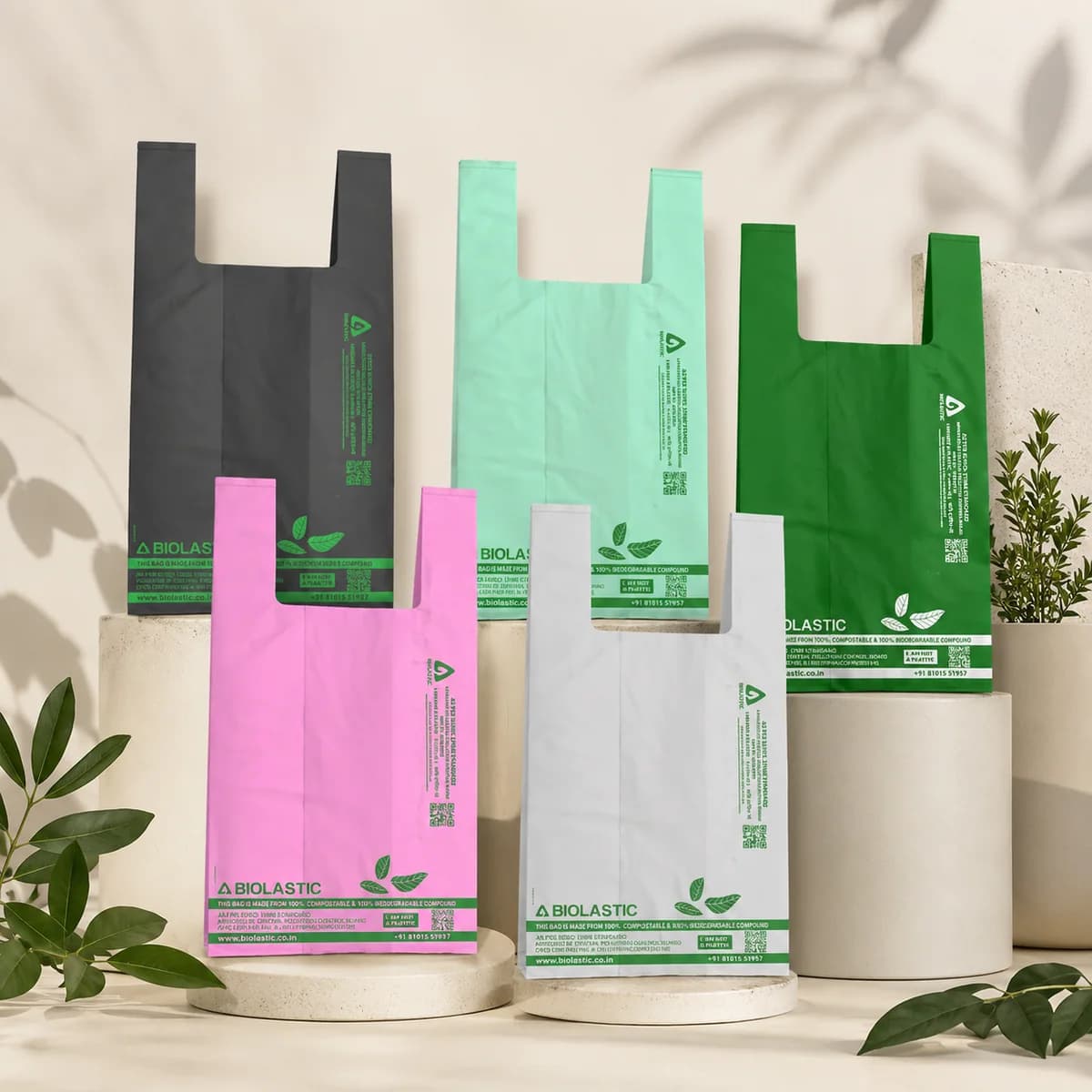
D-Cut vs W-Cut Compostable Carry Bags: Handle Strength, Sizes & Wholesale Cost
A customer walks into a bakery, buys a cake box and a few snacks, and wants a bag that looks tidy on the way home. Across the street, a grocer is packing vegetables, tins and a bottle into a single carry bag. Both shops need a dependable handle—but not necessarily the same bag.
The short answer: A D-cut carry bag has a die-cut hand opening and is often chosen for boutiques, pharmacies, bakeries and presentation-led retail. A W-cut carry bag has a vest-style handle configuration and is often chosen for grocery, produce and everyday checkout use. Neither handle shape guarantees a particular load capacity. Select by real filled-bag testing, handle and seam construction, usable dimensions, film specification, documented compostability and cost per accepted bag.
This guide is for purchasing managers, retail chains, distributors and packaging buyers worldwide. It also answers the practical questions that businesses in Siliguri, Jalpaiguri, Darjeeling, Cooch Behar, North Bengal, Sikkim, Assam and India ask when buying wholesale carry bags.
1. What is the actual difference between D-cut and W-cut bags?
A D-cut bag gets its name from the cut-out handhold in the film near the top. The hand opening and surrounding material carry much of the lifting stress. A W-cut or vest-style bag forms two handles from the upper bag profile; the sides and bottom construction also influence how the load is supported.
| Buyer question | D-cut carry bag | W-cut carry bag |
|---|---|---|
| How is it held? | Through a punched hand opening | By two formed handles |
| Typical shopping context | Boutique, pharmacy, bakery, gift or branded retail | Grocery, produce, takeaway counter and general checkout |
| Important failure point | Tear initiation around the cut-out and top reinforcement | Stretching or tearing at handle roots, side seams and bottom |
| Product presentation | Often suits flat, boxed merchandise | Often suits mixed-shape purchases |
| How to approve it | Filled-bag lift and carry trial with the actual products | The same filled-bag trial, including uneven and sharp-edged loads |
These are use-case tendencies, not performance rankings. A properly engineered D-cut bag can outperform a poorly engineered W-cut bag, and vice versa. Material, thickness, geometry, manufacturing quality and the way customers carry their purchases matter more than the name alone.
2. Compare Biolastic's actual 12 × 18 inch catalogue options
Biolastic lists both 12 × 18 inch compostable D-cut bags and 12 × 18 inch compostable W-cut bags. Their current catalogue descriptions provide indicative values:
| Listed specification | 12 × 18 inch D-cut | 12 × 18 inch W-cut |
|---|---|---|
| Nominal bag size | 12 × 18 inches | 12 × 18 inches |
| Film category | Bio-based compostable film | Bio-based compostable film |
| Thickness | Custom micron options | Custom micron options |
| Catalogue carrying-capacity estimate | Up to 2 kg | Up to 5 kg |
| Catalogue approximate piece yield | 50–60 bags/kg | 45–55 bags/kg |
| Typical enquiry | Retail presentation and lighter mixed items | Grocery and mixed checkout loads |
Do not interpret “up to 2 kg” or “up to 5 kg” as a tested safe working load for every production batch. These are supplier catalogue estimates, not a substitute for a batch-specific test method, acceptance limit or application approval. Actual performance changes with film thickness, bag construction, load shape, temperature, handling and manufacturing variation. Ask for the specification and trial samples that correspond to your purchase.
Also note that 12 × 18 inches is a nominal size, not a promise of identical usable internal volume. The hand opening, handle shape, side folds and sealing allowances affect the space available for goods.
3. Start with what your customer puts inside
Before comparing quotes, observe a normal hour at your checkout. What are people really carrying?
A bakery may need room for a rigid cake box. A pharmacy may need a compact bag for medicine cartons. A vegetable shop may have wet produce and awkward shapes. A restaurant may send out stacked, already sealed takeaway containers. A gift shop may care about the visual appearance of the handle and print.
Use this simple product-to-bag selector:
| Main load | First format worth trialling | Trial focus |
|---|---|---|
| Light boxed retail goods | D-cut | Handle comfort, top-edge tearing, box corners |
| Mixed groceries | W-cut | Handle stretch, bottom seam, uneven distribution |
| Flat folded apparel | D-cut | Usable width, presentation, print position |
| Loose produce | W-cut | Moisture, bag opening, load concentration |
| Stacked takeaway containers | Either | Base stability, hot-product isolation, leakage from inner packs |
| Heavy or sharp hardware | Neither without a specific qualification | Puncture resistance, reinforcement and real load testing |
The table is a starting hypothesis, not an endorsement of a particular bag for a load. A packaging buyer should reject a design that fails the real use case, even if its catalogue description sounds suitable.
4. Handle strength is not the same as film thickness
A common purchasing mistake is to ask only: “How many microns?” Micron is a unit of thickness; 1 micron = 0.001 millimetre. Thickness matters, but it does not independently tell you whether a bag will survive a trip from checkout to vehicle.
For a D-cut bag, stress can concentrate near the punched opening. The radius and finish of the cut, the remaining film above the opening, any reinforcement and the direction of pulling can change failure behaviour.
For a W-cut bag, look at the handle roots, side seals, gussets and bottom seam. A broad bag can still fail if a heavy item concentrates force against one corner.
A useful test plan separates three questions:
1. Does the film resist puncture and tearing?
2. Do the handles and seams hold under the specified load?
3. Does the complete filled bag survive actual customer handling?
Laboratory film methods can support a technical specification. For example, ASTM D882 concerns tensile properties of thin plastic sheeting, and ASTM D1709 addresses free-falling-dart impact resistance. Neither result, on its own, certifies the safe carrying capacity of a finished shopping bag. The finished handle and seams need their own relevant testing.
5. A practical checkout test you can run before a bulk order
Set up a repeatable trial using the products your customers actually buy. Do not use a single bag and call it approved.
Step 1 — Define the intended load. List the normal basket, the heaviest permitted basket and the awkward items. Record actual mass and dimensions.
Step 2 — Request representative samples. They should match the intended production film, handle geometry, seal design, thickness and print construction. Prototype samples made from another film grade may mislead.
Step 3 — Inspect each bag. Look for irregular cut-outs, weak seals, uneven thickness, contamination and damage around the handles.
Step 4 — Fill consistently. Use the same item arrangement for each test. Then repeat with a deliberately uneven but realistic load.
Step 5 — Simulate handling. Lift, carry, set down and lift again. Include the normal route from counter to vehicle and a modest margin appropriate to your risk assessment. Document the distance, duration and number of cycles rather than claiming a universal test.
Step 6 — Check after the carry. Record handle elongation, visible tears, bottom-seam opening, pinholes and deformation. Count failures by sample and batch.
Step 7 — Decide on acceptance criteria. Specify the maximum permitted load, test conditions, sample size and failure threshold in writing. Agree these with the supplier before a production order.
If the bags are used in a cold store, humid market or hot delivery vehicle, qualify them under representative conditions. Do not claim a generic shelf life or temperature range without data for the exact film.
6. Bag size: outside dimensions versus usable packing space
A 12 × 18 inch D-cut and a 12 × 18 inch W-cut are not necessarily interchangeable. The nominal dimensions may be measured differently by different suppliers, and the usable height below the handles can vary.
Ask for a dimensioned drawing showing flat width, overall height, usable fill height, side gusset, bottom seal allowance, handle opening and tolerance. For a D-cut bag, also request the position and width of the die-cut opening. For a W-cut bag, ask how the vest handles and gussets are formed.
Do a physical fit test with your largest typical carton or produce bundle. If the contents fit only when the bag is stretched to its limit, move to a different size or design. A bigger bag is not always better: it can waste material, allow the load to move and raise cost per checkout.
Biolastic also lists a 10 × 15 inch D-cut bag and an 8 × 10 inch W-cut bag. The latter is a compact option described for lightweight checkout use. Treat all listed carrying capacities and piece counts as indicative until confirmed for the exact order.
7. Why bags per kilogram changes the real buying price
Wholesale buyers often receive a price per kilogram, while store managers need a cost per checkout bag. The bridge between those two numbers is actual pieces per kilogram.
Estimated cost per bag = quoted price per kg ÷ accepted bags per kg.
Here is a deliberately hypothetical comparison at the same assumed price of ₹150/kg. This is a teaching example, not a verified current quote, tax-inclusive rate or delivery offer:
| Hypothetical order | Accepted pieces/kg | Material cost per accepted bag |
|---|---:|---:|
| D-cut scenario A | 60 | ₹2.50 |
| D-cut scenario B | 50 | ₹3.00 |
| W-cut scenario A | 55 | About ₹2.73 |
| W-cut scenario B | 45 | About ₹3.33 |
The counts chosen above sit within the approximate ranges displayed in the two 12 × 18 inch catalogue listings. They are not measured acceptance yields. If your real order has rejects, damaged pieces or printing setup waste, the accepted count may be lower.
A more complete formula is:
Landed cost per usable bag = (film/bag purchase + printing + packing + freight + taxes not recoverable + inspection + attributable rejects) ÷ usable bags received.
A bag that costs a few paise less but fails frequently at checkout can be the expensive option. Track breakage complaints, repacking time and damaged merchandise alongside unit cost.
8. How many kilograms should a store order?
Suppose a shop expects 300 customer bags per day over 26 trading days. That is 7,800 bags per month before contingency.
At a planning assumption of 50 usable bags/kg, the material requirement is 7,800 ÷ 50 = 156 kg. At 60 usable bags/kg, it becomes 130 kg. The difference is significant even though both are nominally “12 × 18 inch bags.”
Now add an illustrative 5% operational allowance for variation or damage: 7,800 × 1.05 = 8,190 planned bags. At 50 usable bags/kg, that is about 164 kg after rounding up. This 5% is a budgeting assumption, not Biolastic's measured reject rate.
For a retail chain, calculate each store separately and consolidate by bag size. A bakery, a pharmacy and a produce counter may not share the same demand pattern. Confirm the supplier's current minimum order quantity, pack configuration and lead time before promising stock to branches.
9. Custom printing: keep the brand visible without weakening the bag
A printed carry bag is a small travelling advertisement. But a good logo cannot compensate for a bag that tears.
Ask the supplier for the printable area, handle clearance, artwork orientation, number of colours, registration tolerance and ink compatibility with the chosen film. Printing near a handle cut-out or on a fold may distort the design. A dark background can also affect legibility of legally required markings.
Request a physical pre-production sample for sign-off. Check the print after folding, filling and repeated handling. Specify which side should face outward and whether the logo must remain visible when the bag is carried.
Biolastic's D-cut and W-cut listings describe custom colours, dimensions and brand printing subject to technical feasibility, artwork approval, minimum quantity and production capacity. That is an invitation to request a quote, not a guarantee that every print job is available at every quantity.
10. Compostability claims: verify the finished bag, not just the resin
A bag can be bio-based without being compostable. A film can be tested without the finished printed bag necessarily falling within the same certified scope. And a compostable claim does not mean the bag safely degrades in a river, roadside drain or home compost bin.
ISO 17088:2021 sets requirements for plastics suitable for industrial organic recycling, including disintegration, aerobic biodegradation, effects on compost and constituents. ISO explicitly says the standard does not establish litter biodegradability or home-compost performance.
Biolastic's product pages display CPCB and ISO 17088 certification language. Buyers should request the current certificate number, issuing authority, validity, scope, covered product grades and relevant test documentation for the specific finished bag being purchased. This guide does not independently validate every product-level claim.
Ask whether printing, colourants, handles and other additions are covered by the applicable documentation. Never put a compostability logo or disposal claim on your own branded bag merely because a supplier's marketing page mentions a standard.
11. India: thickness rules, certification and labelling are different questions
India's Plastic Waste Management framework distinguishes conventional plastic carry bags from appropriately certified compostable products. The consolidated rules available through the UN Environment Programme legal database describe the conventional carry-bag thickness requirement and an exemption for qualifying compostable bags, subject to the applicable standard and requirements. They also address CPCB certification and labelling, including the industrial-composting claim.
Do not assume that any bag advertised as “biodegradable” automatically qualifies for the compostable exception. Confirm the current Indian rules, CPCB documentation, label wording, producer identification and any applicable state or local restrictions with the supplier and compliance adviser before buying.
For direct contact with food, a carry bag needs an additional suitability assessment. India's FSSAI Packaging Regulations address food-grade packaging and intended-use suitability. The FSSAI amendment index should also be checked for changes after the 2025 compendium. A bag used only as an outer carrier around sealed food packs is a different use case from a bag directly touching unpackaged food.
12. International buying: don't transfer one country's claim to another
For international procurement, separate bag performance, material and chemical compliance, compostability claims, marking and local disposal infrastructure.
A buyer in the EU, UK, US or another market should identify the destination's current rules before approving packaging or marketing text. An Indian certificate is not automatically an approval to market the same bag with identical claims everywhere. Ask for relevant evidence for the finished product and market, and verify whether local collection systems actually accept the bag.
Biolastic's catalogue supports product enquiries; it should not be interpreted as proof of export authorization, international shipping availability, importer registration, customs clearance or country-specific approval. Confirm these separately before contracting.
13. A buyer's scorecard: compare offers on the same basis
Score each supplier against your actual needs. Use pass/fail for mandatory safety and legal requirements, then compare commercial terms.
| Checkpoint | What to collect | Decision |
|---|---|---|
| Bag geometry | Drawing and representative sample | Fits the intended goods? |
| Handle performance | Agreed filled-bag test record | Passes the defined load? |
| Film specification | Thickness range, tolerances and construction | Consistent with the approved sample? |
| Finished-bag quality | Seals, cut-outs, damage rate | Meets acceptance limit? |
| Compostability | Applicable certificate and scope | Supports the intended claim? |
| Food contact, if relevant | Application-specific documentation | Suitable for intended contact? |
| Printing | Proof, artwork sign-off, marking layout | Legible and acceptable? |
| Commercial terms | MOQ, pieces/kg, freight, taxes, lead time | Acceptable landed cost? |
If one mandatory item fails, do not hide it behind a high overall score. Request a corrected sample and retest.
14. Copy-and-send wholesale enquiry template
Subject: D-cut / W-cut compostable carry bag enquiry — [business / city]
>
We need [D-cut / W-cut / both] bags for [grocery / bakery / pharmacy / other]. Our typical contents are [items] weighing [kg], including [any sharp, wet or awkward products]. We are considering [nominal width × height], with a required usable opening of [measurement].
>
Please quote [estimated monthly bag quantity] and confirm film construction, micron tolerance, pieces/kg, handle and seam design, sample availability, current MOQ, printing options, packing, applicable compliance documents, lead time and freight terms to [destination].
>
We would like to approve the finished bag using a representative filled-bag handling trial before ordering in bulk.
Buyers in Siliguri and North Bengal can also mention their market or delivery pincode so that a realistic supply quotation can be prepared. Buyers elsewhere should include the destination country and any importer-specific requirements.
15. Which should you buy?
Choose D-cut as your first sample when a neat handhold, boxed goods and retail presentation are central to the purchase. Choose W-cut as your first sample when customers carry mixed groceries, produce and other irregular goods. Choose neither without testing when the load is unusually heavy, sharp, wet, hot or valuable.
The strongest purchasing decision is not “D-cut is better” or “W-cut is stronger.” It is: this particular bag, in this material and size, passes our defined checkout test and has the documentation our market requires.
Browse the Biolastic product catalogue or contact Biolastic for a wholesale quotation. Share your intended contents, bag size, monthly quantity, delivery location and printing requirements to receive a specification-led response.
Frequently asked questions
1. Is a W-cut bag always stronger than a D-cut bag?
No. Handle geometry is only one factor. Film grade, thickness, cut quality, seals and actual load distribution all affect performance. Compare finished bags using the same filled-load test.
2. What does 12 × 18 inch mean for a carry bag?
It is a nominal dimension. Ask how the supplier measures width and height, and request usable internal height, gusset, handle dimensions and tolerances before approving the size.
3. How many 12 × 18 inch compostable bags are there per kilogram?
Biolastic's current catalogue gives approximate ranges of 50–60 bags/kg for its D-cut listing and 45–55 bags/kg for its W-cut listing. Actual counts depend on the final specification and should be verified for the order.
4. Can I carry 5 kg in any W-cut compostable bag?
No. Biolastic's 12 × 18 inch W-cut listing includes an indicative “up to 5 kg” figure, not a universal certified load rating. Approve the exact finished bag using a documented load and handling trial.
5. Does 30-micron compostable film follow the same rule as conventional plastic bags in India?
Not automatically. The regulatory treatment depends on whether the finished bag genuinely qualifies under the applicable compostable-plastics provisions and carries required documentation and marking. Verify current rules and the exact product certification.
6. Can D-cut and W-cut bags be custom printed?
Biolastic's catalogue describes custom printing and colours subject to artwork approval, technical feasibility, MOQ and current production capacity. Request a proof and sample rather than assuming every specification is available.
7. Does ISO 17088 mean a bag is home compostable or safe for direct food contact?
No. ISO 17088:2021 addresses suitability for industrial organic recycling; it does not establish home compostability or food-contact compliance. Those are separate questions.
8. How do I compare wholesale quotes fairly?
Compare landed cost per usable bag, not only price per kilogram. Include actual piece yield, rejects, printing, freight, taxes and the cost of failures at checkout.
---
Sources and further reading: ISO 17088:2021 · India Plastic Waste Management Rules (UNEP legal database) · FSSAI Packaging Regulations · ASTM D1709.