Kraft vs Silver Laminated Paper Plate Raw Material: GSM, Forming, Food Contact & Cost
A paper-plate manufacturer can buy two rolls that look almost identical in width and still get very different results on the press. One forms neatly but absorbs oil. Another looks premium on the serving side but cracks at a deep rim. A third runs well until the reel changes.
The practical answer: choose plain kraft when an unprinted natural-paper base suits the product and you can qualify the required food-contact surface; choose kraft laminated when you need a kraft appearance with a specified coating; and choose silver laminated when a silver-finish serving surface is part of the brief. None is automatically superior for hot food, stiffness, recyclability or machine speed. The correct decision comes from the exact laminate construction, grammage, die compatibility, finished-plate testing and cost per accepted plate.
This guide is written for plate converters, paper-dona manufacturers, contract packers and wholesale packaging buyers worldwide. It also addresses the day-to-day purchasing questions of factories in Siliguri, Jalpaiguri, Darjeeling, Cooch Behar, North Bengal, Assam, Sikkim and the rest of India.
1. Four material names buyers often confuse
The names used in local paper markets are helpful shortcuts, but they are not full technical specifications.
| Material | What the name normally communicates | What still needs to be specified |
|---|---|---|
| Plain kraft paper | Kraft-tone paper substrate without a promised barrier layer | Fibre grade, GSM, surface finish, intended food contact, reel dimensions |
| Kraft laminated paper | Kraft substrate with an added surface layer | Exact coating or film chemistry, adhesive, coated side, total construction |
| Silver laminated paper | Paper with a metallic-looking serving face | Whether it is metallised film, foil or another finish; food-contact layer and adhesion |
| Kraft silver laminated paper | Kraft base combined with a silver-finish layer | Kraft grade, laminate stack, coating weight, forming performance |
Important: a silver colour is not proof that a product contains aluminium foil. Equally, a brown kraft appearance is not proof that the paper is uncoated, recyclable, biodegradable or suitable for direct food contact.
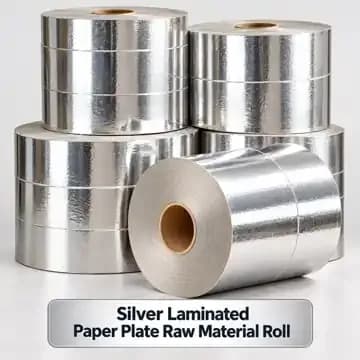
Biolastic's live catalogue includes plain kraft paper plate raw material, kraft laminated paper plate rolls, silver laminated paper plate raw material rolls, and kraft silver laminated paper rolls. These are quotation-based listings, not fixed-price or guaranteed-in-stock offers. The pages describe 100–180 GSM options, with final specification subject to the selected grade and construction.
2. Start with the food and the finished plate—not the roll colour
A plate holding dry biscuits for ten minutes has a different job from a thali carrying hot rice, dal and oily curry. Before buying a reel, write down the actual service conditions.
| Food-service job | Most important qualification | Sensible first sample |
|---|---|---|
| Dry snacks, biscuits or packaged sweets | Appearance, rim stiffness, direct-contact suitability | Plain kraft or laminated kraft, subject to approval |
| Fried snacks and oily foods | Grease resistance, coating integrity, migration suitability | Qualified coated or laminated construction |
| Wet gravies, sauces and mixed meals | Liquid holdout, rim stability, deformation over serving time | Qualified barrier laminate with finished-plate trials |
| Buffet or large thali | Load support, deflection, deep-forming behaviour | Multiple GSM and laminate samples on the actual die |
| Decorative event serving | Surface appearance, print and finish consistency | Silver-finish or kraft-silver samples |
This table is a testing starting point, not a promise that a specific listed material will pass. Ask whether the plate will touch hot food directly, carry food inside another wrapper, or merely support a sealed container. Those uses are not interchangeable.
3. What does 100, 120, 150 or 180 GSM actually tell you?
GSM means grams per square metre. It measures the mass of paper per unit area, not finished-plate strength by itself. ISO 536:2019 specifies a method for determining paper and board grammage.
Higher paper GSM generally means more paper mass for the same cut area. It does not automatically guarantee better wet stiffness, oil resistance or tear-free forming. Fibre furnish, sheet density, orientation, coating, moisture, die radius and press conditions can change the result.
Consider a hypothetical 11.6-inch circular blank (0.29464 m diameter). Its geometric area is about 0.06818 m².
| Paper GSM | Approximate paper-only blank weight |
|---|---:|
| 100 GSM | 6.82 g |
| 120 GSM | 8.18 g |
| 150 GSM | 10.23 g |
| 180 GSM | 12.27 g |
Calculation: blank paper mass in grams = π × (blank diameter in metres ÷ 2)² × paper GSM.
These are mathematical illustrations, not measured Biolastic plate weights. They exclude laminate or coating, ink, adhesive, moisture variation, trimming, tooling clearances and defects. If the material is sold as a combined laminate GSM rather than a paper-only GSM, clarify that before applying the calculation.
For a smaller dona blank, repeat the same calculation with its actual cutting diameter. Do not use the finished bowl's top diameter if the flat blank is larger.
4. Why paper GSM and total laminate GSM must be separated
A buyer might compare a 120 GSM uncoated sheet against a '120 GSM laminated' reel and assume the same amount of paper is present. That can be wrong.
Request the specification in separate lines:
- Paper substrate grammage, measured by an agreed method.
- Coating or film type and coat weight or film thickness.
- Adhesive or bonding system, if applicable.
- Total finished composite grammage, with an agreed tolerance.
- Food-contact face, reel winding orientation and batch traceability.
For example, a 120 GSM paper substrate plus a hypothetical 10 GSM of coating has a nominal combined mass of 130 GSM, if those are the actual measured component weights. That is arithmetic, not a claim about any Biolastic SKU.
If a vendor gives only '120 GSM' without stating whether it means substrate or finished laminate, the quote is not technically comparable.
5. Forming performance: the die decides more than the catalogue photo
The same reel can behave differently in a shallow 6-inch snack plate and a deep 12-inch plate. During pressing, paper must bend, gather and form around the rim. Excess local strain can produce folds, cracks, coating whitening, torn edges or an uneven lip.
Check these variables before committing to bulk production:
1. Blank diameter and die geometry. The nominal finished plate diameter is not the blank diameter. Verify draw depth, rim width, corner radii and cutting clearance.
2. Paper grain direction. Fibre orientation can affect bending and tearing. Ask the supplier how the reel is wound and test both practical orientations where possible.
3. Material moisture and storage. Conditioning matters. A reel stored in a humid warehouse may not form like one sampled immediately after production.
4. Coating flexibility. Some constructions may crack or delaminate during sharp folds; the result depends on the exact material and press.
5. Press temperature, dwell and pressure. Use the machine and die supplier's qualified settings. Avoid treating one recipe as safe for every laminate.
6. Die and blade condition. Burrs, uneven clearance, poor alignment and worn cutting edges can make good paper appear defective.
A trial should produce a batch of finished plates, not one attractive sample. Record the number fed, number accepted, defects by type and reel lot. If the material passes only when the machine is slowed dramatically, include that throughput penalty in the buying decision.
6. A practical roll-acceptance trial for small factories
A useful incoming-material check can be performed before the full reel is released to production.
Stage A — Documentation: record supplier, reel lot, declared GSM, width, finish, lamination construction, winding direction and the approved food-contact application.
Stage B — Dimensional checks: measure roll width at several points, inspect the reel edge and core, and compare the actual material with the signed sample. Confirm how GSM is measured; ISO 536 is the relevant grammage reference, while ISO 534:2011 covers paper thickness and related calculations.
Stage C — Surface checks: look for pinholes, coating streaks, foil- or film-like lifting, contamination, odour, scratches and shade changes. Record whether the food-contact face is correctly oriented.
Stage D — Machine trial: run a representative quantity on the intended die, at the planned production settings. Separate cutting rejects from forming rejects.
Stage E — Service trial: place the intended food on the finished plate for a defined time. Inspect for soak-through, visible staining, rim collapse, coating damage and transfer of unwanted odour or taste. Use controlled laboratory testing where required; a shop-floor food trial alone does not establish regulatory compliance.
Stage F — Commercial decision: approve only when the documented specification, finished-plate quality and total cost meet the buyer's acceptance criteria.
For water absorption of appropriate paper or board samples, ISO 535:2023 specifies the Cobb method. It measures water absorptiveness under defined conditions; it is not, by itself, a grease-resistance, migration or finished-plate food-safety certification.
7. Oil resistance and water resistance are not the same
One of the most expensive assumptions in disposable tableware is that a water-resistant surface must also resist hot oil.
Water, fats and sauces behave differently. A plate might survive a brief water exposure yet stain under oily snacks. A silver-looking layer might appear continuous but fail at a sharp formed fold. A kraft surface may look sturdy while allowing moisture to wick through an unprotected edge.
Ask for the actual intended-use test conditions: food type, contact temperature, contact time, acceptable leakage or staining, and any relevant laboratory method. Test at the formed rim as well as the flat centre. The cut edge is often a separate exposure path.
Do not market any of the catalogue materials as 'oil-proof', 'leak-proof', 'microwave-safe' or 'safe for every hot food' without specific evidence for the finished article.
8. Food-contact compliance for India and international buyers
Food-contact compliance is a property of the intended finished material and use, not a reward for choosing paper over plastic.
For Indian buyers, the FSSAI Packaging Regulations, 2018 compendium sets requirements for food-contact packaging, including paper and board intended for plates and cups. The FSSAI packaging amendments page also lists later amendments, including an August 2026 update. Buyers should review the current consolidated requirements and the amendment scope, not rely on a dated PDF alone.
For EU-facing supply chains, the European Commission's food-contact legislation guidance describes the framework under Regulation (EC) No 1935/2004 and good manufacturing practice under Regulation (EC) No 2023/2006. These frameworks require attention to safety, traceability, manufacturing control and the intended contact conditions. Rules for a specific paper, coating, adhesive or plastic layer may require further market-specific assessment.
For any export enquiry, request documentation for the actual finished construction and the destination market. Do not assume that Indian product listing language, a raw-paper certificate or a silver finish establishes compliance in the EU, UK, US or another country.
A useful buyer request is: 'Please identify the food-contact face, complete material structure, intended food types, permitted contact conditions, applicable test evidence and traceability details for this exact grade.'
9. Recyclable, biodegradable and compostable are three different claims
'Made from paper' is not the same as 'recyclable everywhere'. A laminate can change what local paper mills accept. Adhesives, inks, coatings and metallic-looking layers also matter.
Similarly, a natural brown appearance does not establish biodegradability, and a silver finish does not automatically make a product non-recyclable. The answer depends on construction and collection infrastructure.
Before printing an environmental statement on finished plates, obtain evidence specific to the material, the finished article and the destination market. Avoid vague phrases such as '100% eco-friendly' or 'fully compostable' without applicable verification. Biolastic's four raw-material listings reviewed for this guide do not provide a product-specific environmental certification that would justify such a blanket claim.
10. Cost per accepted plate: a more useful calculation than price per kilogram
Factories often compare raw-material quotes by ₹/kg or another currency per kilogram. The customer, however, buys finished plates. Scrap and reject rates connect those two numbers.
Paper-only theoretical blank mass = area × paper GSM.
Input mass per accepted blank ≈ blank mass ÷ (1 − cutting and process loss fraction).
Raw-material cost per accepted plate ≈ input mass in kg × delivered raw-material price per kg.
Here is a hypothetical example, not a Biolastic quote:
- Blank diameter: 11.6 inches; paper substrate: 120 GSM.
- Paper-only blank mass: about 8.18 g.
- Assumed combined cutting and production loss: 20%.
- Assumed delivered material price: ₹60/kg, for illustration only.
Estimated purchased-material input per accepted plate = 8.18 ÷ 0.80 = 10.23 g.
Illustrative material cost = 0.01023 × ₹60 = about ₹0.61 per accepted plate.
This simplified example treats the purchased material's effective mass as the stated paper-only mass. It is not valid for a laminate until the actual total composite GSM is substituted. It also excludes forming power, labour, tooling, packing, freight to customers, tax effects and overhead.
A supplier offering cheaper rolls may still be the costlier choice if die stoppages, cracks and rejects rise. Record accepted plates per hour and accepted plates per purchased kilogram alongside purchase price.
11. How roll width and nesting affect the real yield
Paper plates are circles cut from a rectangular web. Some material between circles and at reel edges is unavoidable. The amount depends on blank diameter, row arrangement, pitch, machine feeding and whether smaller blanks can be nested in the remaining width.
For a simple straight row, a 24-inch web with two 11.6-inch circles across uses 23.2 inches of nominal width, leaving 0.8 inch before practical clearances. That does not mean only 3.3% of the paper is wasted: curved gaps between circular blanks remain.
A simple geometric illustration with two 11.6-inch circles inside a 24 × 11.6-inch repeating rectangle gives:
- Two-circle area ≈ 2 × π × 5.8² = 211.37 square inches.
- Repeating web area = 24 × 11.6 = 278.4 square inches.
- Idealised area utilisation ≈ 75.9%; geometric unused area ≈ 24.1%.
This is not a production guarantee. Blade clearances, registration, edge margins, feed pitch, alternate nesting, mixed-size dies and stoppages can change the result substantially. A staggered or mixed-diameter layout should be drawn and trialled before any savings claim.
For roll quotations, ask for a nesting drawing, blank size, pitch, expected usable yield and how scrap is measured. Comparing two reel prices without comparing layout can mislead.
12. What to ask when buying raw material for a 12-inch plate press
The correct purchase specification should be short enough for a supplier to quote but complete enough to prevent surprises.
| Field | What the buyer should send |
|---|---|
| Finished product | Plate or dona; nominal diameter and rim depth |
| Tooling | Flat blank diameter, die drawing and machine type |
| Surface | Plain kraft, kraft laminated, silver laminated or kraft-silver |
| Paper | Target substrate GSM and allowable variation |
| Lamination | Full material stack, coating side and intended food contact |
| Reel | Width, core size, outer diameter or reel weight as required |
| Trial | Sample quantity and acceptance criteria |
| Volume | Expected monthly reel requirement |
| Destination | City, state/country and delivery terms to quote |
| Documentation | Applicable food-contact and material test records |
A business in Siliguri or North Bengal can share its die dimensions and required reel width to discuss an appropriate sample. Buyers elsewhere should add their destination and any destination-specific regulatory needs. A catalogue enquiry does not by itself establish worldwide delivery or export availability.
13. A 15-minute supplier comparison scorecard
Give each offer a pass/fail on the non-negotiables first. Then compare commercial value.
| Decision gate | Evidence to request | Result |
|---|---|---|
| Intended food contact | Material structure and application-specific documentation | Pass / clarify / fail |
| Machine fit | Representative reel sample and die trial | Pass / clarify / fail |
| Surface performance | Food and temperature trial, relevant lab evidence | Pass / clarify / fail |
| Repeatability | Reel lot specification and quality tolerances | Pass / clarify / fail |
| Cost | Delivered price plus yield and rejection data | Comparable / not comparable |
| Environmental claim | Evidence for exact article and target market | Supported / not supported |
Do not award extra points for an unsupported certification logo or a generic 'food grade' statement. If a mandatory requirement fails, ask for a revised construction and retest.
14. Copy-and-send wholesale enquiry
Subject: Kraft / silver laminated paper plate raw material enquiry — [company, location]
>
We manufacture [plate/dona type] using [machine type] and [finished size] dies. Our flat blank diameter is [mm/inches] and the target serving application is [dry snacks / hot oily food / mixed meal].
>
Please quote [plain kraft / kraft laminated / silver laminated / kraft silver] material at [GSM] with a [roll width] reel. We need [monthly kg or reels], delivered to [destination].
>
Please confirm whether GSM refers to the paper substrate or the complete laminate; the full material construction; food-contact face and supporting documentation; reel/core dimensions; tolerances; trial sample availability; current MOQ; price; and lead-time terms.
>
We will approve the material after a production trial and finished-plate testing.
For relevant Biolastic materials, see the paper plate and dona raw-material category and send the completed specification through Biolastic's contact page.
15. The buying decision in one minute
Choose plain kraft as a trial candidate when you want an unprinted kraft substrate and the application does not require an unverified barrier claim. Choose kraft laminated when a kraft appearance and a specified surface layer are both required. Choose silver laminated or kraft silver laminated when a silver finish is part of the product brief—but approve it only after checking the actual layer structure, food-contact evidence and forming performance.
For every option, compare the finished plate, not just the reel. A stable press run, suitable food-contact surface, predictable rejection rate and documented specification are worth more than a low headline price.
Ready to compare materials? Request paper plate raw-material samples and a wholesale quotation from Biolastic. Share your die size, roll width, target GSM, food use and monthly quantity so the enquiry can be evaluated against the right construction.
---
Frequently asked questions
Is kraft paper automatically greaseproof enough for hot food?
No. Uncoated kraft paper may absorb oil or moisture. Ask for the exact paper and any food-contact coating specification, then test with the actual food, temperature and serving time.
Does silver laminated paper plate raw material always contain aluminium foil?
No. Silver describes an appearance, not a verified layer structure. Request a written laminate construction and food-contact documentation for the actual grade.
Which GSM should I use for 12-inch disposable paper plates?
There is no universal GSM. Biolastic lists relevant raw materials across 100–180 GSM, but the correct grade depends on die geometry, plate depth, laminate, intended food load and forming trials.
Is 180 GSM always stronger than 100 GSM after forming?
Not necessarily. GSM is paper mass per square metre, not a complete measure of stiffness, wet strength, coating integrity or forming quality. Test finished plates under realistic loads.
How do I calculate paper weight per circular plate blank?
Convert diameter to metres, calculate area as pi × (diameter ÷ 2)², then multiply by paper GSM. This gives approximate paper-only blank mass before lamination, edge trim and production losses.
Can I use a silver laminated plate directly with hot, oily foods?
Only after confirming that the finished food-contact surface and entire article are suitable for the intended food, temperature and contact duration. A silver appearance alone is not evidence of food-contact compliance.
Is laminated paper plate raw material recyclable or compostable?
Not by default. Recycling and compostability depend on the exact fibre, coating, adhesives, inks and local collection or processing systems. Obtain product-specific evidence before making environmental claims.
What details should a wholesale buyer send to Biolastic?
Send plate diameter, blank diameter, die profile, target GSM, desired kraft or silver finish, coating requirements, reel width, reel weight, estimated monthly quantity, food-contact use and destination. Request samples and written specifications before bulk approval.
Technical and regulatory references
Editorial note (31 October 2026): all prices and process losses in worked examples are explicitly hypothetical. Actual Biolastic prices, stock, certification, minimum quantities and delivery terms require a current quotation and relevant documents.