Mini Stretch Film vs Packing Tape for Bundling: Hold, Damage & Cost per Pack
Why this comparison matters
A warehouse team bundles six narrow cartons with tape because that is what is already on the bench. A parts distributor wraps the same cartons with narrow stretch film because it wants a removable overwrap. Both methods can work, but the cheaper roll is not necessarily the cheaper packed shipment. The relevant question is how reliably the bundle survives handling, and what it costs to produce one accepted pack.
This guide is for procurement managers, fulfilment teams, manufacturers and packaging distributors comparing mini stretch film for bundling with pressure-sensitive packing tape. It focuses on real packing decisions rather than promising that one material always wins. The same method applies to small businesses in Siliguri, North Bengal and elsewhere in India, as well as international buyers.
What Biolastic actually lists
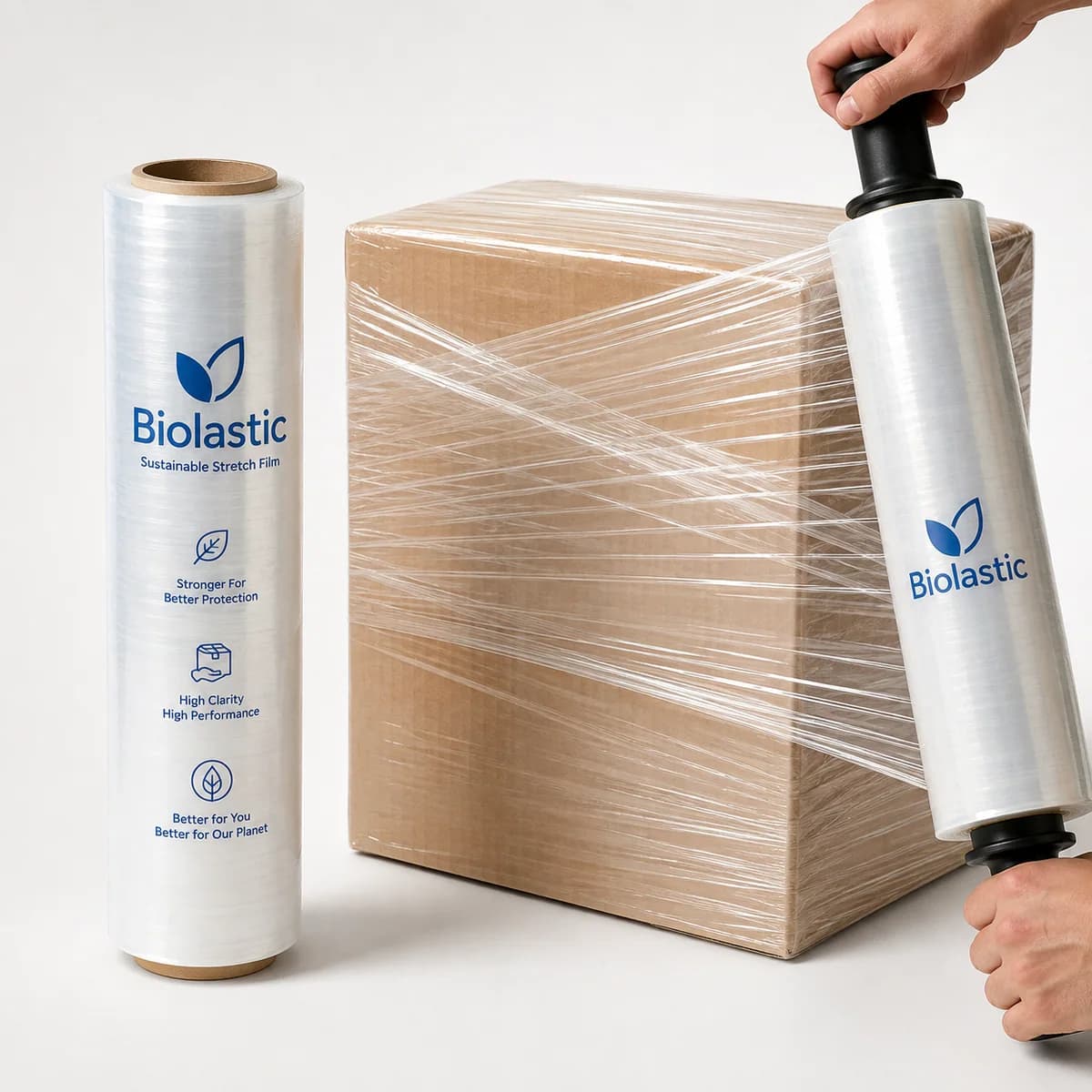
Biolastic's live catalogue includes a Mini Stretch Film Roll for Bundling & Small Packaging. The listing describes a narrow-format LLDPE stretch film for smaller products and selected sections of larger packages, including boxes, components, pipes, profiles and cables. Its width, gauge, roll weight and core specification must be confirmed before an order. It is quotation-based, and the listing does not establish current inventory, an exact selling price, performance rating or a certified recycled-content claim.
This is not the same as Biolastic's Jumbo Stretch Film Roll, which is positioned for larger industrial or conversion requirements. Nor should a buyer assume the mini format is appropriate for securing a pallet load. Product format and intended application must match.
What each material does
Mini stretch film is wrapped around a bundle under controlled tension. Its elastic recovery and layer-to-layer contact help hold items together. It generally does not require an adhesive bond to the product surface. It is not a heat-shrink film: a shrink tunnel is not part of ordinary stretch wrapping.
Packing tape normally uses a backing and a pressure-sensitive adhesive to bond to a carton or another suitable surface. Tape performance depends on substrate, surface cleanliness, application pressure, temperature and dwell time. Tape is useful for closing cartons and can also be used to strap or group small items, but adhesive removal may damage labels, printed surfaces or weak carton fibres.
Neither method should be treated as a certified load-restraint system merely because a bundle looks tight. Heavy or sharp items may need a strap, protective sleeve, carton, edge protector or engineered restraint.
Side-by-side buyer comparison
| Decision factor | Mini stretch film | Packing tape |
|---|---|---|
| Primary holding mechanism | Wrap tension and film recovery | Adhesive bond to a surface |
| Surface contact | Wraps around the group | Often sticks directly to carton or product |
| Removing the material | Usually cut or unwind | Peel or cut; adhesive residue or fibre lift is possible |
| Irregular profiles | Can conform around many shapes | May bridge gaps and lose contact |
| Carton closure | Not a substitute for a properly specified sealing method | Common closure method when matched to carton |
| Fragile goods | Excessive wrap tension can crush | Tape removal can damage surfaces |
| Sharp edges | Film can puncture or tear | Tape can also be cut or abraded |
| Buying unit | Net film mass, width, gauge, length | Roll length, width, backing, adhesive |
| Best cost metric | Cost per accepted bundle | Cost per accepted bundle |
This is a functional comparison, not a test result for any particular brand or grade. Trial both options under the same dispatch conditions.
Choose the application before choosing the roll
Small cartons: Mini film may help group several closed cartons for internal transfer. Tape may be preferable for sealing each carton, with an additional bundling step if needed. Do not confuse the closure requirement with the bundling requirement.
Pipes, profiles and cable bundles: Narrow film can wrap a selected section without coating the entire product in adhesive. Smooth round items may slip unless the bundle geometry and wrap pattern are suitable. Sharp ends need protection.
Printed retail boxes: A non-adhesive overwrap may reduce direct adhesive contact with artwork, but high tension can still dent corners or scuff finishes. Test the actual packaging.
Heavy hardware: Do not assume mini film alone is sufficient. Calculate load mass, handling forces and edge hazards, then validate the complete packaging design.
Short-term warehouse identification: Tape and film can both obscure barcodes if applied over labels. Place labels where they remain readable, and test scanner performance after wrapping.
Film width, micron and length: specify all three
A buyer asking only for “mini stretch roll” has not specified enough to obtain comparable quotations. Request nominal film width in millimetres, single-layer thickness in microns, net film mass, gross roll mass, core inside diameter, roll outside diameter and any available length or tolerance information.
Micron is thickness, not strength. A thicker film can use more material at a given area, but puncture, elongation, cling and holding force also depend on resin formulation and processing. A supplier's thickness alone cannot establish safe bundle weight.
A narrow roll is often easier to apply locally around a small object than a full-width pallet roll. However, it can take more passes to cover a wide bundle. The optimum width depends on bundle geometry and the operator's wrapping method.
Calculate film use without confusing gross and net weight
For a single layer of flat film, theoretical mass is:
Film mass (g) = width (m) × applied film length (m) × thickness (µm) × density (g/cm³).
This convenient unit conversion works because one square metre at one micron has a volume of one cubic centimetre. For a hypothetical polyethylene film density of 0.92 g/cm³, 0.10 m width, 8 m of unstretched film and 20 µm thickness, the theoretical mass is 14.72 g.
That is a calculation example, not a Biolastic mini-film specification. Real applied mass changes with stretching, overlap, edge waste, breakage and how length is measured. If film is stretched during application, distinguish length dispensed from the roll from the longer length covering the package.
For 500 accepted bundles, that hypothetical 14.72 g per bundle corresponds to 7.36 kg of film, before rejects and setup waste. A roll's gross mass includes the core and should not be used as net film mass in a material-cost calculation.
Compare tape use on the same basis
For tape, record the total length applied per accepted bundle and the delivered cost per metre of the actual tape grade. A hypothetical tape costing ₹0.70 per metre and using 1.8 metres per bundle has a direct tape cost of ₹1.26. This is not a market quotation.
For film, if the hypothetical 14.72 g consumption is priced at ₹160 per kg, direct film cost is ₹2.36 per bundle. This example deliberately shows that film is not automatically cheaper. It also excludes dispensing time, rejected packs, tape residue, damaged cartons and freight effects.
The useful comparison is total bundling cost ÷ accepted bundles. Include operator time, consumables, damaged packaging, rework and the cost of extra protective materials. Do not compare a film price per kilogram with a tape price per roll without converting both to the same accepted-pack basis.
A practical controlled trial
Select representative packs: the lightest, heaviest, longest and most damage-prone combinations. Record product dimensions and mass, ambient conditions, operator, wrap pattern and handling route. For each material, prepare a defined number of bundles using a documented method.
Check the bundle immediately after wrapping, after storage and after realistic handling. Look for slip, loose components, crushed cartons, punctures, torn film, failed tape adhesion, unreadable labels and time required to open the pack. Repeat with more than one operator if manual technique varies.
A useful scorecard records accepted bundles, packing seconds per bundle, film or tape consumed, material cost, rework, damage and opening experience. If the shipment will experience stacking, vibration or distribution impacts, use a packaging engineer to select appropriate distribution testing. An informal drop test is not a substitute for validated transport qualification.
Common failure modes and corrections
Film snaps at corners: Inspect burrs, sharp product edges and excessive tension. Protect edges and test a suitable film grade; do not simply increase thickness without examining the cause.
Bundle becomes loose: Check wrap overlap, tension consistency, shape of the pack and whether smooth components can slide. More turns may increase consumption without fixing the geometry.
Boxes deform: Reduce tension and consider a tray or outer carton. The goal is secure grouping, not maximum compression.
Tape peels away: Check surface dust, moisture, temperature, tape grade and application pressure. A tape that seals one board may fail on another coating.
Tape leaves marks: Test adhesive removal on the exact print and finish before approving a customer-facing package.
Both methods fail: Reconsider the packaging system. A strap, carton insert, sleeve or rigid container may be more suitable than adding more consumable.
Environmental and regulatory questions
Do not describe conventional LLDPE stretch film as compostable, biodegradable or plastic-free. Biolastic's mini-film listing identifies LLDPE and does not provide a compostability certificate. Likewise, a generic “recyclable” claim should not be made without considering the actual film construction, contamination and local collection system.
Packaging waste rules differ by jurisdiction and can change. Indian businesses should check the current Central Pollution Control Board and Ministry of Environment, Forest and Climate Change requirements applicable to their activity. International buyers should confirm destination-market packaging and extended-producer-responsibility obligations with qualified advisers. This article is a procurement guide, not a declaration of legal compliance for any specific shipment.
For waste reduction, measure grams of packaging per accepted shipment and the percentage of shipments needing rework. Lower weight can be useful, but it is not an environmental benefit if damaged products and repacking increase.
What to include in a wholesale RFQ
Send the supplier the product dimensions and weight, the bundle arrangement, monthly volume, intended use, preferred roll width, target film gauge if already tested, core compatibility and the location of delivery. Ask for net film mass per roll, packaging units, tolerances, a sample plan and the price basis.
For Siliguri, Jalpaiguri, Darjeeling, Bagdogra and other North Bengal locations, specify the receiving address and required dispatch window. Buyers elsewhere in India or internationally should request a destination-specific quotation rather than assuming export service, shipping terms or stock availability.
Enquire with Biolastic about mini stretch film specifications and a bulk quotation. Include a photograph or drawing of the bundle, desired quantity and the performance problem you are trying to solve. Current pricing, MOQ, inventory, lead time and delivery feasibility require written confirmation.
Frequently asked questions
Is mini stretch film the same as shrink film?
No. Stretch film is applied under tension and holds through its wrapping behaviour. Heat-shrink film is designed to contract under suitable heating conditions.
Can mini stretch film replace carton-sealing tape?
Not automatically. Carton closure and grouping several closed cartons are different jobs. Validate the required closure and transport performance separately.
What is the best micron for mini stretch film?
There is no universal best gauge. The right choice depends on bundle weight, shape, sharp edges, wrap tension and trial results. Request available specifications.
Does a narrower roll always use less plastic?
No. A narrower roll may require more turns or overlap. Measure actual net grams per accepted bundle.
How do I calculate mini stretch film weight?
Multiply width in metres, unstretched length in metres, thickness in microns and density in g/cm³ to estimate grams of film. Adjust for actual dispensing and waste.
Can I wrap printed boxes without damaging them?
Potentially, but test for crushing, scuffing and print damage under realistic tension. Avoid assuming that absence of adhesive means zero damage risk.
Is Biolastic mini stretch film compostable?
The live product listing identifies LLDPE stretch film and does not establish compostability certification. Do not treat it as a certified compostable product.
Does Biolastic publish a fixed mini-roll width or price?
The live listing asks buyers to confirm width, thickness, roll weight and core specification and is quotation-based. Request current commercial terms.
Can international buyers request a quote?
They can submit a specification enquiry. Export availability, documentation, freight and destination compliance must be confirmed for the specific order.
Sources and editorial scope
The product facts above were checked against the Biolastic mini stretch film catalogue and Biolastic jumbo film catalogue. General polymer and packaging calculations are illustrative, not certified test data. For packaging testing, consult applicable published methods from ASTM International and select a protocol appropriate to the actual distribution environment. No unverified certification, stock, export capability or performance guarantee is asserted.