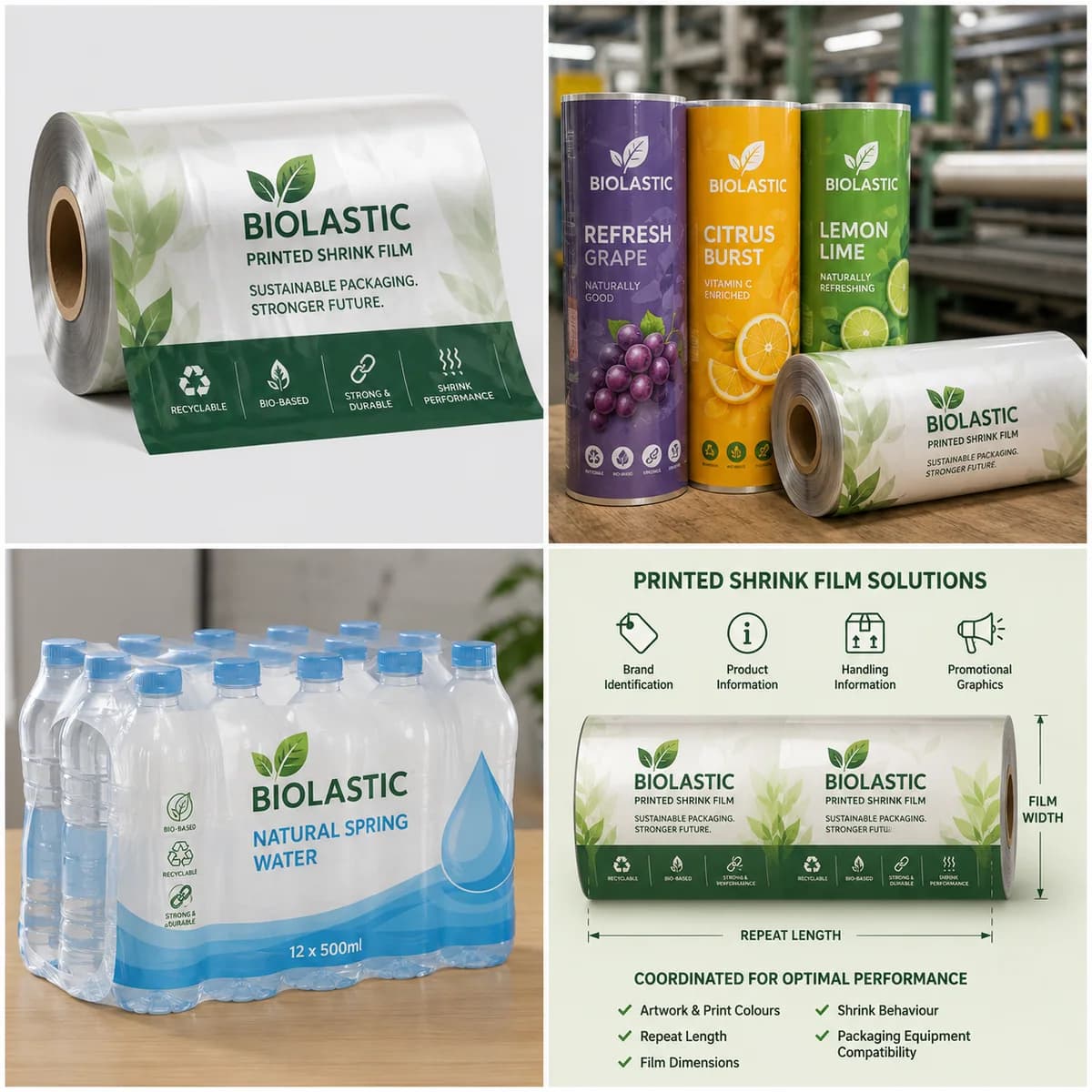
Printed Shrink Film Rolls: Artwork Registration, Shrink Distortion & Wholesale RFQ Guide
A shrink-wrapped bundle can look excellent on a designer's screen and disappointing when it leaves the tunnel. The logo has moved around a corner, the barcode sits over a fold, or the product name appears stretched. Those are not necessarily printing defects. They are often the result of artwork being approved without considering how the film moves, shrinks and contacts the pack.
For purchasing teams, the real question is not simply “Can you print our logo?” It is can the supplier, printer and packing line reproduce an acceptable finished bundle at a commercially viable cost? This guide explains how to specify printed shrink film rolls for secondary packaging, compare quotations and avoid expensive artwork revisions.
What Biolastic lists—and what remains to be confirmed
Biolastic's Printed Shrink Film Roll is a quotation-based catalogue product for commercial packaging where graphics and shrink wrapping are required together. Its listing mentions branding, product and handling information, and asks buyers to specify artwork, print colours, repeat length, film width, thickness, roll format, application, quantity and machinery. Printing and production capability are subject to confirmation.
The catalogue does not publish a guaranteed resin grade, fixed micron, shrink percentage, colour count, printing technology, ink specification, minimum order, price, stock level, certification or export availability. Those details should be established in the quotation and approved sample. Buyers who only need identification colour can also investigate the separate Coloured Shrink Film Roll, whose opacity and dimensions likewise require confirmation.
This is a guide to preparing a reliable RFQ, not a promise that any specific construction or print process is available.
Printed, coloured or unprinted: three different purchasing decisions
| Format | Typical reason to consider it | What needs checking |
|---|---|---|
| Printed shrink film | Brand identity, handling text or repeated graphics | Artwork repeat, distortion, print placement, registration and ink compatibility |
| Coloured shrink film | Colour coding or obscuring the contents | Shade, opacity, visual inspection needs and colour consistency |
| Unprinted shrink film | Secondary bundling where graphics are unnecessary | Film gauge, shrink profile, sealing, pack stability and cost |
Printing adds another set of controls to an already demanding shrink process. If the bundle will later receive a separate label, compare the cost and performance of a plain film plus label against printed film; do not assume either is cheaper without a production trial.
Start with the finished pack, not the film roll
A supplier cannot infer the right web from a flat artwork PDF alone. Describe the finished pack's width, height, depth, shape and product count. Explain whether the film encloses cartons, bottles, cans or another group, whether the bundle is supported by a tray, and which faces must show the design.
The film's machine direction (MD) follows travel through the converting or packaging process. The transverse direction (TD) is across the web. Shrink response may differ in these directions. The exact response depends on material and manufacturing history; do not assume one universal shrink percentage.
Ask the packer to mark on a photograph where the seal sits, where folds or openings occur and where graphics must remain readable. This is especially important for multi-unit packs where the final film surface is curved or uneven.
Artwork zones that deserve extra attention
Keep critical elements away from anticipated seals, heavy folds, corners, perforations and zones of uneven shrink. Consider separating the artwork into three functional areas: a must-read zone for the brand and essential information, a tolerant zone for patterns and decorative graphics, and a no-critical-content zone near uncertain edges or seals.
A barcode should not be approved merely because its file looks sharp. Verify readability after shrinking, on the actual pack, with the intended scanners and lighting. If a regulated label is required, have the responsible business check that its content, placement and legibility comply with the destination market.
Why printed graphics distort in a shrink tunnel
Shrink film changes dimensions as it is heated. But the film does not necessarily shrink freely once it is wrapped around a rigid pack. Corners, seals, trapped air, product spacing and differential heat exposure all affect the final appearance.
A circle in flat artwork can become an oval after wrapping. Straight rules can curve around a bottle shoulder. A solid colour may appear different where film overlaps. These effects should be anticipated with a trial rather than “fixed” using an arbitrary stretch factor in the artwork.
ASTM D2732 covers a method for measuring unrestrained linear thermal shrinkage of plastic film and sheeting at specified temperatures. It is useful for characterising a film, but it does not by itself predict how a printed image will look on a particular bundle in a tunnel. That requires an actual pack test.
A sensible approval sequence
1. Approve the physical pack configuration and machine route.
2. Request the proposed film specification and available shrink-characterisation data.
3. Agree on print repeat, image orientation and likely distortion zones.
4. Produce a controlled print or mock-up trial using the intended construction.
5. Run samples at documented sealing and tunnel settings.
6. Photograph all pack faces and record defects, barcode readability and operator adjustments.
7. Revise the artwork or pack design and repeat until the agreed acceptance criteria are met.
Do not approve a large printed-film run solely from a flat proof. A flat proof checks text, colours and layout; a shrink-pack proof checks how the design survives production.
Registration marks and print repeat: the machine-fit questions
A printed film can be beautiful and still fail to run on a packing line. Many automated systems use an optical mark and sensor to identify where a repeating image begins or where a cut or seal should occur. The required mark size, colour contrast, location and repeat depend on the actual sensor and control system.
Print repeat is the distance between successive images along the machine direction. It must work with the machine's film feed, pack pitch and intended seal position. Confirm whether the packer needs a fixed repeat, a tolerance range or a particular mark-to-image offset.
Request a drawing showing the film travel direction, printed face, roll winding orientation, repeat dimension, registration-mark position and any seam or cut location. Also specify whether the artwork should appear right-reading when the roll unwinds into the machine.
A registration mark is not a cure for mechanical slip, unstable web tension, inaccurate feed or a badly configured sensor. Test these issues separately.
Film specification: the RFQ should be measurable
A usable enquiry includes more than “printed shrink film, 50 micron.” Request the following as separate fields:
| RFQ field | Why it matters |
|---|---|
| Intended application and finished bundle dimensions | Determines whether the proposed construction is suitable |
| Film construction and resin family | Affects processing, shrink response and downstream obligations |
| Nominal single-wall thickness and tolerance | Enables comparable material quotations |
| Web width and winding format | Determines machine fit and material use |
| MD/TD shrink behaviour and test conditions | Helps predict the pack trial |
| Print colours, repeat and artwork orientation | Controls design and registration |
| Ink system, print side and rub resistance | Important for handling and appearance |
| Roll core, outside diameter and net mass | Affects loading, handling and purchasing |
| Proposed MOQ, setup charges and lead time | Needed for true landed-cost comparisons |
| Sample approval and rejection criteria | Prevents disagreements after delivery |
Ask the supplier to state which properties are measured, which are nominal and which are subject to a production trial. Thickness is not a substitute for a validated shrink profile or seal performance.
How to estimate film weight and material cost
For an approximate single-layer web before stretch or shrink, use:
Mass (kg) = width (m) × length (m) × thickness (µm) × density (g/cm³) ÷ 1000.
For illustration only, a 0.50 m-wide, 100 m-long, 40 µm film with an assumed density of 0.92 g/cm³ has theoretical mass of 1.84 kg. This is a mathematical example, not a Biolastic product specification. If the film is tubular, account for both walls when calculating the mass from layflat width. Real roll mass also depends on tolerances, printing, waste and the core.
For a printed-film order, total unit cost should include film, printing and plate or setup charges if applicable, shipping, startup waste, rejected packs and packaging-line labour. Calculate total relevant cost divided by accepted bundles, rather than relying on a quoted price per kilogram.
Example: why rejection matters
Suppose a hypothetical production run spends ₹12,000 on material and printing and yields 9,000 accepted bundles. Direct material-and-print cost is ₹1.33 per accepted bundle. If the same spending produces only 8,000 accepted bundles because of rejects, the figure rises to ₹1.50. Neither number is a market quote. The example shows why a cheaper film that runs poorly may not be cheaper overall.
Print setup charges can also change the economics of short orders. Ask for a clear distinction between recurring film price, one-time artwork costs, repeat-order costs and the conditions for storing or reusing printing cylinders or plates.
Test the actual packaging line
Record the make and model of the wrapping and shrink equipment, film path, sealing configuration, tunnel temperature settings, conveyor speed and product spacing. The supplier may recommend a trial window, but do not publish or rely on a universal temperature or dwell time. The correct settings depend on the actual film and equipment.
During the trial, inspect seal continuity, punctures, trapped air, loose areas, excessive tightening, distortion, scuffing and print transfer. Evaluate the pack immediately and after representative storage and handling. Where the bundle has a transport-protection function, validate the complete pack against its distribution conditions rather than assuming a visually tight wrap is sufficient.
Keep a signed sample and an approved artwork revision. Record the lot, roll orientation and machine settings that produced the accepted pack. These simple controls make reorders much easier.
Troubleshooting common printed-shrink defects
Logo shifts toward a corner. Check artwork placement, pack geometry, repeat accuracy and whether the film moves unevenly as it shrinks.
Print becomes hard to read. Move critical text away from severe shrink zones, review font size and contrast, and validate after the tunnel.
Registration drifts. Inspect sensor setup, mark contrast, web tension, feed accuracy and roll winding.
Seal damages the design. Reserve a seal-safe area and verify the seal position against the print layout.
Pack wrinkles after shrinking. Review film fit, product spacing, air evacuation, tunnel conditions and the film's shrink characteristics; increasing heat is not always the answer.
Ink rubs or transfers. Request an investigation of ink adhesion, curing, print surface, contact pressure and handling. Do not assume a different ink will solve a mechanical abrasion problem.
Too much waste during startup. Track the number of rejected metres and bundles, then check artwork registration, changeover procedure and film consistency.
Regulatory, food-contact and environmental claims
Printed secondary packaging should not automatically be described as food-contact safe. If the film or printed surface may contact food, the buyer needs the correct material, ink and migration or compliance documentation for the intended use and destination. A shrink-wrapped outer multipack and a film directly touching food present different exposure scenarios.
For India, buyers should consult the Food Safety and Standards Authority of India for applicable food-contact packaging requirements and the Central Pollution Control Board for relevant plastic-waste obligations. Applicability depends on the packaging activity and product.
For European Union buyers, Regulation (EU) 2025/40 establishes packaging and packaging-waste requirements, with provisions applying on different dates. Buyers should assess the exact packaging and their role in the supply chain. A supplier quotation is not evidence that every destination-market requirement has been met.
Do not call a printed shrink film compostable, biodegradable, recycled-content certified or universally recyclable without documentation for the actual construction and claim. Inks, coatings, multilayer structures, contamination and local collection systems may affect end-of-life options. The live Biolastic printed-film listing does not establish these certifications.
Environmental comparisons should consider grams of material per accepted bundle, damage prevention, actual waste and destination-specific collection systems. A lighter package is not automatically better if it fails in transit.
Buying from Siliguri, North Bengal, India or overseas
A beverage distributor in Siliguri may need a small initial validation run, while a national co-packer may focus on repeatability across several lines. An international buyer may also need destination-specific documents and shipping terms. All should begin with the same technical facts: pack geometry, film path, artwork, repeat, expected monthly volume and acceptance tests.
Biolastic accepts specification enquiries through its website. Current manufacturing or printing capability, available grades, minimum quantities, price, lead time, dispatch location and international fulfilment must be confirmed for the particular order. No guaranteed export service or fixed delivery promise is implied.
Copy-and-send printed shrink film enquiry
We need printed shrink film for [product/bundle]. Finished pack dimensions: [W × H × D]. Machine: [make/model]. Film format and width: [if known]. Target gauge: [if tested]. Artwork colours: [number]. Repeat and registration requirements: [details]. Monthly quantity: [estimate]. Delivery location: [city/country]. Please confirm feasible construction, sample approval process, MOQ, printing/setup charges, technical documentation and a delivered quotation.
Request printed shrink film specifications and a wholesale quotation from Biolastic. Attach a pack photograph, equipment details and artwork if available. That is the fastest way to move from a generic enquiry to a testable specification.
Frequently asked questions
Can ordinary packaging artwork be printed unchanged on shrink film?
Not safely by assumption. Graphics can distort after shrinking; confirm film shrink direction, package geometry, print process and a physical approval sample.
What is print repeat length?
The distance between recurring printed images along the machine direction. It must match the packing equipment and intended pack pitch.
Does a registration mark guarantee perfect alignment?
No. The mark only helps a compatible sensor and controller detect position. Film tracking, tension, slip and machine calibration still matter.
Which film micron should I buy?
Choose by package geometry, load, equipment and validated tests. Biolastic does not publish a fixed gauge for this product.
Is printed shrink film suitable for direct food contact?
Do not assume so. Confirm the exact film, ink construction, contact conditions and relevant destination-market food-contact documentation.
How is shrink performance tested?
ASTM D2732 describes unrestrained linear thermal shrinkage testing. Actual package appearance also needs trials on the intended equipment.
Can printed shrink film be recycled?
Recyclability depends on the complete material and print construction plus local collection and recycling systems. A generic claim is not justified.
Does Biolastic have a fixed MOQ or export price?
The live listing is quotation-based; confirm printing capability, MOQ, specifications, pricing, dispatch and export feasibility in writing.
Sources and scope
Product-specific claims were checked against the live Biolastic printed shrink film listing and coloured shrink film listing. The technical distinction between free-film shrinkage and finished-pack performance is informed by ASTM D2732. EU regulatory context is based on the official text of Regulation (EU) 2025/40. Calculations are illustrative; they are not certified product tests or commercial offers.