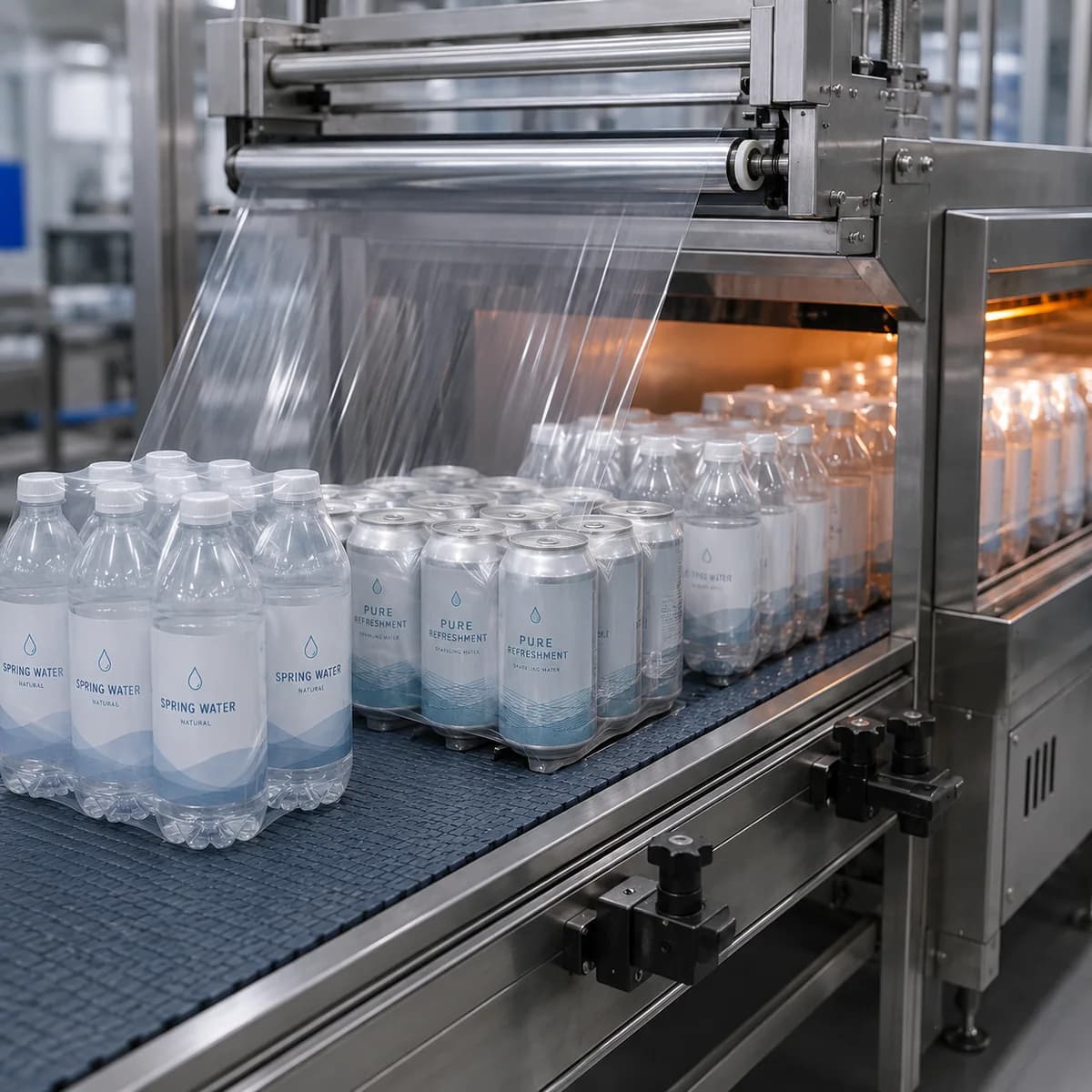
Shrink Film Tube Roll vs Single-Wound Film: Width, Sealing & Cost Guide
A buyer asks for a “12-inch shrink-film roll”. The supplier sends a 12-inch flat sheet. The packing operator needed a 12-inch layflat tube. Both parties think they quoted the right width, but the material arriving at the machine is fundamentally different.
The short answer: choose tubular shrink film when your approved process needs a continuous two-wall sleeve that can be opened, loaded, cut or sealed and then shrunk. Choose single-wound shrink film when the machine is designed to handle one flat web and form a wrap or package with its own sealing arrangement. Neither format is universally cheaper or stronger. Specify film format, measurement convention, material, single-wall micron, machine compatibility and accepted-pack cost before comparing quotations.
This is a practical buying guide for manufacturers, contract packers, beverage and carton bundlers, warehouse teams and packaging distributors worldwide. It also addresses buyers in Siliguri, Jalpaiguri, Darjeeling, Cooch Behar, North Bengal, Assam, Sikkim and the rest of India, where a mistaken width specification can hold up an entire packing shift.
1. Start with the format, not the film's appearance
Shrink film contracts under controlled heating, but the shape in which it arrives at your packing machine changes how it must be handled.
| Buying term | Physical supply format | Critical measurement | What the machine must do |
|---|---|---|---|
| Tubular shrink film | Continuous sleeve with two walls connected along the sides | Layflat width plus single-wall thickness | Open the tube, insert or enclose the product, cut/seal as required, then shrink |
| Single-wound shrink film | One flat web wound on a roll | Flat web width plus thickness | Wrap or form the web around the product, create required seals, then shrink |
| Other shrink-film configurations | May include centerfold or custom formats | Depends on construction | Must match the machine's designed film path |
Do not assume that the term “shrink film roll” tells you the configuration. A machine built for centerfold film, for example, may not accept a tubular reel or single-wound reel without different tooling. A tunnel supplies heat; it does not necessarily perform the wrapping, opening, cutting or sealing steps.
Biolastic's catalogue lists an LDPE Shrink Film Tube Roll, a Single Wound Shrink Film Roll and a Custom Size Shrink Film Roll. The first is explicitly described as LDPE shrink film. The single-wound listing uses the broader description “shrink film”; its precise polymer formulation must be confirmed for the quoted grade. These are quotation-based listings; no fixed micron, selling price or immediate stock promise is established by those pages.
2. Layflat width: the most expensive unit mistake
When a tube is laid flat, the measurement across its flattened face is called layflat width. A nominal 300 mm layflat tube has two film walls, each approximately 300 mm wide when flat. Its approximate unshrunk perimeter is:
Tube perimeter ≈ 2 × layflat width
For a 300 mm layflat tube, the nominal perimeter is 600 mm. That is not the same as a 300 mm wide single-wound sheet. Nor does it mean the tube can wrap every product with a 600 mm perimeter: allowances for product corners, opening, sealing, handling and controlled shrinkage must be established in a real packaging trial.
A quick dimensional example
Suppose a rectangular bundle measures 200 mm across and 100 mm deep in the direction the sleeve must pass around. Its simple rectangular perimeter is:
2 × (200 + 100) = 600 mm
A 300 mm layflat tube has a nominal 600 mm circumference, leaving no geometric allowance in this simplified example. A trial might begin with a larger layflat width, but there is no universal extra-percentage rule: film stretch, opening equipment, product corners, shrink ratio and desired finish all affect the answer.
For a rounded or irregular bundle, measure the actual path the sleeve must follow. If bottles have handles, protrusions or a carrier, account for those features too.
Buying instruction: write “300 mm layflat tubular film, single-wall gauge 50 µm” rather than “300 mm film, 50 micron”. That one extra phrase can prevent a wrong-format shipment.
3. Single-wall thickness is not double-wall thickness
A tubular roll contains two walls when flattened. If the material is specified as 50 µm, the normal technical intent is 50 µm per wall, not 50 µm across both walls combined. The flattened pair has approximately 100 µm of total stacked thickness, but the film itself is still 50 µm gauge.
That distinction matters in weight calculations. A buyer who uses the single-wound formula for a tubular roll can understate the material mass by roughly half.
Ask the supplier to record:
- The nominal single-wall thickness in microns.
- How thickness is measured and the acceptable tolerance.
- Whether the tube is gusseted, printed, perforated or otherwise modified.
- The layflat width, width tolerance, reel core and winding direction.
- The polymer grade or blend, not simply “plastic film”.
For film-thickness measurement, ISO 4593:1993 describes mechanical scanning and was confirmed current in 2025. Its published scope excludes embossed film; agree a suitable measurement approach for any unusual surface.
4. The geometry of film weight: tube versus single wound
For a uniform film, the theoretical weight follows the same physical relationship regardless of brand:
Mass = film area × thickness × density
Use metres for dimensions and kg/m³ for density if you want the result in kilograms.
Single-wound film, kg per metre of roll length:
`flat web width (m) × thickness (m) × density (kg/m³)`
Tubular film, kg per metre of roll length:
`2 × layflat width (m) × single-wall thickness (m) × density (kg/m³)`
These equations exclude edge trims, seals, print coatings, variable gauge, winding defects and cores. They also assume a plain, ungusseted tube.
Worked example: 300 mm tube, 50 µm, 1,000 metres
For illustration only, assume density = 920 kg/m³. This is a calculation assumption, not a measured or guaranteed density for any Biolastic grade.
- Layflat width = 0.300 m.
- Thickness per wall = 0.000050 m.
- Film area per metre = 2 × 0.300 × 1 = 0.600 m².
- Theoretical mass per metre = 0.600 × 0.000050 × 920 = 0.0276 kg, or 27.6 g.
- Theoretical film mass for 1,000 metres = 27.6 kg, excluding the core and packaging.
Now compare a 600 mm wide single-wound film, also at 50 µm and the same assumed density. It also weighs 27.6 kg per 1,000 metres in this idealised calculation because both formats have the same total film area per metre.
This does not make them interchangeable on a machine. It simply shows why material mass should be compared using total developed area, not the width printed on the reel label.
For more general calculations, see Biolastic's plastic-film weight and roll-length guide. That article covers the mathematics across film types; the present guide focuses on format selection, machine fit and packaging-line acceptance.
5. How many sleeves can one kilogram produce?
With the same 300 mm layflat, 50 µm tubular example, assume each package consumes 500 mm of tube length, including the selected end-seal and cut allowances.
- Film mass per 500 mm sleeve = 27.6 g/m × 0.5 m = 13.8 g.
- Ideal theoretical sleeves per kilogram = 1,000 g ÷ 13.8 g ≈ 72.5 sleeves.
This is an area-and-density illustration, not a production output promise. A real run may consume extra material for machine setup, seal tails, cut losses and rejected packs. The chosen 500 mm cut length may not suit your actual product.
If the process has an illustrative 6% total material loss, the accepted yield based on this theoretical example becomes approximately 72.5 × 0.94 = 68.1 accepted sleeves per kilogram. Keep the loss definition consistent: it must represent film consumed that does not become an accepted pack, not merely a count of rejected packages.
A useful factory record has four numbers: kilograms of film issued, accepted packages, rejected packages and the amount of recoverable trim. That gives a much stronger buying signal than a catalogue claim of “high yield”.
6. Choosing the right configuration for your machine
Before buying even one commercial reel, ask the operator to describe the machine's actual film path.
| Machine question | Why it matters | What to confirm |
|---|---|---|
| Does the machine open a tube? | A single sheet cannot behave like an open sleeve without a forming mechanism | Tube opener, mandrel or loading system |
| Does the machine form a wrap from one web? | A tubular reel may not thread correctly | Web path, forming collar or wrapping sequence |
| Where are the seals made? | Tubing and flat film can require different sealing layouts | End seals, longitudinal seal, seal-jaw geometry |
| Is film fed intermittently or continuously? | Reel tension and registration affect cut length | Feed method, tension control and indexing |
| Is the line printed-film capable? | Graphics need registration and repeat control | Print mark sensor and artwork repeat |
| What is the maximum usable width? | Nominal machine width may not equal usable film width | Actual roller, jaw and tunnel clearances |
| What material has been approved? | Not all shrink films respond alike | Resin family, thickness, shrink behaviour and seal settings |
A “shrink tunnel” alone is not enough information for a supplier to select film. Two lines with similar tunnel openings can have completely different film-feed and sealing stations.
Best practice: send a photo of the existing reel label, a short film-threading video if permitted, and the machine make/model. For new machinery, obtain the machine builder's recommended roll-format specification before ordering.
7. Shrink ratio: request two directions and the test conditions
A common sourcing mistake is to ask for “high shrinkage” without specifying the direction. Film can contract differently along the machine direction (MD) and transverse direction (TD).
Why that matters:
- A sleeve may need enough circumferential contraction to tighten around the bundle.
- Excessive contraction in the cut-length direction can pull on end seals or expose product ends.
- An asymmetric shrink response can twist graphics or distort the finished bundle.
- The heat profile and exposure time influence the result; one percentage without a test condition is incomplete.
ASTM D2732-14(2025) is the active ASTM method for unrestrained linear thermal shrinkage of plastic film and sheeting under specified conditions. It helps characterise the material; it is not a guarantee of finished-package appearance, because a real product restrains the film and the tunnel applies a specific thermal history.
Ask for MD and TD shrink values at clearly stated test conditions. Then verify them in a production trial on the actual package.
8. Sealing matters as much as shrinking
A good-looking film can still produce weak packages if the sealing system is incompatible. Seal problems are not always solved by increasing heat. Too much heat can thin, distort or burn the film, while too little heat may leave incomplete bonds.
Check the seal-jaw type, contact time, pressure, jaw condition and cooling under controlled machine settings. The correct operating window depends on the exact material and equipment; it cannot be responsibly prescribed from the word “LDPE” alone.
Where quantitative seal testing is required, ASTM F88/F88M-23 provides a recognised method for seal strength in flexible barrier materials. Seal-strength data should be reported with the specimen preparation and test method. A good seal-strength number alone does not prove that the whole package is leakproof, puncture-resistant or fit for shipping.
For industrial bundles, inspect the seal after the tunnel and after representative handling. Record whether failure occurs through the seal, through the film beside it, or because the bundle slips out of the wrap.
9. A simple first-article acceptance test
The first reel should be treated as a qualification sample, not proof that every subsequent batch will behave identically.
Step 1 — Record the incoming specification. Note reel ID, film format, measured width, gauge, material declaration, net film weight, core, winding direction and supplier lot.
Step 2 — Verify the machine path. Thread the film safely according to the equipment maker's instructions. Check that the tube opens properly or the single web forms correctly without folding or excessive drag.
Step 3 — Check cutting and sealing. Run a controlled batch. Record actual cut length, seal position, seal appearance, jams and off-centre packages.
Step 4 — Establish a safe shrink window. Have trained personnel adjust the equipment within the machine and film supplier's approved ranges. Observe wrinkles, holes, distortion, loose corners and seal pullback. Do not invent a universal tunnel temperature.
Step 5 — Test the finished bundle. Use the actual product, pack count, handling method, stacking arrangement and transport simulation appropriate to the business.
Step 6 — Calculate accepted yield. Weigh film consumed and count saleable packages. Compare film used per accepted pack, not just the number of cycles completed.
Step 7 — Approve the specification in writing. Keep a reference sample and record accepted tolerances, machine settings, defects and reorder requirements.
For tensile characterisation where useful, ASTM D882-26 addresses thin plastic sheeting. Tensile data can inform material comparison, but it does not substitute for shrink and finished-pack testing.
10. Cost per accepted package: the fair way to compare suppliers
Two suppliers may offer the same quoted price per kilogram while delivering different accepted-package costs.
Use:
Film cost per accepted package = net film cost consumed ÷ number of accepted packages
For a planning estimate, you can also use:
Theoretical film mass per package × delivered price per kg ÷ (1 − material loss fraction)
Hypothetical cost example — not a Biolastic price
Continue with the 300 mm layflat, 50 µm tube and 500 mm cut-length illustration:
- Theoretical film per sleeve: 0.0138 kg.
- Assumed delivered film price: ₹150/kg.
- Assumed total material loss: 6%.
- Ideal material value per sleeve: 0.0138 × ₹150 = ₹2.07.
- Estimated material cost per accepted sleeve: ₹2.07 ÷ 0.94 = about ₹2.20.
This estimate excludes sealing power, tunnel energy, labour, core and freight allocation, printing, equipment depreciation, testing and downstream damage. The assumed ₹150/kg is only an example, not a current quote.
To compare a single-wound solution, calculate its actual developed web area per accepted pack, including longitudinal overlap and trim. A tube may eliminate one seam in a particular design, but it may require different loading and cutting hardware. The cheaper choice depends on the complete process.
11. The hidden costs that rarely appear on a price sheet
Machine downtime. A reel that repeatedly telescopes, wrinkles or fails to open can cost more than the price difference between suppliers.
Overwide film. Extra width raises consumption and may cause excess material to bunch after shrinking. Too-narrow film may create sealing or coverage failures.
Gauge variation. A nominal micron value does not tell you the spread across the roll. Thin spots may affect seals and strength; heavy spots change weight and heating response.
Shrink inconsistency. If one lot shrinks more than another, the same tunnel settings may produce different appearance or damage.
Unclear roll-weight basis. A 30 kg “roll” may include the core and packaging. Always compare net film weight, not just gross roll weight.
Printed-film scrap. Artwork registration, cut length and the visual distortion caused by shrinkage can add waste. Biolastic separately lists a Printed Shrink Film Roll for quotation, subject to printing capability and specification review.
12. Common defects and what to investigate first
| Observed defect | First checks | What not to assume |
|---|---|---|
| Film will not open as a sleeve | Confirm it is actually tubing; inspect layflat folds and opening mechanism | That every two-layer-looking roll is tubular |
| Excess loose film after tunnel | Width, shrink response, heat exposure and package geometry | That a hotter tunnel always fixes it |
| Holes or burned areas | Local heating, dwell, material grade, film contact and hot spots | That increasing gauge is the only remedy |
| Seal peels open | Seal conditions, jaw condition, contamination and film compatibility | That more pressure alone solves every seal |
| Film jams or tracks sideways | Reel winding, tension, alignment, width and core fit | That the roll is defective without machine checks |
| Printed design appears distorted | Artwork compensation, registration and MD/TD shrink behaviour | That flat artwork will retain its dimensions after shrinking |
| Package looks tight but fails in handling | Seal, puncture, impact, load geometry and handling test | That appearance proves transport suitability |
Record defect rates over a representative batch rather than judging one package. If two film grades are compared, use the same product and a documented test protocol.
13. Packaging compliance for global buyers
Secondary shrink wrapping is not automatically approved for direct food contact. If the film directly touches food, request documentation for the exact material and intended use in the destination market. Do not infer food-contact suitability from a bottle-bundling or carton-wrapping application.
For EU-bound packaging, the European Commission's 12 August 2026 update explains that the EU's new packaging and packaging-waste rules apply from that date, with phased requirements for recyclability, material composition, waste prevention and labelling. Buyers should check the requirements and transition dates relevant to their exact packaging and market rather than assuming a single rule applies identically to every pack immediately.
Likewise, LDPE does not automatically mean “recyclable everywhere”, and a thin film is not inherently compostable or biodegradable. Collection availability, labels, printing, additives and the packaging construction affect what can realistically be recovered. Do not print an environmental certification or recycled-content percentage unless supported for the actual product and market.
For India and overseas supply, clarify the legal role of the buyer, brand owner, importer and packaging supplier. Request the required material and regulatory evidence before approving product claims.
14. Buying for Siliguri and North Bengal — without over-ordering
Businesses in Siliguri, Jalpaiguri, Darjeeling, Cooch Behar, Alipurduar, Assam and Sikkim often purchase for smaller lines, regional distribution or seasonal packing demand. A wrong-format reel can immobilise equipment just as easily as it can in a large international plant.
A sensible buying sequence is to confirm the machine format, request a technical sample where feasible, approve one finished-package trial, and then discuss the repeat-order specification and commercial quantity. For worldwide buyers, add the delivery country, destination-specific documentation and requested Incoterm or commercial terms for evaluation. Do not assume export shipping is available until confirmed.
Biolastic's shrink-film catalogue provides starting points for tubular LDPE, single-wound film and custom-size film. The live listings are quote-based and require technical review; this guide does not claim fixed stock, lead time or delivery coverage.
15. Copyable RFQ: get comparable shrink-film quotations
Send the same information to every supplier so you are not comparing unlike materials.
Subject: Shrink film RFQ — tubular / single-wound — [company and destination]
>
We pack [product] in bundles measuring [length × width × height], with [quantity] units per bundle. Our packaging machine is [make/model], and the current approved film is [material and configuration, if known].
>
Required format: [layflat tubular / single-wound flat web]. Width: [mm, clearly state layflat or web]. Thickness: [µm per wall or single sheet]. Material: [polymer/approved grade]. Roll: [core ID, winding direction, target net film weight or length]. Sealing: [seal layout and machine type]. Shrink performance: [MD/TD target and test conditions, if known]. Quantity: [trial and monthly requirement]. Destination: [city, country].
>
Please confirm the proposed construction, tolerances, suitable tests, sample availability, current MOQ, quotation validity, net film weight basis, packing, dispatch terms and any documentation needed for our intended market.
If the supplier cannot confirm whether the width is layflat or single-web, clarify that before placing the order.
16. A five-gate supplier scorecard
| Gate | Evidence | Decision |
|---|---|---|
| 1. Format | Tube or single-wound matches the machine's approved feed path | Pass / clarify / fail |
| 2. Dimensions | Layflat or web width, single-wall micron, core and roll size specified | Pass / clarify / fail |
| 3. Process | Sealing and shrink behaviour validated on the actual line | Pass / clarify / fail |
| 4. Finished pack | Representative bundles survive agreed handling checks | Pass / clarify / fail |
| 5. Commercial | Net kg, accepted-pack yield, quote terms and required documentation comparable | Pass / clarify / fail |
Do not award a pass merely because a sample looks glossy or a supplier quotes a lower price per kilogram. The final purchasing decision should be based on accepted packages per net kilogram, line uptime and fit for the intended use.
17. Frequently asked questions
What is the difference between tubular shrink film and single-wound shrink film?
Tubular film is a continuous two-wall sleeve with joined longitudinal edges; single-wound film is one flat web. The correct format depends on the machine's film path and sealing arrangement.
Is a 300 mm layflat tube the same as a 300 mm single-wound sheet?
No. The 300 mm layflat tube contains two walls and has an approximate 600 mm unshrunk circumference. The single-wound film is only 300 mm wide.
How do I calculate shrink-film tube weight per metre?
Use 2 × layflat width (m) × single-wall thickness (m) × density (kg/m³). For a hypothetical 300 mm tube, 50 µm gauge and 920 kg/m³ density, that gives 27.6 g/m.
Does a 50 micron tube contain 50 or 100 microns of film?
Normally 50 µm per wall. Two layers together are about 100 µm when stacked, but each wall remains 50 µm nominal gauge.
Can any shrink tunnel run tubular film?
No. The wrapping or loading and sealing equipment must be compatible, and the film's thermal behaviour must suit the controlled tunnel process.
Which tests should I ask for?
Consider thickness, MD/TD shrink response, relevant tensile measurements, seal performance and a finished-pack trial. Agree the methods and conditions in advance.
Is LDPE shrink film automatically recyclable or safe for direct food contact?
No. Both claims need evaluation against the actual construction, intended use and destination-market requirements.
Can Biolastic supply custom shrink film for international buyers?
Biolastic accepts technical enquiries for tubular, single-wound and custom-size shrink-film listings. The exact capability, pricing, documentation and international shipping arrangements must be confirmed individually.
Request a technical shrink-film quotation
Choosing between a tubular sleeve and a single-wound web should take a few measurements and a machine check—not a costly production stoppage. Send your film format, layflat/web width, single-wall micron, machine model, product dimensions, required quantity and destination to Biolastic's enquiry team.
Request Shrink Film Samples & Wholesale Quote
Technical references consulted: ISO 4593:1993 (film thickness; confirmed in 2025), ASTM D2732-14(2025) (unrestrained thermal shrinkage), ASTM D882-26 (tensile properties), ASTM F88/F88M-23 (seal strength), and the European Commission's packaging-rules update of 12 August 2026. These are methods and policy references, not claims that a specific Biolastic product has been tested or certified.