Soft vs Hard Paper Napkins for Restaurants: 70-Piece Packs, Testing & Wholesale Cost
When a restaurant runs out of napkins halfway through lunch, the problem is obvious. The more expensive problem is less visible: staff putting three or four sheets on every table because one sheet does not do the job.
For cafés, tea shops, caterers, hotel breakfast counters and food-service distributors, the right paper napkin is not necessarily the softest or the cheapest packet. It is the one that works reliably for your customers, fits your service routine and gives you a predictable cost per guest.
Quick answer: Trial soft and firm paper napkins side by side. Compare their actual sheet dimensions, feel, wet handling, absorption, number of sheets used per guest and delivered cost. Do not treat “soft,” “hard,” “GSM” or “70 pieces” as a complete performance specification.
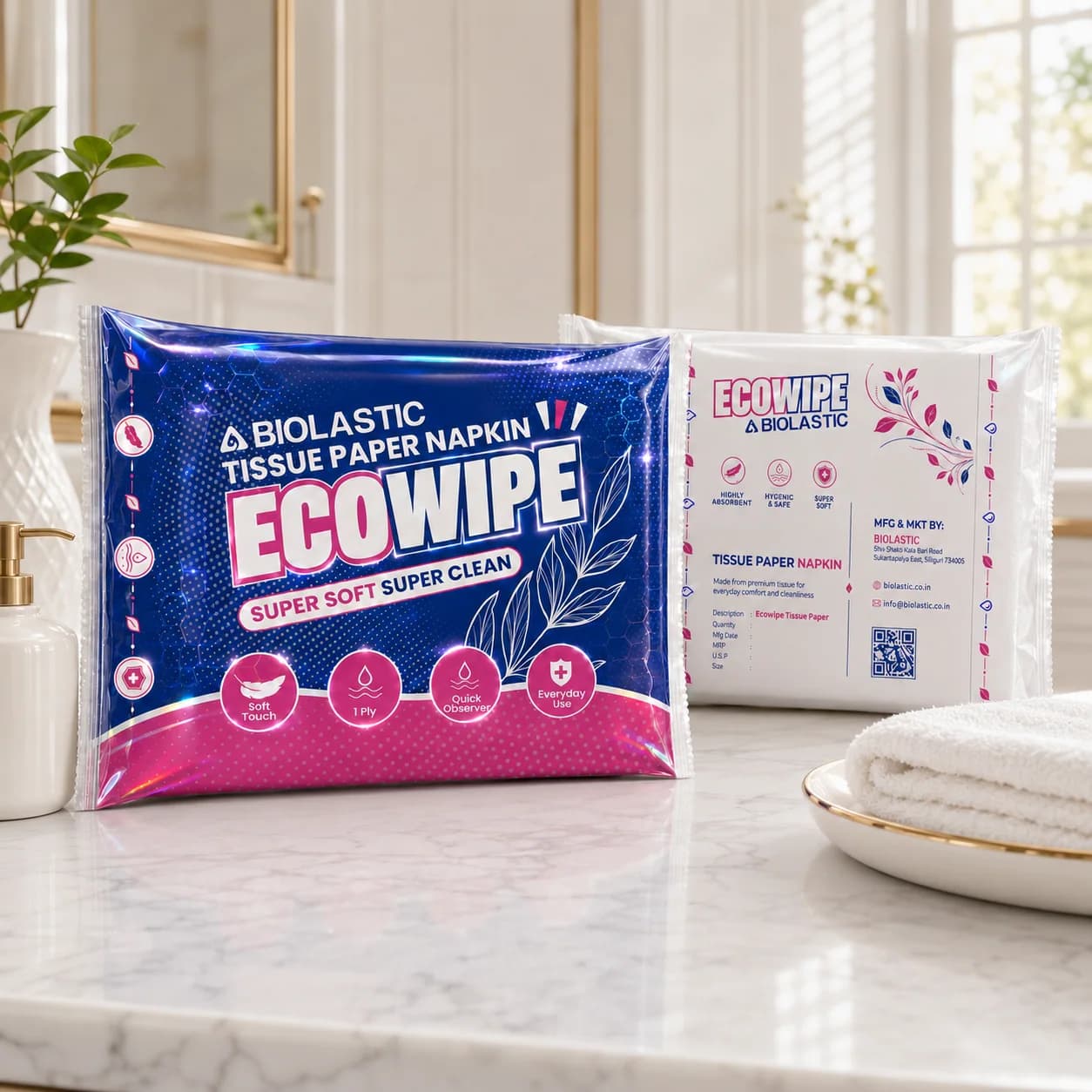
This guide uses the real Ecowipe Soft Paper Napkins — 70 Pieces and Ecowipe Hard Paper Napkins — 70 Pieces listed by Biolastic in Siliguri, India. The buying method is useful worldwide, whether you serve ten tables a day or source cartons for a multi-location hospitality business.
Soft versus hard paper napkins: the practical comparison
In a product listing, soft describes a more pliable, gentle-feeling variant; hard or firm describes a firmer-feeling one. These are useful shopping descriptions, but they are not internationally standardised performance grades.
| Buyer question | Soft paper napkin | Hard / firm paper napkin |
|---|---|---|
| Typical buying priority | Customer feel and table presentation | Firm feel and routine counter service |
| What the name establishes | A soft variant is offered | A firm variant is offered |
| What it does not establish | Superior absorption, extra ply or stronger wet handling | Higher GSM, greater durability or lower usage |
| Ecowipe packet count | 70 pieces | 70 pieces |
| Verified GSM and ply in current listing | Not specified | Not specified |
| Best next step | Test feel, absorption and actual consumption | Test feel, absorption and actual consumption |
| Buying decision | Cost per accepted service experience | Cost per accepted service experience |
Neither product should be described as a guaranteed high-absorbency, food-contact-certified or compostable tissue without supporting product-specific documentation.
Which should a café or restaurant trial first?
A sit-down café serving coffee and pastries might prioritise softness and presentation. A fast-moving tea counter might care more about dispenser handling, easy separation and stock turnover. A caterer may want both: a softer napkin for plated meals and a firmer option at a self-service snack counter.
Those are trial scenarios, not laboratory conclusions about either Ecowipe variant. The same napkin can perform differently when used with dry snacks, oily food, drinks or wet hands.
What is actually confirmed in Biolastic's catalogue?
At the time of this guide's preparation on 25 October 2026, the Biolastic product catalogue identifies two Ecowipe options:
These are dated catalogue snapshots, not wholesale quotations. Current selling price, taxes, available stock, discounts, MOQ, carton count, freight and delivery terms need confirmation before ordering.
The current listings do not establish verified open and folded sheet dimensions, ply, GSM, fibre composition, absorption results or individual product certifications. Buyers should request those details instead of inferring them from product photographs.
What does GSM mean for a paper napkin?
GSM means grams per square metre. It describes the mass of a paper sheet relative to its area, not how soft it feels or how much water it can absorb.
For tissue products, ISO 12625-6:2016 specifies a method for determining grammage. When a supplier quotes GSM, ask whether it refers to one ply, the combined finished product or another stated measurement basis.
Why ply and GSM are not interchangeable
Ply is the number of tissue layers in a finished sheet. GSM measures basis weight. A two-ply napkin is not automatically twice as strong or twice as absorbent as a one-ply napkin from a different paper grade.
Embossing, fibre composition, creping, sheet size and manufacturing conditions also influence feel and performance. That is why a procurement comparison should record more than a single GSM figure.
An illustrative sheet-weight calculation
Suppose a hypothetical single-ply tissue sheet measures 300 × 300 mm and has a grammage of 18 GSM.
Area = 0.30 m × 0.30 m = 0.09 m².
Theoretical dry paper mass = 0.09 × 18 = 1.62 g per sheet.
At 70 sheets, theoretical paper mass would be 113.4 g, before considering packet material or production variation.
Important: these are sample numbers for explaining the calculation. They are not verified Ecowipe dimensions, ply, GSM or packet weights. A folded sheet still has the same total area as its unfolded form; measuring only the folded footprint would understate its paper area.
How to test napkin quality before buying cartons
A simple sample trial can reveal more than a polished product description. Use samples from the actual grade and, if possible, different production lots.
Test 1: sheet count and consistency
Open several packets and count the sheets. Check whether the napkins separate cleanly or pull out in clumps. Note visibly torn edges, uneven folds, dust and inconsistent sizes.
For a food-service buyer, the question is not merely whether the label says 70. It is whether the team can dispense the sheets efficiently without waste.
Test 2: softness and feel
Ask a small group of staff or customers to handle both samples without showing the product names. Record which feels more comfortable and whether the preference matters for the intended service.
Softness is partly subjective. A blind side-by-side test is more useful than assuming the product named “soft” is automatically better for every customer.
Test 3: water absorption
Use the same sheet area, same liquid volume, same temperature and same observation time for both samples. Record how quickly the tissue wets and whether it retains its shape during normal wiping.
For formal comparison, ISO 12625-8:2010 specifies a basket-immersion method for tissue water-absorption time and capacity. A casual kitchen spill test is a useful operational screen, not an ISO-certified result.
Do not claim that a napkin absorbs a particular number of millilitres until it has been measured under stated conditions.
Test 4: strength and wet handling
A napkin that tears immediately when picked up after wiping may increase consumption. Compare the same action across samples and record tearing, pilling and visible fibre shedding.
For a formal dry tensile-property assessment, ISO 12625-4:2022 specifies a tissue test method for tensile strength, stretch and tensile energy absorption. This is distinct from a restaurant's informal wet-handling test; neither automatically proves the other.
Test 5: real service consumption
This is the test that connects product quality to purchasing economics.
Give one team the firm napkin and another comparable team the soft napkin, or alternate them across matched service periods. Keep the menu, guest count and dispensing policy as similar as possible. Record:
1. Guests or orders served.
2. Napkins issued.
3. Unused napkins discarded.
4. Napkins damaged before use.
5. Complaints or repeat requests.
6. Packets opened and packets remaining.
Napkins consumed per guest = usable napkins issued ÷ guests served.
The aim is not to ration customers. It is to understand actual use and prevent waste without making service worse.
How many 70-piece napkin packets do you need?
Start with the number of guests, an observed napkin allowance and a realistic reserve.
Packets required = round up [(guests × napkins per guest × (1 + reserve rate)) ÷ 70].
Worked example: a 500-guest event
Assume 500 guests, two napkins per guest and a 10% contingency.
Base requirement = 500 × 2 = 1,000 napkins.
Including reserve = 1,000 × 1.10 = 1,100 napkins.
Packets = 1,100 ÷ 70 = 15.71, so buy 16 complete packets.
That gives 1,120 sheets, a 20-sheet buffer above the planned requirement. If guests are expected to use more than two sheets, revise the calculation using actual event or restaurant data.
Quick planning table
| Guests | Assumed sheets per guest | 10% reserve | Whole 70-piece packets |
|---:|---:|---:|---:|
| 100 | 2 | 220 sheets | 4 |
| 250 | 2 | 550 sheets | 8 |
| 500 | 2 | 1,100 sheets | 16 |
| 1,000 | 2 | 2,200 sheets | 32 |
| 500 | 3 | 1,650 sheets | 24 |
These are planning calculations, not fixed consumption standards. A banquet, quick-service counter and school canteen may have very different real usage.
What is the real cost per napkin and per guest?
A packet price is only a starting point. Compare price per usable sheet and cost per guest after considering waste.
Published catalogue snapshot: 25 October 2026
| Item | Hard Ecowipe | Soft Ecowipe |
|---|---:|---:|
| Catalogue display price per packet | ₹14 | ₹16 |
| Pieces per packet | 70 | 70 |
| Arithmetic price per sheet | ₹0.200 | ₹0.229 |
| Cost of 16 packets | ₹224 | ₹256 |
The calculations use the listed retail display prices on the stated date. They do not represent negotiated wholesale prices or delivered costs. The 16-packet illustration assumes identical usage for both variants; actual consumption could differ.
A difference of ₹2 per packet looks small. Across many outlets and thousands of meals, even small differences matter—but only if performance is comparable.
The better metric: cost per guest
Cost per guest = total relevant napkin spend ÷ guests served.
Include purchase cost, freight, tax where applicable, discarded sheets and any unusable stock. If one napkin requires more sheets to complete the same task, compare that real consumption rather than just the price per piece.
Imagine two hypothetical trial outcomes:
- Option A costs ₹0.20 per sheet and averages 2.5 sheets per guest: ₹0.50 per guest.
- Option B costs ₹0.23 per sheet and averages 2.0 sheets per guest: ₹0.46 per guest.
Despite the higher unit price, Option B is cheaper in this scenario. These consumption figures are invented solely to demonstrate the method; they are not observed Ecowipe performance results.
A buyer's scorecard for a seven-day trial
Use a simple 100-point scoring system if several people need to agree on a supplier. The weighting below is illustrative and can be adjusted to your operation.
| Criterion | Suggested weight | What to record |
|---|---:|---|
| Comfort and customer acceptance | 20 | Feedback from actual use |
| Dispensing and sheet consistency | 15 | Double-pulls, tears, folds |
| Wiping and absorption performance | 20 | Repeatable side-by-side test |
| Consumption and wastage | 20 | Sheets per guest and unused waste |
| Delivered cost | 15 | Actual quote and freight |
| Supplier documentation and repeatability | 10 | Specification, lot consistency, documents |
Score each criterion from 0 to 5, then multiply by its weight divided by 5. The result is a total out of 100.
A scorecard helps avoid two common mistakes: selecting a napkin solely because it feels nice in the hand, and selecting another solely because the packet is cheaper.
Wholesale buying: specifications that prevent expensive misunderstandings
“Send 100 packets of tissue” is not a complete purchase order. For reliable repeat supply, ask the supplier to confirm:
- Exact product and grade: soft or firm, brand and SKU.
- Sheet dimensions: open size and folded size, in millimetres.
- Construction: ply, GSM measurement basis, colour, embossing and fibre composition.
- Packing: sheets per packet, packets per carton, net and gross carton weight.
- Quality: count tolerance, visual defects, relevant absorption or strength test reports.
- Commercials: current price, MOQ, tax, freight, lead time and payment terms.
- Documents: product-specific declarations appropriate to the intended use and destination.
- Continuity: whether future deliveries will use the same specification.
A supplier may offer customised branding or packing, but that must be confirmed for the exact quantity and design. Do not assume custom printing is included in a standard 70-piece retail packet.
Why carton details matter for distributors
A distributor ordering for dozens of outlets needs to know how many packets fit in a carton, how much space they occupy and how many cartons can be handled without crushing the product.
Two suppliers can quote the same packet count but different carton dimensions, sheet sizes or weights. Those differences affect storage, transport and the real value received.
For a chain, assign one approved product code and keep a sample of the accepted specification. Ask that substitutions be communicated before dispatch.
What about food-contact safety and environmental claims?
A table napkin is not automatically approved for use as a food wrapper. If it will touch unpackaged food directly, request documentation for the exact paper, inks and intended contact conditions.
For India, the FSSAI Food Safety and Standards (Packaging) Regulations, 2018 — consolidated compendium provides a regulatory starting point for materials used in food packaging; check current amendments and applicability to your intended use.
For EU-market buyers, the European Commission's food-contact materials legislation overview explains the general safety framework for materials intended to contact food. A product intended only for ordinary table wiping should not be casually marketed as a certified food wrapper.
Does paper mean compostable?
Not necessarily. Paper products can vary in fibre, additives, coatings, printing and contamination after use. A broad statement about another Biolastic product category does not establish a compostability certification for these two napkin products.
The Ecowipe soft and hard product pages currently show “Certification Not Specified.” Do not claim these napkins are certified compostable, biodegradable under a named standard, made from virgin fibre, recycled or free from particular chemicals without evidence.
Disposal also depends on local waste-collection rules and what the used napkin contains. Avoid universal promises about recycling or composting in every country.
Buying for Siliguri, North Bengal and international operations
A Siliguri tea stall may need a compact daily-use packet. A hotel in Darjeeling may focus on table presentation and consistent quality. A caterer serving Jalpaiguri or Cooch Behar may need an accurate event quantity and predictable replenishment. A distributor elsewhere in India or overseas may need detailed carton data and formal quality documentation.
The same procurement method applies in each case: trial the exact grade, measure consumption and request a complete quote.
Biolastic is based in Siliguri and lists both Ecowipe variants in its tissue paper napkin category. International businesses can send a specification enquiry, but export availability, shipping destinations, import obligations and local compliance must be confirmed individually; no global delivery guarantee is implied.
Copy-ready RFQ for restaurant paper napkins
We need paper napkins for [restaurant/café/hotel/catering/distribution] use. Please quote Ecowipe soft and/or hard 70-piece packets. Expected demand: [packets or sheets per month]. Please confirm open and folded size, ply, GSM, fibre composition, colour, sheets per packet, packets per carton, carton dimensions and weight, current price, MOQ, taxes, freight, sample availability, lead time and applicable test or material documents. Delivery location: [city, postal code, country]. Our main priority is [softness/dispensing/absorption/low cost per guest]. Please advise whether custom branding is available for our order quantity.
For a quotation, browse Biolastic paper napkins and use the contact page with your quantity, application and destination.
Frequently asked questions
Are soft paper napkins always more absorbent than hard napkins?
No. Softness and water absorption are different properties. Compare actual samples using a consistent test and, where necessary, request results based on ISO 12625-8. Neither Ecowipe listing currently publishes verified absorption results.
How many napkins are in an Ecowipe soft or hard packet?
Both current Biolastic catalogue listings specify 70 pieces per packet. Confirm the current pack specification and carton quantity before a wholesale purchase.
Is a hard paper napkin the same as a two-ply napkin?
No. Hard or firm describes the product's feel or handling, while ply describes the number of tissue layers. The ply and GSM of these Ecowipe products are not currently confirmed in their catalogue listings.
How many 70-piece packets are needed for 500 guests?
At two napkins per guest, 500 guests need 1,000 napkins, or 15 packets before reserve. With a 10% reserve, plan 1,100 napkins, which requires 16 full 70-piece packets.
What is the best way to compare paper napkin cost for a restaurant?
Compare delivered cost per usable napkin and, more importantly, cost per guest or order. Record how many sheets are actually used, torn or wasted in a representative trial.
Can Ecowipe paper napkins be described as certified compostable?
Not on the evidence currently shown for these two products. Their catalogue pages say certification is not specified. Request product-specific evidence before making compostability, biodegradability, recycled-content or food-contact claims.
What details should an international wholesale buyer request?
Request open and folded size, ply, GSM, fibre composition, sheet count, carton packing, pallet details, quality-test data, relevant material documentation, MOQ, lead time and a delivered quotation. Export and destination eligibility must be confirmed individually.
Can a restaurant use a table napkin to wrap food directly?
Do not assume a general table napkin is approved as a food wrapper. For direct food-contact use, obtain documentation for the exact paper and intended application, and check applicable destination-market rules.
Final buying advice
Do not choose a restaurant napkin from a photograph or packet price alone. Start with the actual 70-piece pack, request missing specifications, test how it behaves during service and calculate what you spend per guest. That is the comparison a purchasing manager can defend—and one that works for a small tea counter just as well as a large hotel group.
Ready to compare the two Ecowipe variants? Request soft and hard napkin samples and a wholesale quotation. Include your monthly usage and delivery destination so the enquiry can be assessed against the correct specification.
Technical references: ISO 12625-6:2016 (grammage); ISO 12625-8:2010 (water absorption); ISO 12625-4:2022 (tensile properties). These describe test methods, not certifications held by Ecowipe. Prices are a dated catalogue snapshot, not a binding offer.