Water Bottle Shrink Film for 6-Pack & 12-Pack Bundles: Micron, Tunnel Setup and Cost Guide
A shrink-wrapped bottle bundle can look perfect when it leaves the tunnel and still fail before it reaches the retailer. One pack tears at the carrying edge. Another develops a loose corner. A third is so tightly shrunk that bottles lean or labels wrinkle. In each case, the purchasing team may be tempted to order a thicker film. That is not always the right fix.
Quick answer: For 6-pack and 12-pack drinking-water bundles, choose shrink film by the actual bottle layout, total filled weight, wrapping-machine format, sealing method, heat-shrink response and distribution test results. Compare quotations by cost per accepted bundle, not only micron or price per kilogram. There is no single film thickness or tunnel temperature that works for every bottling line.
This guide is for bottlers, contract packers, beverage brands, packaging distributors and factory procurement teams worldwide. It is also relevant to businesses sourcing packaging around Siliguri, North Bengal, Assam and elsewhere in India. It focuses on secondary shrink packaging around already sealed bottles, not the material of the water bottle itself.
What is water bottle shrink film?
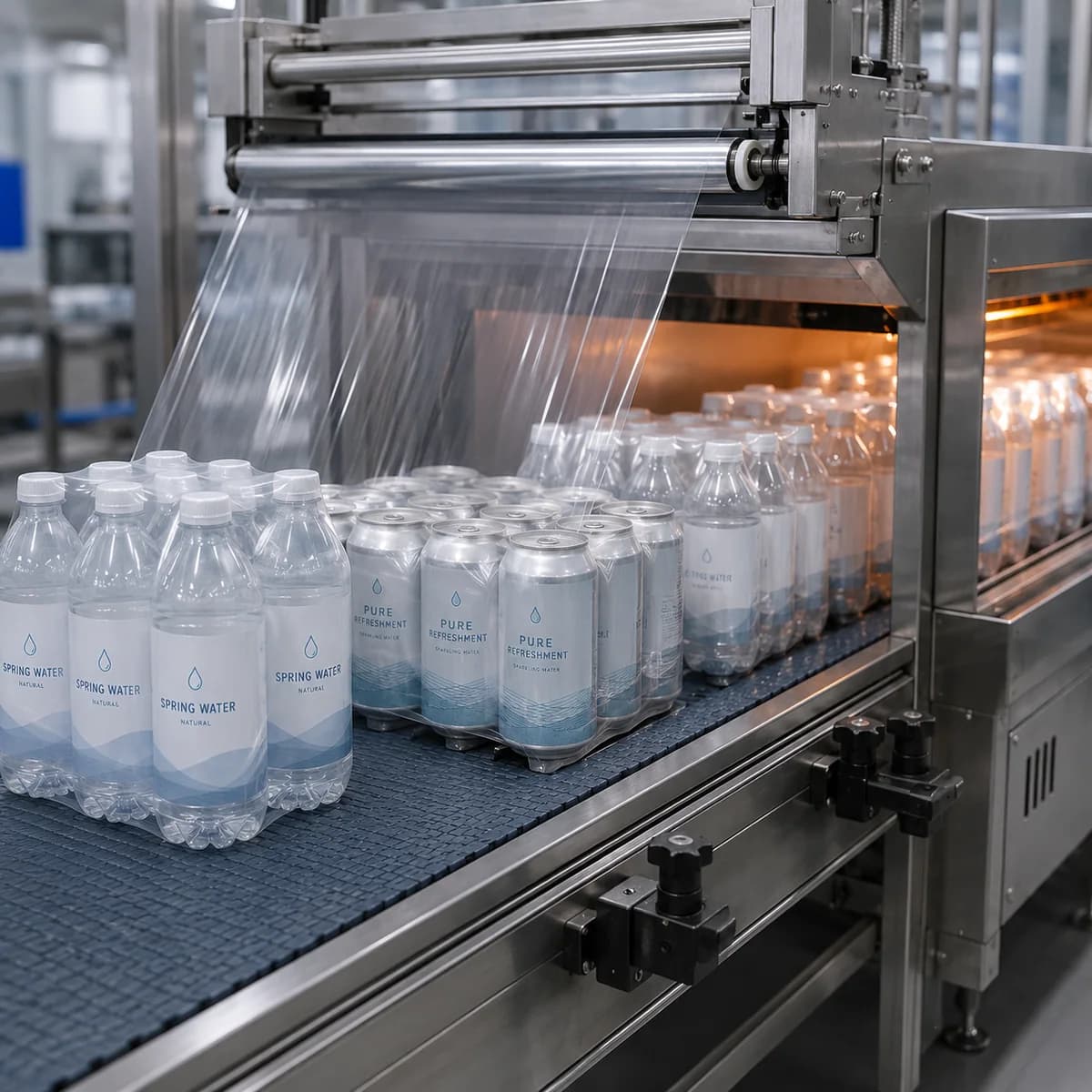
Water bottle shrink film is a web or sleeve of plastic packaging applied around a group of filled, closed bottles. The pack then passes through suitable heat-shrinking equipment so the film contracts around the bundle. Depending on the line, the process may include a collation station, film unwinding, cutting or sealing, transfer belts and a controlled shrink tunnel.
Biolastic's current catalogue includes a Water Bottle Shrink Film Roll for secondary packaging of drinking-water multipacks, plus a Beverage Multipack Shrink Film Roll for grouped beverage containers. A general heat-shrink film listing covers additional wrapping and bundling applications. These are application listings, not published guarantees of one universal resin grade, thickness, shrink percentage, food-contact approval or international delivery service.
The product listings ask buyers to confirm bottle size, units per bundle, film width, gauge, roll format and machine details before quotation. As checked on 27 October 2026, the water-bottle listing does not state a fixed thickness, price, certification or guaranteed lead time. Those details should be agreed in writing for the exact supplied grade.
Six-pack versus twelve-pack: the bundle changes the engineering
A six-pack might be arranged as two rows of three bottles; a twelve-pack might use three rows of four or another layout. These are examples of pack geometry, not a claim about any particular customer's line.
| Purchasing question | Six-bottle bundle | Twelve-bottle bundle |
|---|---|---|
| Bottle arrangement | Often a compact layout | More combinations of rows and columns |
| Bundle mass | Lower for the same bottle size | Higher for the same bottle size |
| Film width and cut length | Must fit the actual arrangement | Must be recalculated, not blindly doubled |
| Handling | Check grip points, seals and corner tension | Pay extra attention to weight, carrying and stacking |
| Validation | Tunnel exit, transfer and transport | Tunnel exit, transfer and transport |
| Best quotation basis | Accepted packs per kg of film | Accepted packs per kg of film |
The practical starting point is a dimensioned sketch of the assembled bottles. Record the maximum outside length, width and height, including caps, labels and any protruding features. A 500 ml bottle from one brand may not share the same diameter, shoulder or height as a 500 ml bottle from another brand.
If a buyer simply writes “film for 6 × 500 ml water bottles,” the supplier still does not know enough to specify a reliable roll.
Bottle shape changes the shrink result
Round shoulders, narrow necks and deep spaces between bottles can make film draw unevenly. A very tight tunnel setting may cause distortion or overstress while a low-energy setting can leave loose material. Smooth bottles may slide relative to one another; unusual caps and shoulder profiles can create local stress points.
A good trial uses the actual filled bottles, not empty substitutes. It also uses the intended labels and closures, because the shrink process must not damage them.
How to specify film width and cut length
Start by separating pack dimensions from web dimensions. For each candidate film format, ask the machine supplier how the film travels through the line.
- Single web: One sheet passes through a wrapping path; overlap and sealing geometry depend on the machine.
- Centre-folded film: The web is folded so that two panels are available; the stated width may refer to the folded width rather than the fully opened width.
- Tubular or sleeved film: Film surrounds the product as a tube or sleeve, with different cut and seal considerations.
- Other automatic bundler formats: Some lines feed paired webs or use machine-specific wrapping paths.
These formats are not interchangeable dimensional descriptions. A supplier who quotes “450 mm film” must specify whether that means flat web width, folded width, lay-flat tube width or something else.
Record the machine make and model, maximum web width, roll core diameter, permissible outside roll diameter, winding direction, available film path, cut length control and seal configuration. Confirm any machine-specific threading or splice requirements.
A useful fit-check sequence
First measure the complete bottle group. Next identify the actual web path and the supplier's dimensional convention. Then estimate the required material coverage, including overlap or seal allowances. Finally, run sample packs and check for exposed areas, folds, tearing, seal defects and heat damage. Do not use a perimeter formula alone to release a production order. Shrink behaviour and machine geometry matter.
Micron: what thickness can and cannot tell you
A micron is one thousandth of a millimetre. It is a thickness unit, not a direct measurement of pack strength. Two films with the same nominal micron can behave differently because of resin formulation, extrusion conditions, orientation, additives and the resulting mechanical properties.
For a water-bottle bundle, ask the supplier to describe the candidate film's gauge tolerance, transverse and machine-direction shrink response, tensile behaviour, seal performance and recommended processing window. The final selection depends on the actual load and equipment.
Do not assume that a thicker roll is always better. It uses more material at the same dimensions, may require process changes and can still fail at a poorly designed seal or an exposed sharp edge. Equally, a thinner film that looks economical on a price list may tear during transport or require so many rejects that it costs more overall.
Three tests worth understanding
Thermal shrinkage: ASTM D2732-14(2025) addresses unrestrained linear thermal shrinkage of plastic film at specified specimen temperatures. It helps characterise how a sample contracts under controlled test conditions. It does not certify that a bottle multipack will survive transport.
Tensile behaviour: ASTM D882 concerns tensile properties of thin plastic sheeting. Testing may help compare films when specimen and method conditions are controlled. Tensile data alone cannot predict every real-world pack failure.
Film slip: ASTM D1894-24 addresses static and kinetic coefficients of friction for plastic film and sheeting. Film slip can affect handling and feeding; measured values must be interpreted in the context of actual equipment and film ageing.
Ask for actual supplier data where available. Do not describe a Biolastic film as “ASTM certified” merely because a standard is mentioned in this guide.
Shrink tunnel settings: control the process, not a guessed temperature
Operators often ask for a single tunnel temperature. There is no responsible universal setting. The suitable recipe depends on the film's shrink curve, bottle geometry, conveyor speed, tunnel airflow, heater arrangement, seal design and the product's heat sensitivity.
Start with the film and machine suppliers' recommended operating windows. Then adjust through controlled trials while measuring the actual outcome: pack integrity, bottle deformation, label condition, film wrinkles, seal strength and rejects. Record the recipe for each bottle-and-film combination.
| Symptom | Possible causes to investigate | Sensible next check |
|---|---|---|
| Loose film after tunnel | Insufficient shrink exposure, wrong film response, excess material | Compare shrink data, film size and validated tunnel recipe |
| Torn corners | Local tension, sharp edges, excessive shrink, weak film or seam | Inspect failure position and the pack geometry |
| Wrinkled or damaged labels | Excessive heat exposure or unsuitable label/adhesive | Measure process exposure and assess label compatibility |
| Seams opening | Seal settings, contamination, incorrect film format or tension | Check seal design and repeatability |
| Film tracking sideways | Web alignment, roll winding, tension or slip | Inspect unwinding and transport path |
| Uneven pack tightness | Airflow distribution, bottle layout or nonuniform material | Map failures by position in the tunnel |
Change one process variable at a time and record it. If multiple settings are altered simultaneously, it becomes difficult to know what solved the problem. Keep guards, ventilation, thermal protection and equipment safety procedures in place; do not bypass interlocks to increase throughput.
The first-hour production check
Run a controlled startup sample before approving a full batch. Record film lot, bottle lot, roll identification, operator, speed, setpoints, observed defects and accepted packs. Inspect both warm packs at the tunnel exit and cooled packs after handling. Some problems only become obvious after the pack has settled or been lifted.
How to calculate film weight per bundle
Film consumption is a powerful purchasing metric because it links technical design to cost. But the formula must match the film format.
For an illustrative two-panel, centre-folded blank with two full equal rectangular panels, an idealised calculation is:
Film mass (g) = 2 × folded panel width (m) × cut length (m) × single-layer thickness (micron) × assumed film density (g/cm³).
The unit conversion works because one square metre of film at one micron and a density of 1 g/cm³ has a mass of 1 gram. This equation excludes seal scrap, trim, variable thickness, overlapping extra material, startup waste and other machine losses. It is not a finished bundle specification.
Worked example: hypothetical six-pack
Suppose a sample two-panel blank has a folded width of 0.45 m, cut length 0.65 m, nominal single-layer gauge 50 micron, and assumed density 0.92 g/cm³.
Theoretical mass = 2 × 0.45 × 0.65 × 50 × 0.92 = 26.91 g per blank.
At an entirely hypothetical film price of ₹170/kg, film-only cost is 0.02691 × 170 = ₹4.57 per blank, rounded. These dimensions and the rate are arithmetic examples; they have not been validated for any six-bottle arrangement or quoted by Biolastic.
Worked example: hypothetical twelve-pack
For a different illustrative blank, suppose folded width 0.60 m, cut length 0.85 m, gauge 60 micron, and the same assumed density.
Theoretical mass = 2 × 0.60 × 0.85 × 60 × 0.92 = 56.30 g per blank.
At the same hypothetical ₹170/kg, the film-only cost is about ₹9.57 per blank. Again, this is a demonstration, not a recommended twelve-pack size, micron or market price.
| Illustrative input | Six-pack calculation | Twelve-pack calculation |
|---|---:|---:|
| Folded panel width | 0.45 m | 0.60 m |
| Cut length | 0.65 m | 0.85 m |
| Single-layer gauge | 50 micron | 60 micron |
| Assumed density | 0.92 g/cm³ | 0.92 g/cm³ |
| Theoretical film per blank | 26.91 g | 56.30 g |
| Hypothetical film-only cost at ₹170/kg | ₹4.57 | ₹9.57 |
| Validated for production? | No | No |
These examples show why a twelve-pack does not automatically use exactly twice the film of a six-pack. Real geometry, film width, cut length, shrink response and chosen gauge all change the result.
The number that matters: accepted bundles per roll
For a meaningful trial, weigh the usable film actually consumed and count accepted bundles. A simple operational metric is:
Net film used per accepted bundle (kg) = net film consumed during the trial (kg) ÷ accepted bundles.
Then calculate:
Film cost per accepted bundle = net film used per accepted bundle × delivered film price per kg.
Include rejects, seal scrap, trial waste and startup losses in the film-consumed figure. Add labour, heating energy, maintenance, handling, damage and equipment costs for a complete process comparison. A lower price per kilogram is not a saving if the line makes fewer accepted packs.
A buyer's comparison: six-pack and twelve-pack economics
Suppose a bottler has two possible configurations. Both pass an agreed transport test, but one consumes less film and runs slower. The purchasing team should compare total cost per accepted bundle at the required output, not choose from material mass alone.
A simple scorecard can assign importance to film consumption, sealing consistency, reject rate, accepted packs per hour, transport stability and equipment compatibility. These weights are internal procurement choices, not universal standards.
| Evaluation criterion | What to record |
|---|---|
| Film consumption | Kilograms consumed per 1,000 accepted bundles |
| Sealing and shrink quality | Defect count and defect type |
| Line efficiency | Accepted bundles per operating hour |
| Handling performance | Failures after defined lifting, stacking and distribution tests |
| Process stability | Settings, operator variation, film breaks and downtime |
| Delivered cost | Film, energy, labour, scrap and damage per accepted bundle |
Do not approve a film solely because the first ten packs look neat. Include multiple roll lots and the handling conditions that the product will actually face.
How to test bundle strength before a bulk order
Start with a small production trial on the real line. Use the exact filled bottles and the intended pack arrangement. Document the film and machine settings. Let the packs cool as required, then assess appearance, seam integrity, ease of handling and failures.
Next, test realistic handling: conveyor transfers, lifting or gripping, case or pallet stacking and relevant transport movements. Use a written pass/fail checklist that reflects your customer's acceptance requirements. If the bundle is sold as a hand-carry pack, evaluate the intended carrying method; a bundle that only survives a gentle tabletop lift may be unsuitable.
A practical trial sheet records:
1. Bottle size, filled mass, cap type, shape and label construction.
2. Pack arrangement and measured outer dimensions.
3. Film supplier, batch, format, nominal gauge, width and cut length.
4. Machine model, tunnel settings, speed and sealing recipe.
5. Packs made, accepted, rejected and defect reasons.
6. Film kilograms consumed, including waste.
7. Handling or distribution test and documented result.
8. Agreed acceptance criteria and responsible approver.
A passed in-house trial is evidence for that configuration. It is not proof that the film works for every other bottle, machine or shipping route.
Secondary packaging, food contact and international requirements
Shrink film wrapped around sealed water bottles is generally secondary or grouped packaging, rather than the bottle's primary water-contact layer. That distinction is useful, but it does not remove the need to assess contamination, heat exposure, labelling, transport and destination-specific rules.
For EU-market packaging, the European Commission's Packaging and Packaging Waste Regulation guidance explains that Regulation (EU) 2025/40 applies in phases. The Commission confirmed on 12 August 2026 that new packaging rules began to apply on that date. Different obligations have different transition periods. A shrink-film purchase order does not by itself establish conformity, recyclability, recycled content or the right to market packaging in a specific country.
For buyers in India, the United Kingdom, the United States, the Middle East, Southeast Asia or other destinations, check the rules and buyer specifications applicable to the particular packaging and supply chain. Ask for accurate resin and additive declarations, relevant test results, traceability, packaging composition and any documentation required by the destination. Do not use the words “food grade,” “eco-friendly,” “fully recyclable” or “export certified” without evidence appropriate to the exact film and market.
Shrink film is not automatically compostable. Nor is every shrink film identical to an LLDPE stretch wrap. These are separate material and process decisions.
Why Siliguri and North Bengal bottlers should measure dispatch conditions
A beverage line serving Siliguri, Jalpaiguri, Darjeeling, the Dooars, Assam or other parts of Northeast India may move packs through multiple warehouses, trucks and retail handling points. A pack must survive the actual route, not just the shrink tunnel.
For a local buyer, the most efficient starting trial is often one popular bottle size and one standard bundle layout. Fix the bottle geometry, record the machine settings, trial a candidate film and measure the results. Only then expand to additional bottle sizes or pack counts.
Biolastic lists shrink-film products from Siliguri for specification-based enquiries. The catalogue does not establish that every film format is immediately in stock or available for international dispatch. Ask for written confirmation of MOQ, roll format, grade, production lead time, freight, documentation and supply terms.
Copy-ready request for quotation
We require shrink film for sealed drinking-water bottle multipacks. Bottle capacity: [ml]; filled bottle mass: [g]; bottle height/diameter: [mm]; pack count and layout: [6 or 12, rows × columns]; finished bundle dimensions: [L × W × H mm]. Equipment make/model: [details]; film format: [single web/centre-fold/tube/other]; current width, cut length and micron: [details]; roll core and maximum OD: [details]. Please quote a technically suitable trial grade, specify material, gauge tolerance, shrink properties, roll net weight, sample availability, MOQ, delivered price, lead time and available test documentation. Our delivery location is [city, country, postal code]. We will approve after line and handling trials.
This enquiry format gives a supplier enough information to begin a serious technical discussion without pretending that an untested film is already approved.
Where to enquire at Biolastic
Review the Water Bottle Shrink Film Roll for drinking-water multipacks or the Beverage Multipack Shrink Film Roll for broader beverage applications. Send your pack sketch, bottle count, machine details and expected monthly quantity. Request a sample-and-quotation discussion, including film format, thickness, roll dimensions and documentation. Commercial availability and performance must be confirmed before ordering.
The practical takeaway: Start with the bundle and the machine. Test the film. Measure accepted packs and actual consumption. Buy the specification that works—not the headline micron.
Frequently asked questions
What film thickness should I use for a six-bottle water pack?
There is no universal micron for every six-pack. Bottle dimensions, filled weight, film construction, seal design, tunnel conditions and distribution handling determine the suitable gauge. Ask for a machine trial and quote the measured specification.
Is a 12-pack simply double the film required for a 6-pack?
No. A 12-pack changes bundle geometry, wrap width, cut length and possibly gauge. Calculate actual original film consumption for each layout and verify it with roll-weight measurements.
What is the difference between shrink film and stretch film?
Shrink film contracts under controlled heat after application; stretch film is tension-wrapped without a heat-shrink step. They are not interchangeable on the same equipment.
Can the same shrink roll work on every wrapping machine?
No. Check web width, roll diameter, core, winding direction, film format, sealing method and the equipment's operating window before ordering.
How do I calculate shrink film cost per water bottle bundle?
Measure net film kilograms consumed over accepted bundles, multiply by the delivered film rate per kilogram, then add sealing energy, tunnel energy, labour, scrap, maintenance and rework. Compare cost per accepted bundle rather than only price per kilogram.
Does thicker shrink film always make a stronger bottle pack?
No. Thickness affects mass and may influence performance, but sealing, shrink balance, puncture resistance, bottle arrangement and process settings also matter. Test actual packed bundles.
Does shrink film need direct food-contact certification for sealed water bottles?
Film outside sealed bottles is usually secondary packaging rather than direct contact with drinking water. The actual packaging configuration, possible transfer pathways and destination rules still require assessment; do not assume compliance from this distinction.
Can Biolastic supply shrink film internationally?
Biolastic lists water-bottle and beverage multipack shrink-film products and accepts specification-based enquiries. International shipping, destination eligibility, certifications, MOQ, stock, pricing and lead times must be confirmed in a written quotation.
Sources and technical reading
Technical examples are illustrative and not specifications or quotations for a Biolastic product. This guide is not a substitute for product-specific testing or destination-specific compliance advice.